Yes, muscles can absolutely grow after 50. The research is clear on this: resistance training increases muscle fiber size and strength in older adults, including people well into their 60s, 70s, and beyond. What changes with age is the rate and ease of that growth, not the fundamental capacity for it. You'll likely need more protein, smarter programming, and better recovery habits than you did at 30, but the biology of hypertrophy doesn't switch off at any birthday.
Can Muscles Grow After 50? How to Build Lean Mass

Marcus Kellerman
15 May 2026

Yes, muscle growth after 50 is real, here's what changes and what doesn't
The core machinery of muscle growth, mechanical tension triggering satellite cell activation, muscle protein synthesis outpacing breakdown, fibers getting bigger and stronger, works the same at 52 as it does at 22. What changes is the efficiency of that process. Researchers call it anabolic resistance: older muscle tissue requires a higher threshold of stimulus (both from training and from protein) to produce the same muscle protein synthetic response that younger adults get more easily. There are also concurrent deficits in ribosomal biogenesis, which means the cellular machinery responsible for building new proteins takes longer to spin up.
Hormonal shifts matter too. Testosterone, growth hormone, and IGF-1 all trend downward across middle age, and these hormones amplify the anabolic signal from training. Lower baseline levels mean you're working with a smaller hormonal tailwind. On top of that, many people over 50 have spent years being less active, so some of what looks like age-related muscle loss is actually disuse atrophy, and that part is very responsive to training.
Here's the part that gets underreported: anabolic resistance is not the same as anabolic inability. A systematic review specifically testing essential amino acid responses in healthy older adults found no universal anabolic resistance to protein feeding after resistance exercise training, the issue is more about dose and threshold than a biological brick wall. Systematic reviews and meta-analyses of randomized trials confirm that resistance training increases muscle size and strength even in very elderly populations.
The gains may be smaller in absolute terms than what a 25-year-old achieves, but they are real, measurable, and meaningful. If you're 50 and wondering whether it's too late, the answer from the literature is a firm no. In other words, if you are trying to figure out how to grow muscle after 50, this is exactly where you should focus first.
If you've been in the gym for years and feel like your gains have stalled, the same hypertrophy principles still apply, so you can refocus on stimulus, protein, and recovery how to grow muscles after 8 years in the gym.
It's also worth noting that 50 and 60 are not the same context. If you're close to 60 or past it, the principles here still apply, but recovery windows tend to lengthen further and volume tolerance may require more conservative management. If you're wondering how to grow muscle after 60, focus on progressive overload, enough protein, and recovery that matches your slower bounce-back close to 60.
The same is true going the other direction: if you're in your early 50s and have trained consistently, you may be closer to the 40-year-old experience than you think. If you are asking, can you grow muscle after 40, the good news is that the training approach is still fundamentally the same, just with smarter dose and recovery.
Training for hypertrophy at 50+: sets, reps, intensity, and progression

The fundamental driver of hypertrophy is progressive overload, consistently asking your muscles to do slightly more than they did before. That principle does not age out. What changes is how you manage the dose.
Intensity and rep ranges
Pooled data from dose-response meta-analyses in older adults points to intensities in the 51–69% of 1RM range as effective for hypertrophy, which corresponds roughly to a weight you can lift for 12–20 reps with solid form before failure. That's not a ceiling, heavier work in the 70–85% range (6–12 reps) is also productive and may be preferable if your joints tolerate it. The honest answer is that a wide range of intensities can drive muscle growth as long as sets are taken close to failure. Leaving 2–4 reps in reserve (RIR) on most sets is a reasonable practical guideline: challenging enough to produce a strong stimulus, conservative enough to protect joints and reduce injury risk.
Frequency and volume
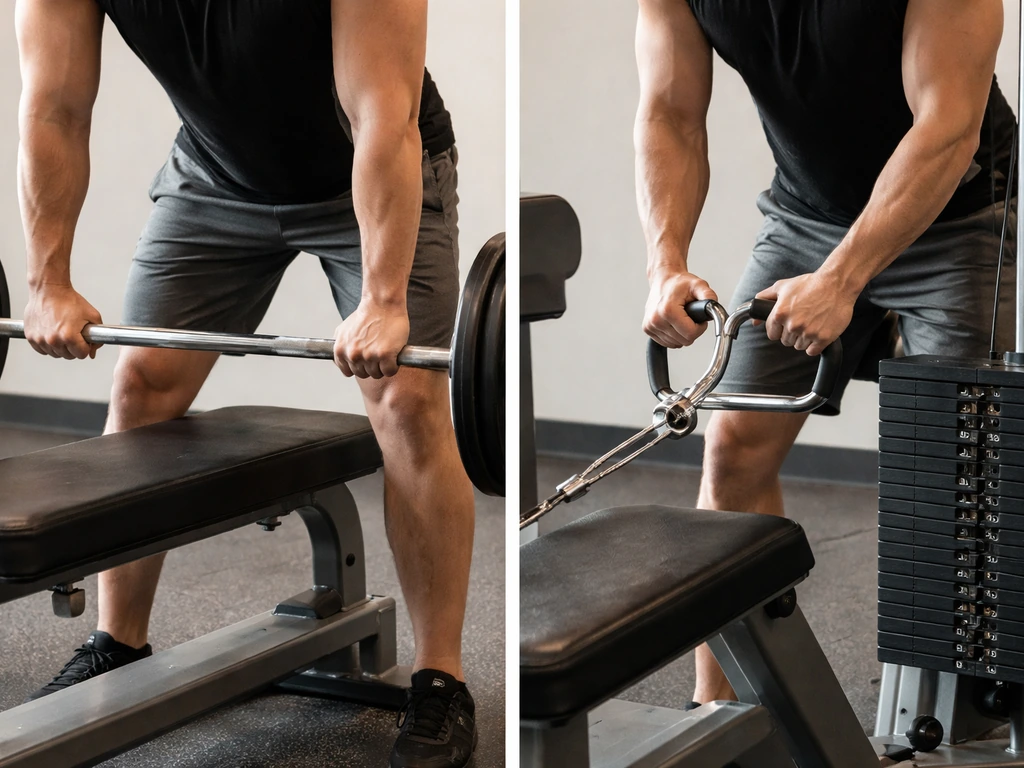
A meta-regression in adults over 60 found that training frequency doesn't have a significant independent effect on hypertrophy when total weekly volume is matched. What matters most is how many quality sets you accumulate per muscle group per week, not whether those sets are spread across 2 sessions or 4. That said, training 3 days per week is consistently represented in the literature as an effective and manageable structure for older adults. Starting with 10–15 weekly sets per major muscle group is a reasonable target, with the understanding that beginners will see results from even lower volumes and that recovery capacity will dictate how quickly you can add.
Exercise selection and progression
Compound movements, squats, deadlifts, rows, presses, remain the backbone of any hypertrophy program because they recruit the most muscle mass and drive the strongest systemic stimulus. At 50+, joint health and movement quality become more important considerations. Machine variants and cable exercises are not inferior; they often allow you to load muscles effectively with less spinal and joint stress. If barbell back squats aggravate your knees, a leg press or goblet squat will still build your quads. Don't let exercise ideology get in the way of training consistently.
Progressive overload should be gradual. Adding 2.5–5 lbs to a lift every 1–2 weeks is realistic and sustainable. When weight increases stall, you can progress by adding a rep, adding a set, reducing rest time slightly, or improving range of motion. Rest periods of around 2 minutes between sets are supported by the research for hypertrophy in older adults and also give connective tissue and cardiovascular recovery enough time.
Protein and calories after 50: how much to eat and when

Protein is where most people over 50 leave gains on the table. The standard RDA of 0.8 g/kg/day was never designed to support muscle building, it's a minimum to prevent deficiency. For hypertrophy, the ISSN recommends 1.4–2.0 g/kg/day for most exercising adults, and for older adults specifically, erring toward the higher end of that range makes sense given anabolic resistance. This recommendation aligns with an ISSN position stand stating that for most exercising individuals, about 1.4, 2.0 g/kg/day protein is sufficient and it also addresses per-meal dosing targets to stimulate muscle protein synthesis 1.4–2.0 g/kg/day. That means a 180 lb (82 kg) person should be targeting roughly 115–165 g of protein per day.
Per-meal distribution matters too. Research consistently shows that 25–30 g of high-quality protein per meal is sufficient to maximally stimulate muscle protein synthesis in both younger and older adults. Spreading your intake across 3–4 meals spaced roughly every 3–4 hours is more effective than front-loading or back-loading. A practical setup: a protein-rich breakfast, a solid lunch, a pre- or post-workout meal with 25–40 g of protein, and a protein-containing dinner. That covers the bases without requiring complicated timing rituals.
On the calorie side, you don't need to be in a large surplus to build muscle after 50, especially if you're newer to training or returning after a break. A modest surplus of 200–300 calories above maintenance is plenty. If you're carrying excess body fat, research shows that resistance training can support muscle protein synthesis even during mild calorie restriction, particularly when protein intake is high. The priority is hitting your protein target; total calories can be adjusted around that depending on your composition goals.
Protein quality counts more than most people realize at this age. Leucine, one of the essential amino acids, is the key trigger for activating the mTOR pathway and stimulating muscle protein synthesis. Whey protein, eggs, meat, fish, and dairy are all high in leucine. Plant proteins generally have lower leucine content per gram, so vegans and vegetarians should either eat more total protein or prioritize leucine-rich plant sources like soy and lentils, and consider combining sources.
Recovery and injury-risk management for older lifters
Recovery is where age genuinely changes the game the most. After 50, your muscles, tendons, and nervous system take longer to bounce back from hard sessions. This isn't a weakness; it's just physiology. Trying to train like you did at 30 without accounting for this is one of the most common ways older lifters get hurt and quit.
Sleep
Sleep is probably the most undervalued recovery tool available. Adults need 7–9 hours per night, with most guidance for adults 65+ suggesting 7–8 hours as a reasonable target. Growth hormone secretion is concentrated during deep sleep, and consistently getting less than 7 hours will impair muscle repair, increase cortisol, and tank your next day's performance. If you're serious about building muscle, treat sleep as a non-negotiable training variable.
Managing soreness vs. actual injury
Delayed onset muscle soreness (DOMS) peaks 24–72 hours after exercise and is a normal response to unfamiliar or high-effort training. It does not reliably indicate growth, and you should not be chasing it. The distinction that matters is soreness versus pain: diffuse muscle ache that resolves within a few days is normal; sharp, joint-specific, or worsening pain is not. If something hurts during a movement, stop the movement and find a substitute. Pushing through joint pain is how minor irritation becomes a serious injury that sidelines you for months.
Practical recovery strategies
- Schedule at least one full rest day between sessions for the same muscle group
- Use light activity (walking, mobility work) on rest days to support blood flow without adding training stress
- Prioritize warming up properly before lifting: 5–10 minutes of movement prep reduces injury risk and improves performance
- Consider cold water immersion or contrast showers for acute soreness management after very hard sessions
- Monitor your weekly fatigue; if performance is declining across multiple sessions, reduce volume by 30–40% for a deload week
- Manage life stress alongside training stress: cortisol from work, sleep deprivation, or emotional strain blunts recovery just as much as overtraining
Consistency over time is the real recovery strategy. Ten months of training with manageable soreness beats three months of training hard followed by a forced six-week rest from an injury. Build a program you can sustain.
Supplements that can help (and what to skip)
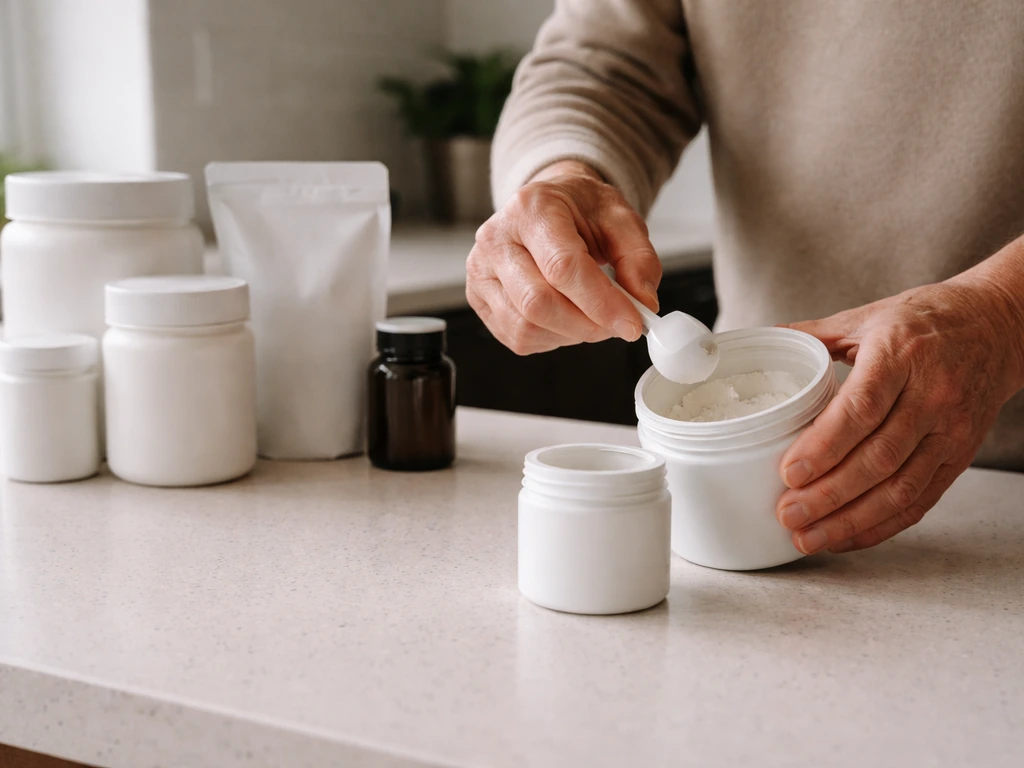
Most supplements are not worth buying. A short list of things with actual evidence for older adults is useful; everything else is marketing.
| Supplement | Evidence for 50+ | Practical Recommendation |
|---|---|---|
| Creatine monohydrate | Strong: meta-analyses show improved lean mass and strength vs. training alone in older adults | 3–5 g/day with no loading phase needed; take daily, ideally with a meal |
| Whey protein (or other high-quality protein) | Strong: effective for hitting protein targets and providing fast-absorbing leucine post-workout | Use to fill protein gaps if whole food intake is insufficient; 25–30 g per serving |
| HMB (beta-hydroxy beta-methylbutyrate) | Moderate: 2025–2026 meta-analyses show benefits for older adults combined with resistance training, but effects are smaller and less consistent than creatine | May be worth considering at 3 g/day if creatine doesn't suit you, but prioritize creatine first |
| Omega-3 fatty acids (fish oil) | Moderate: benefits more consistent for strength and function than for muscle mass per se; may support joint health and reduce inflammation | 1–3 g EPA/DHA daily is reasonable, especially if fish intake is low |
| Beta-alanine | Weak for hypertrophy in older adults: evidence for strength and functional outcomes is inconsistent | Skip unless you're doing high-rep endurance-style training where buffering matters |
| Vitamin D | Relevant if deficient: low vitamin D is common over 50 and linked to reduced muscle function | Get levels tested; supplement if deficient (typically 1,000–2,000 IU/day with food) |
Creatine monohydrate is the clearest recommendation for older adults. Meta-analyses specifically in older populations show it improves lean tissue mass and strength outcomes when combined with resistance training. It's cheap, well-studied, and safe. If you do nothing else on this supplement list, do creatine. Omega-3s are a reasonable secondary addition, particularly if your diet is low in fatty fish and you want to support joint health alongside training.
What results to expect and a 30–90 day action plan
Here's what the evidence actually looks like in terms of timelines. In the first 2–4 weeks, most of the strength gains you experience come from neural adaptation: your nervous system gets better at recruiting muscle fibers, not from the fibers getting bigger. This is why you can feel and perform noticeably better quite quickly. Visible hypertrophy, where the muscles themselves are measurably larger, typically takes 6–12 weeks of consistent training to become reliably detectable, and it accumulates more slowly in older adults than in younger ones. Strength improvements tend to appear before size changes, and that's a useful early signal that the program is working.
Realistic expectations matter here. You're not going to look dramatically different after 30 days, but you will be stronger, you'll move better, and if you're eating enough protein, your muscle fibers will have already begun the process of remodeling. The 60–90 day mark is where most people see meaningful, visible changes in muscle fullness and body composition when the program and nutrition are consistent.
Your 30–90 day action plan
- Days 1–7: Establish your baseline. Pick a 3-day-per-week full-body or upper/lower program using compound movements. Start at a moderate effort — sets where you could do 3–4 more reps than you do. Log your weights and reps. Calculate your current protein intake for one day to see where you stand.
- Days 1–30: Build the habit. Train 3 days per week consistently. Hit 25–30 g of protein per meal across at least 3 meals daily. Aim for total protein of 1.6–2.0 g/kg of bodyweight. Start 3–5 g of creatine monohydrate daily. Get 7–8 hours of sleep. Do not add more volume yet — just execute the baseline reliably.
- Days 30–60: Add progressive overload. Increase weight by small increments (2.5–5 lbs) when you hit the top of your rep range for two consecutive sessions. Add one set per exercise if recovery is good. Evaluate soreness and joint comfort: if something consistently hurts, substitute the exercise rather than forcing through it.
- Days 60–90: Assess and adjust. Take photos and re-test your weights. Most people will have added meaningful strength across all major lifts. Some will see visible muscle changes; others will notice changes in how clothes fit before they see them in the mirror. If progress has stalled, evaluate sleep, total calories, and protein first before adding training volume.
- Ongoing: Plan a deload week every 6–8 weeks where you reduce volume by about 30–40% but keep frequency. This is not optional at 50+ — it's how you stay in the game long-term. Muscle growth compounds over months and years, not days.
One last thing worth saying directly: the biggest predictor of results at any age is consistency over time, but this is especially true after 50. Six months of showing up 3 days a week with adequate protein will produce better results than any specific program, supplement stack, or training hack. The biology works, you just have to give it the input and the time.
FAQ
If I’m 50+ and I can’t lift heavy, can I still grow muscle?
Yes. You can drive hypertrophy with moderate loads as long as sets are challenging, typically stopping around 2-4 reps in reserve (RIR). Focus on controlled tempo, full usable range of motion, and accumulating enough quality sets weekly, rather than chasing maximal weight.
How many weekly sets per muscle group should I start with after 50?
A practical starting target is about 10-15 hard sets per major muscle group per week. If you recover slowly, begin closer to the lower end and increase by small amounts every 2-4 weeks, watching performance and soreness rather than only the calendar.
What if my joints hurt when I train, do I just stop?
Don’t train through joint pain. Replace painful lifts with joint-friendlier options (machines, cables, neutral-grip variations, split squats) and keep effort high. If pain is sharp, localized, or worsening during a movement, switch the exercise immediately and consider reducing total volume for a week.
Should I train more frequently if I’m older?
Frequency itself is less important than weekly volume. If splitting sessions helps you keep sets high quality and manage fatigue, 3 days per week is a common sweet spot. If you can tolerate it and recover, more frequency can work, but only if total quality sets increase or stay stable.
Do I need to take protein immediately after workouts to build muscle after 50?
No special timing ritual is required. What matters is hitting your daily protein target and distributing it across meals. A post-workout meal with 25-40 g can help you reach the total, but protein timing won’t replace low daily intake.
How much protein should I eat if I’m overweight or trying to lose fat while building muscle?
Use your protein goal based on your body weight, but consider practicality with composition goals. A common approach is still targeting roughly 1.4-2.0 g/kg/day, and keeping calories only mildly above maintenance or at a small deficit (while staying consistent). If appetite limits protein, prioritize high-leucine sources like dairy, whey, eggs, fish, and lean meats, or use protein supplements strategically.
Can I build muscle after 50 on a vegetarian or vegan diet?
Yes, but you usually need more total protein and careful meal planning because leucine per gram is often lower. Favor soy and other higher-protein foods like lentils, beans, and seitan, and consider combining sources across the day to hit your daily grams consistently.
Is creatine safe after 50, and how should I take it?
Creatine monohydrate is generally well supported for older adults and is one of the few supplements with consistent evidence alongside resistance training. Take 3-5 g daily, timing is less important than consistency. If you have kidney disease or a complex medical history, confirm with your clinician first.
Why am I getting stronger but not seeing visible muscle gain yet?
Early strength gains are often neural (better coordination and recruitment), so size may lag. Visible hypertrophy typically becomes reliably detectable after about 6-12 weeks of consistent training, especially after 50, so track progression in lifts and total weekly effort rather than only appearance.
How close to failure should I train at my age?
A workable guideline is most sets at about 0-4 RIR, especially for compound lifts where joint stress matters. If you’re hurting or recovery is poor, use slightly more RIR on some sets while keeping enough total quality work. The goal is stimulus you can recover from, not constant max effort.
What rest time should I use between sets for muscle growth after 50?
Around 2 minutes is a common evidence-based range for hypertrophy in older adults. If you need more rest to maintain form and effort, extend it. If you rest too little, you may reduce the effective stimulus by letting reps and range of motion degrade.
How do I know soreness is normal and not a warning sign?
Normal soreness is diffuse muscle ache that peaks within 24-72 hours and improves over a few days. Avoid training the same movement if pain is sharp, joint-specific, worsening, or occurs during the lift. In that case, swap the exercise and temporarily reduce volume until symptoms settle.
Should I change my program if I’m near 60 or older?
You usually keep the same fundamentals, progressive overload plus sufficient protein and weekly hard sets, but manage the dose more conservatively. Recovery windows often lengthen, so you may need slower progression, slightly fewer weekly sets at first, and more joint-friendly exercise selection.