For most people training consistently with progressive resistance and eating enough protein, the first noticeable changes show up in about 4 to 8 weeks. Those early changes are mostly strength and coordination improvements, not much actual muscle tissue yet. How much muscle you can grow depends on things like training consistency, protein intake, calorie surplus, and recovery how much muscle can you grow.
How Long Does It Take to Grow Muscle Mass? Timelines

Marcus Kellerman
24 Apr 2026

If you are wondering how much muscle you can grow in a month, the key is that the first changes are mostly strength and only later becomes obvious hypertrophy how much muscle can you grow in a month. It can be useful to compare that early timeline with how much muscle you can grow in 3 months as well how much muscle can you grow in 3 months.
Real, visible hypertrophy that other people notice tends to take 3 to 6 months. If you want a more personal estimate, your training age, recovery, and nutrition determine how fast you progress from those early changes to visible muscle how long does it take for muscles to grow. Meaningful body composition changes, the kind that clearly matter on the scale and in the mirror, usually take 6 to 12 months of consistent work.
That range is wide on purpose, because a lot of variables pull the timeline in different directions, and understanding those variables is the most useful thing you can do right now. If you want a realistic timeline, it helps to consider how long it takes to grow muscle naturally based on your training, nutrition, recovery, and starting point variables.
Realistic Timelines: What to Expect and When

Muscle growth happens in stages, and conflating them is one of the biggest sources of frustration for new lifters. The first stage, roughly weeks 1 through 4, is dominated by neural adaptations. Your nervous system gets better at recruiting motor units, coordinating muscle contractions, and stabilizing joints. You'll get stronger noticeably fast during this window, but your muscles aren't actually much bigger. Don't let that discourage you. The strength gains are real and they matter, even if the mirror hasn't caught up.
Starting around weeks 4 to 8, actual protein synthesis begins ramping up meaningfully inside muscle fibers. You may notice your muscles feel denser or harder, clothes might fit slightly differently around the shoulders or thighs, and strength keeps climbing. This is early hypertrophy, and it's genuinely exciting if you know what to look for. Most research interventions last around 12 to 14 weeks for good reason: that's enough time to detect statistically meaningful muscle growth in study participants.
By the 3-month mark, a beginner training twice a week with good programming can expect to gain roughly 1 to 2 pounds of actual muscle tissue, sometimes more depending on their starting point and adherence. At 6 months, that number could be 4 to 6 pounds for a beginner, less for someone with more training history. At a year in, consistent beginners can realistically add 10 to 15 pounds of muscle in their first year under ideal conditions. That's a meaningful body composition shift that genuinely changes how you look, move, and feel. If you're trying to estimate how many months to grow muscle for your situation, start by looking at which timeline stage you are in.
| Timeframe | What's Happening | What You'll Notice |
|---|---|---|
| Weeks 1–4 | Neural adaptations, motor pattern learning | Strength gains, better technique, little visible change |
| Weeks 4–8 | Early hypertrophy begins, protein synthesis increases | Muscles feel fuller, slight size changes, strength climbing |
| Months 2–3 | Measurable hypertrophy accumulating | Visible muscle definition, clothes fitting differently |
| Months 3–6 | Consistent hypertrophy, 1–2 lbs/month possible for beginners | Clear size changes, others may notice |
| Months 6–12 | Continued growth, rate slows as you advance | Significant body composition shift, strength well established |
| Year 2+ | Intermediate gains, more effort for smaller increments | Physique clearly changed, requires more precision to keep progressing |
Why Your Timeline Will Be Different From Someone Else's
The ranges above assume solid training, adequate nutrition, and decent recovery. In the real world, those three things are rarely all dialed in at once, which is exactly why individual timelines vary so much. Here are the factors that matter most.
Training Age

If you've never lifted seriously, you're sitting on a massive advantage called beginner gains. Your body responds aggressively to the novel stimulus of resistance training, and you can build muscle while also getting stronger and even losing fat simultaneously. That window narrows as you accumulate training years. Someone with 5 years of consistent lifting might work hard to gain 4 to 6 pounds of muscle in a year, where a true beginner could hit that in 3 to 4 months.
Age and Hormonal Context
Age slows things down, but it does not stop them. Adults over 50 and 60 absolutely build muscle in response to resistance training, and the research is unambiguous on this. The timeline is longer and the rate of gain is more modest, but the mechanism still works. Muscle protein synthesis responds to training and to protein intake at any age. Older adults may need slightly higher protein doses per meal to maximally stimulate synthesis, and recovery may take an extra day or two, but the path forward is the same. Don't let anyone tell you it's not worth starting because of your age.
Sex
Men tend to build more absolute muscle mass per unit of time, largely because of higher baseline testosterone. Women gain muscle at a meaningful rate too, often with comparable relative gains when body size is accounted for, but the total pounds of muscle added per year will typically be lower. That doesn't make the process any less worthwhile. The strength, metabolic, and body composition benefits are proportionally similar.
Genetics and Starting Point
Some people have more fast-twitch muscle fibers, more favorable muscle insertion points, or hormonal profiles that make hypertrophy easier. You can't control that. What you can control is consistency. Someone with average genetics who shows up reliably for a year will build more muscle than someone with elite genetics who trains sporadically. Starting point also matters: if you're returning after a break, muscle memory means you'll regain lost tissue faster than you built it originally.
The Training Habits That Actually Drive Growth
The American College of Sports Medicine's resistance training guidelines recommend blank" rel="noopener noreferrer">training each major muscle group at least 2 days per week, with roughly 10 or more sets per muscle group per week as a target for hypertrophy. Meta-analytic summaries like Nutrient Metrics suggest weekly working sets around a ~10, 20 range are generally responsive for hypertrophy, with diminishing returns at very high volumes blank" rel="noopener noreferrer">10 or more sets per muscle group per week as a target for hypertrophy. For most people, that's a full-body program 3 days a week or an upper/lower split 4 days a week. Both work well. The specific split matters far less than hitting the weekly volume target consistently.
For rep ranges, 8 to 20 reps per set covers the hypertrophy range effectively. You don't need to max out every session. Research on proximity to failure suggests you need to train reasonably close to failure to stimulate growth, but grinding out every set to absolute muscular failure isn't necessary and adds unnecessary fatigue. Some Reddit users discussing the 2026 ACSM position stand debate proximity-to-failure interpretation and practical weekly set targets (for example, around ~10, 20 sets per muscle per week) blank" rel="noopener noreferrer">proximity to failure. Leaving 1 to 3 reps in the tank on most sets is a practical sweet spot that accumulates volume without destroying your recovery.
Progressive overload is the non-negotiable. Your muscles grow in response to a stimulus that exceeds what they're already adapted to. That means you need to be adding reps, adding weight, or adding sets over time. If you're doing the same workout with the same weight for 6 months, you're maintaining, not growing. Track your lifts. Chase small, regular improvements. That's the mechanism.
- Train each muscle group at least 2 times per week
- Target around 10 or more sets per muscle group per week for hypertrophy
- Use 8 to 20 reps per set, stopping 1 to 3 reps short of failure most of the time
- Rest 2 to 3 minutes between sets for compound lifts to maintain performance
- Apply progressive overload consistently: more reps, more weight, or more sets over time
- Prioritize compound movements (squat, deadlift, row, press, pull) for efficient volume
Eating to Support Muscle Growth
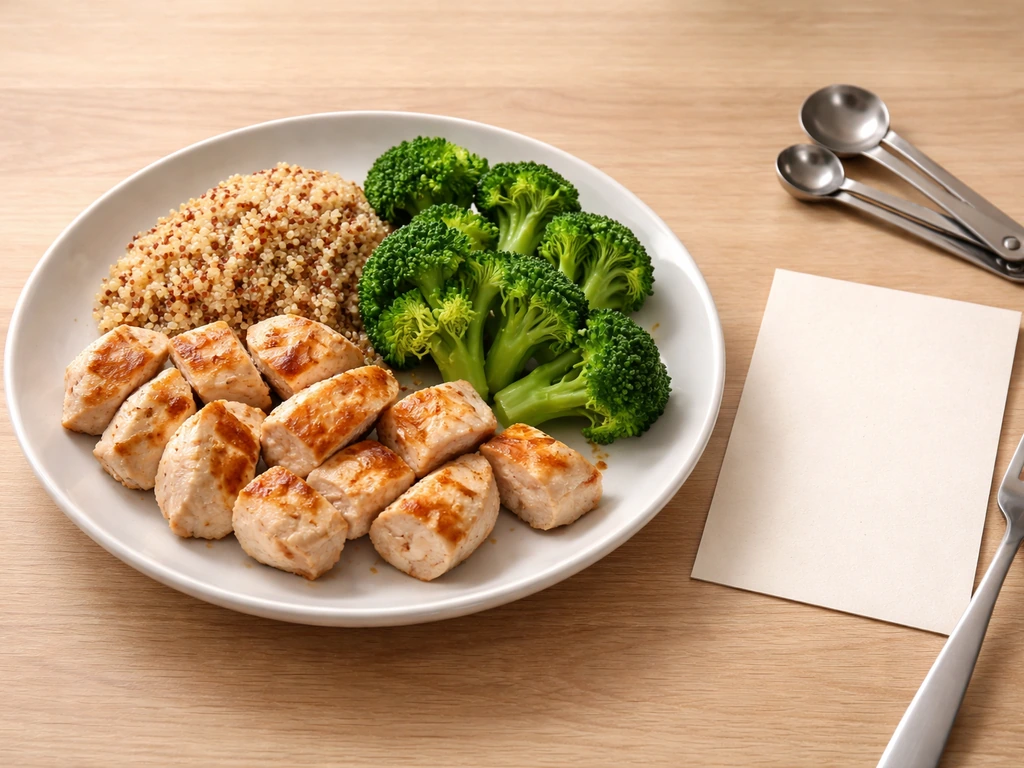
Training is the stimulus, but nutrition is what your body uses to actually build the tissue. Without enough protein and total calories, the signal goes unanswered. This is one of the most common reasons people train hard and see minimal results.
Protein: The Baseline Requirement
The International Society of Sports Nutrition recommends 1.4 to 2.0 grams of protein per kilogram of body weight per day for people trying to build or maintain muscle. For a 180-pound (82 kg) person, that's roughly 115 to 165 grams of protein per day. A useful per-meal target is around 0.25 g/kg, which for that same person works out to about 20 grams of protein per meal. Spreading protein across 3 to 5 meals keeps muscle protein synthesis elevated more consistently throughout the day than eating it all in one or two sittings.
Calories: You Need a Surplus to Grow
Building new muscle tissue requires energy. If you're consistently eating at or below maintenance calories, growth will be very slow or stall entirely. A modest caloric surplus of 200 to 400 calories above your maintenance needs is enough to support muscle growth without gaining excessive fat. Beginners can often build muscle even in a slight deficit if protein is high enough, but this becomes much harder as you advance. If the scale isn't moving at all and your lifts have stalled, eating more is usually the lever to pull.
Carbohydrates and Nutrient Timing
Carbohydrates fuel your training sessions and support glycogen replenishment afterward. While nutrient timing is less critical than total daily intake, having carbohydrates around your training window (before and after) supports performance and recovery. A pre-workout meal with protein and carbs 1 to 2 hours before training, and a protein-rich meal within a couple of hours after, is a practical approach that serves most people well without overcomplicating things.
Sleep and Recovery: The Part Most People Undervalue

Muscle doesn't grow during training. It grows during recovery, primarily during sleep when growth hormone release peaks and muscle protein synthesis is elevated. Consistently getting less than 7 hours of sleep per night measurably impairs muscle protein synthesis, increases cortisol, reduces testosterone, and slows the rate of hypertrophy. If you're training hard and eating well but sleeping 5 to 6 hours, you're leaving a significant amount of your potential gains on the table.
Recovery between sessions also matters. Most muscle groups need 48 to 72 hours to recover adequately before they're trained again at high volume. That's why training each muscle group twice a week (not once, not every day) tends to be the sweet spot for most people. Soreness is not a reliable indicator of whether a muscle has recovered or grown, by the way. You can have a productive session on a muscle that isn't sore, and you can be devastatingly sore from a session that did very little for hypertrophy.
- Aim for 7 to 9 hours of sleep per night as a non-negotiable recovery tool
- Allow 48 to 72 hours before training the same muscle group at high volume again
- Manage stress: chronically elevated cortisol directly impairs muscle growth
- Active recovery (walking, light mobility work) on rest days keeps blood flow up without adding recovery debt
- Deload weeks every 6 to 8 weeks can help if fatigue is accumulating and progress has stalled
How to Actually Track Whether You're Building Muscle
The scale alone will mislead you. Body weight fluctuates with water, food volume, and glycogen levels, and it doesn't tell you whether the change is muscle, fat, or just water. You need multiple data points to know if you're actually progressing.
The most reliable tracking approach combines strength logs, body measurements, and photos. Strength is your fastest-moving indicator in the early months. If your squat, deadlift, bench, and row numbers are climbing consistently, you're almost certainly building muscle or at minimum creating the conditions for it. Tape measurements of your chest, arms, waist, and thighs give you body composition data the scale can't. Progress photos taken monthly in the same lighting and from the same angles are surprisingly effective at catching changes your eyes miss day to day.
- Log every workout: exercises, sets, reps, and weights used. Review monthly for trends.
- Take circumference measurements of arms, chest, shoulders, thighs, and waist every 4 weeks.
- Take front, side, and back progress photos monthly under consistent lighting.
- Weigh yourself 3 to 4 times per week, first thing in the morning, and track the weekly average, not individual readings.
- Track how your clothes fit, particularly in the shoulders, chest, and legs.
- Note subjective energy, workout performance, and recovery quality weekly as qualitative markers.
If after 8 weeks your strength hasn't budged, your measurements haven't changed, and the scale is flat, something in the system is off. Usually it's calories (eating too little), volume (training too infrequently), or recovery (sleeping too little or under too much stress). Those three levers fix the vast majority of plateaus.
Common Reasons Progress Stalls and How to Fix Them
Even people doing most things right hit stretches where muscle growth slows or stops. These are the most common culprits and what to do about them.
Under-Eating
This is the single most common cause of stalled muscle growth. People underestimate how much they're eating, overestimate their deficit tolerance, or fear gaining any fat so they keep calories too low. If you've been training consistently for 8 to 12 weeks and nothing is moving, try adding 200 to 300 calories per day for 4 weeks and see what happens. Track protein first and make sure you're consistently hitting 1.6 to 2.0 g/kg/day before adjusting anything else.
Not Enough Volume or Progressive Overload
Doing the same workout for months without adding load or volume is maintenance training, not growth training. If you haven't added weight to your main lifts in 4 to 6 weeks, you've likely hit a training plateau. Add a set to your main exercises, increase the weight by the smallest increment available, or add a session per week. Small changes compound significantly over time.
Poor Recovery
If you're sleeping less than 7 hours, managing high chronic stress, or training so frequently that fatigue accumulates faster than you can recover, growth will slow. Take an honest audit of your sleep and stress levels. A planned deload week where you drop volume by 40 to 50 percent every 6 to 8 weeks can reset accumulated fatigue and let growth catch up.
Inconsistency
Missing sessions breaks the progressive overload chain. One missed week here and there is fine, but if your training is sporadic over months, the timeline for results extends proportionally. The research on how quickly muscle grows assumes consistent training. The research on how quickly muscle grows assumes consistent training like the factors discussed in how quickly does muscle grow. Consistency isn't about perfection, it's about showing up often enough that the overload signal stays present. Two solid sessions per week, every week, beats four sessions per week with frequent gaps.
Expecting Linear Progress
Muscle growth is not linear. You'll have weeks where nothing seems to change, followed by a stretch where it suddenly clicks and the mirror looks noticeably different. Monthly and quarterly comparisons are far more useful than week-to-week assessments. Give the process 12 weeks before making major changes to your approach. Changing programs every 3 to 4 weeks because you're not seeing daily results is one of the most reliable ways to slow your progress down.
FAQ
How can I tell if I’m actually gaining muscle when my scale isn’t changing?
Use at least two metrics, weight and measurements, and expect different signals at different times. In the first 4 to 8 weeks, scale and photos can be misleading because strength and coordination improve before obvious hypertrophy. A better check is whether your working weights are rising week to week, while your waist and at least one upper or lower body measurement (arm, chest, thigh) trends upward over 1 to 2 months.
What should I do if my strength is up but my muscle size isn’t?.
If your strength increases but you see no visible muscle for 3 to 6 months, it usually means either training intensity or recovery is holding back hypertrophy, or you are not in a sufficient calorie and protein range. Start by confirming you are training each muscle about 2 times per week with roughly 10 or more hard sets weekly, then verify protein is consistently in the 1.4 to 2.0 g/kg/day range and you are in a small surplus or at least not in a prolonged deficit.
Why do I not see muscle growth yet if I’ve only been training for a month?
If you train for only 4 to 8 weeks and judge results, you are likely measuring the neural phase and water shifts, not finished muscle gain. A practical expectation is to give the plan about 12 weeks before changing major variables like exercise selection, set counts, or rep ranges, then reassess with monthly photos and strength trends.
How do I know if my workouts are too hard and slowing muscle growth?
The timeline is usually slower if you train too hard too often without enough recovery, even if your calories and protein are correct. If you are sore frequently, your reps and loads are stalling, or workouts feel worse week to week, reduce fatigue by dropping total weekly sets 40 to 50 percent for a deload week (typically every 6 to 8 weeks) and keep the same basic exercise order when you restart.
Can I grow muscle while cutting, and how long will it take?
Yes, but it is a smaller and more variable window. You may gain some muscle while losing fat, especially as a beginner, but the “visible timeline” often stretches because you have less energy to support growth. If you are not seeing strength progress for 8 to 12 weeks, add 200 to 300 calories daily for 4 weeks and track whether your performance and measurements begin moving.
Does restarting after a break make muscle growth faster?
If you are starting from a long break, “muscle memory” can speed up the return of size and strength, especially in the first 4 to 12 weeks. Real gains still depend on consistency and progressive overload, so treat the timeline as faster than a true beginner, but still plan on at least 3 to 6 months for noticeable hypertrophy in many people.
How much does sleep really affect how long it takes to grow muscle?
Sleep becomes a limiting factor when you are already training hard and eating close to your effective range. If you consistently get under 7 hours, expect slower hypertrophy even if your workouts are solid. A useful tactic is to keep bedtime consistent, protect a full night after hard sessions, and aim for 7 to 9 hours most nights instead of making up sleep only on weekends.
What if my weight is going up quickly, is that muscle or fat?
If your body weight is going up mainly because of water and glycogen, muscle gain can still be happening, but you need better indicators. Rely on (1) strength progression, (2) waist and limb measurements, and (3) photos monthly in consistent lighting. A short-term weight increase of a few pounds over days does not automatically mean fat gain, especially right after harder training blocks.
I’ve hit a plateau, what’s the first thing to adjust?
A plateau usually means one of the growth levers is missing, not that time alone is failing. Common order of operations is: confirm protein is hitting the 1.6 to 2.0 g/kg/day range, confirm weekly training volume and frequency match your plan (about 2 times per week per muscle), then check calories. Only after those are correct should you adjust sets, rep ranges, or exercise variations.
Should I train every set to failure to grow faster?
You do not need to train to absolute failure every set, and doing so often worsens recovery and slows long-term progress. A practical approach is leaving about 1 to 3 reps in reserve on most sets, then using the last sets of a session to get closer to failure when technique stays strong. The goal is consistent quality volume across weeks, not exhausting yourself every day.
Is training more days per week always better for muscle growth?
More time does not automatically mean more muscle, because the bottleneck is effective volume and recovery. If you add sessions but total hard sets do not increase meaningfully, or fatigue prevents progressive overload, gains will not speed up. Use your weekly set target as the anchor, then distribute it across 2 to 4 training days for the muscle group rather than adding random extra days.
If my genetics are “average,” what’s the best realistic timeline to aim for?
Genetics can shift how fast you respond, but they do not remove the practical variables you control. Focus on consistency, progressive overload, adequate protein, and enough calories to support growth. If two people train the same way but one improves faster, the faster responder usually has better recovery, fewer missed sessions, and a more consistent surplus.