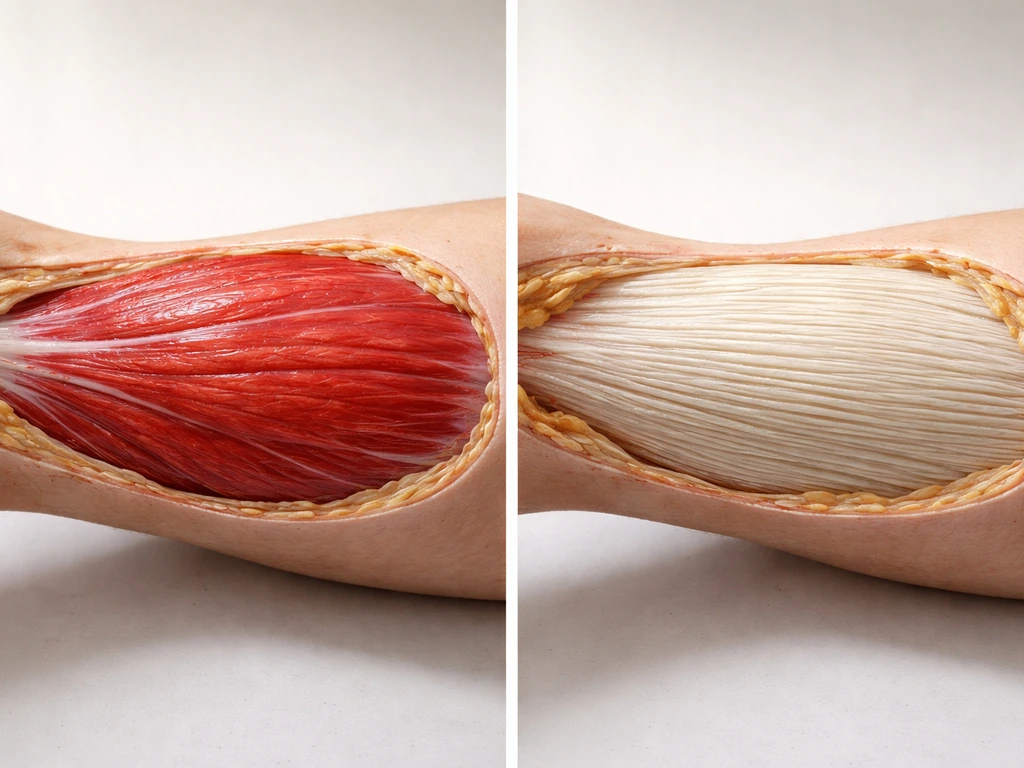
Back muscles can grow detectably fast, especially if you're new to lifting. Research shows measurable increases in muscle thickness within 2 weeks of starting resistance training, and most people see meaningful hypertrophy (visible and measurable size gains) within 4 to 8 weeks of consistent, progressive training. That said, the back is a large, complex region involving multiple muscle groups, and how "fast" it grows depends heavily on exercise selection, training volume, nutrition, and recovery, not just effort or time in the gym. To build slow twitch muscles, you can emphasize longer sets and slower control, keeping tension on the target throughout the range of motion the back is a large, complex region.
Do Back Muscles Grow Fast? Timelines and What Works

Marcus Kellerman
29 Apr 2026

How fast back muscles can realistically grow

Let's put some real numbers on this. In untrained or early-stage lifters, muscle thickness can exceed the threshold of measurement error after just 2 weeks of resistance training. That's not just strength adaptation, that's actual tissue change. Over a 10-week training block, upper body muscles including the back typically show consistent hypertrophy, though the first 2 to 4 weeks tend to be dominated by neuromuscular improvements (better motor unit recruitment, improved coordination) rather than pure size gains. The true hypertrophy ramp-up accelerates after that initial phase.
For practical timelines, here's what most people experience across different training backgrounds: If you want to understand why some people grow muscle faster than others even with similar training, see why do some people grow muscle faster for the key drivers behind faster hypertrophy.
| Experience Level | Noticeable Strength Gains | Visible/Measurable Size Gains | Realistic 3-Month Outcome |
|---|---|---|---|
| Beginner (0–6 months) | 1–2 weeks | 4–8 weeks | Significant thickness and width gains, especially in lats and traps |
| Intermediate (6 months–2 years) | 2–4 weeks | 8–12 weeks | Moderate gains requiring more structured overload |
| Advanced (2+ years) | 4–6 weeks | 12+ weeks | Smaller, harder-earned increments needing periodized programming |
| Older adults (50+) | 2–4 weeks (strength) | 6–10 weeks | Comparable hypertrophy to younger adults with adequate protein and recovery |
One thing worth noting: older adults aren't at the disadvantage many people assume. The research consistently shows that back muscles in people over 50 respond to resistance training with hypertrophy similar in magnitude to younger lifters, provided protein intake is sufficient and recovery is respected. Age slows things down at the margins, not at the fundamentals.
Why back growth may feel "fast" (or slow): key factors
The back is actually a favorable region for hypertrophy for a few reasons. It contains large, force-producing muscles (latissimus dorsi, rhomboids, traps, erector spinae) that respond well to mechanical tension, which is the primary driver of muscle protein synthesis. Because these muscles are relatively undertrained in most sedentary people, they often respond quickly when you start loading them properly. That's the beginner advantage in action.
But the back also has a reputation for being stubborn, and that reputation isn't unfounded. The main reason: most people pull with their arms and biceps rather than actually loading the back. Poor mind-muscle connection here is common because you can't see your back in the mirror while training it. This makes it easy to go through the motions without the mechanical tension actually reaching the target muscles, which slows growth considerably.
Other factors that determine whether back growth feels fast or slow include training volume (total sets per week), progressive overload, nutrition, sleep quality, and individual genetics around muscle fiber distribution. Some people also grow some muscle groups faster than others due to fiber type ratios and insertion points, which is worth acknowledging even if you can't control it. If you're curious about which muscles tend to be the slowest growers across the body, that's worth exploring separately.
Back training that drives hypertrophy

Exercise selection
Not all back exercises are equal for hypertrophy. You want movements that load the lats, mid-back, and traps through a full range of motion under meaningful tension. The best choices are compound rows and vertical pulls, supplemented by isolation work for the mid-back and rear delts.
- Barbell or dumbbell rows: one of the highest-stimulus back exercises, loading the lats and rhomboids under heavy load
- Pull-ups and lat pulldowns: vertical pull patterns that maximally stretch and contract the lats, excellent for width
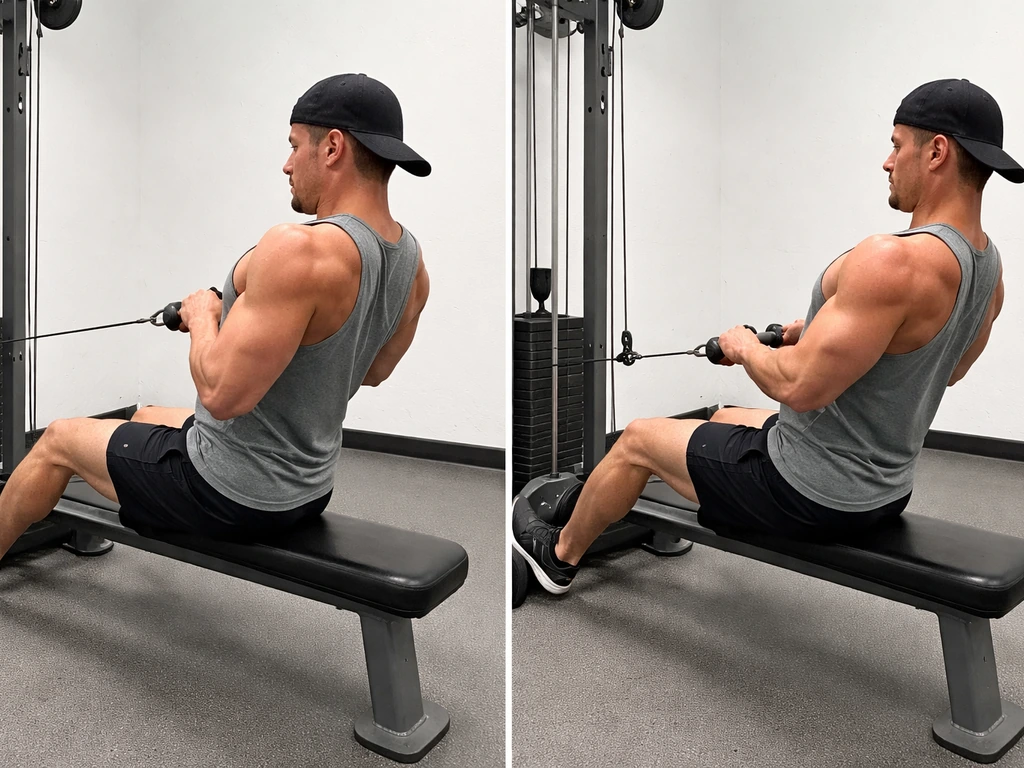
- Seated cable rows: allows constant tension through the full range, great for mid-back thickness
- Single-arm dumbbell rows: helps correct imbalances and allows heavier loading per side
- Cable pullovers or straight-arm pulldowns: isolate the lats without bicep involvement, great for building the mind-muscle connection
- Deadlifts and Romanian deadlifts: significant erector and trap stimulus, though not the primary hypertrophy tool for upper back
Volume and frequency

For hypertrophy, most evidence points to 10 to 20 working sets per week for a muscle group as an effective range, with beginners starting closer to 10 and intermediate lifters pushing toward 15 to 20 as they adapt. The back, being large and composed of multiple muscles, can tolerate and benefit from higher volumes than smaller muscle groups.
Research comparing training frequency (say, 2 versus 4 sessions per week) finds that when total weekly volume is equated, the frequency itself matters less than accumulating enough quality sets. Practically, training your back 2 to 3 times per week tends to work well because it distributes the volume without excessive fatigue per session.
An ACSM overview of reviews recommends that healthy adults perform resistance training with high effort at least twice weekly while engaging all major muscle groups [training your back 2 to 3 times per week tends to work well](https://pmc. ncbi. nlm. nih.
gov/articles/PMC12965823/).
A simple starting structure: 3 to 4 back exercises per session, 3 to 4 working sets each, 2 times per week. That puts you at roughly 18 to 32 working sets per week, which is a solid hypertrophy range without overwhelming your recovery. Adjust based on how you respond.
Rep ranges and effort
For back hypertrophy, a rep range of 6 to 15 reps per set covers the sweet spot. Heavy compound rows in the 6 to 10 rep range build thickness and strength. Moderate-load cable work and pulldowns in the 10 to 15 range are excellent for accumulating volume with good technique. What matters more than the exact rep count is how close you are to muscular failure.
Proximity to muscular failure is also emphasized in a systematic review of resistance training volume for achieving an optimal hypertrophy stimulus across rep ranges [how close you are to muscular failure](https://pmc. ncbi. nlm. nih.
gov/articles/8884877/). Sets should feel genuinely hard, finishing 1 to 2 reps from failure. Going through the motions at low effort is one of the most common reasons back training stalls.
Progression and intensity: how to keep adding stimulus

Progressive overload is the mechanism that keeps your back growing after the initial adaptation phase. Your body responds to novel stress, and once your current training is no longer novel, growth slows unless you raise the stimulus. The most reliable way to do this is adding weight to your key compound movements every 1 to 2 weeks, even if it's a small increment (2.5 to 5 lbs). When you can't add weight without breaking form, add a rep or an extra set.
Beyond load, you can increase intensity through techniques like slow eccentrics (3 to 4 seconds lowering the weight), pausing at full stretch in movements like single-arm rows or pulldowns, and reducing rest periods to increase metabolic stress. None of these replace progressive overload, but they add variety and can help when linear progression stalls. Periodization, alternating between higher-load and higher-volume phases across 4 to 8 week blocks, is particularly useful for intermediate and advanced lifters who can't add weight every session.
One practical tool: keep a training log. It sounds basic, but most people who complain their back "won't grow" haven't actually been overloading consistently. If your back growth feels slow, it usually comes down to not progressively overloading, not eating enough protein, or not recovering well why my muscle grow slow. Seeing that you've been doing the same weight for 3 months is a useful reality check.
Nutrition, protein, and calories for faster back growth
You can't out-train a nutrition deficit. Back muscles, like all skeletal muscle, grow during recovery when the building blocks (amino acids from protein) are available and when total caloric intake is sufficient to support anabolic processes. Eating in a meaningful caloric deficit makes muscle gain significantly slower, even with perfect training.
Protein is the priority. The current evidence supports 1.6 to 2.2 grams of protein per kilogram of bodyweight per day for muscle gain, with some benefit for older adults at the higher end (up to 2.4 g/kg). Spread it across 3 to 5 meals or feedings, with each containing at least 25 to 40 grams of protein to maximally stimulate muscle protein synthesis per session. Sources like chicken, eggs, fish, beef, Greek yogurt, cottage cheese, and legumes are all reliable options.
For calories, a modest surplus of 200 to 400 calories per day above maintenance is the sweet spot for gaining muscle without excessive fat accumulation. You don't need to "bulk" aggressively. Beginners and those returning from a break can sometimes gain muscle in a neutral caloric balance, but most people benefit from a small surplus if the goal is speed of growth.
On supplementation: creatine monohydrate is the most evidence-supported supplement for increasing strength and muscle mass. 3 to 5 grams per day is the effective dose, no loading required. It works by increasing phosphocreatine availability, which lets you push harder in training, and it also has direct effects on muscle protein synthesis pathways. A quality protein powder (whey, casein, or plant-based) is a practical tool if you're struggling to hit protein targets from whole food alone, but it's not magic. Hydration also matters: aim for at least 2 to 3 liters of water per day, as muscle protein synthesis is impaired in even mild dehydration.
Recovery, sleep, and managing fatigue
Muscle growth happens between sessions, not during them. The training session is the stimulus, but the actual tissue remodeling occurs during recovery, and sleep is when the majority of that repair and growth takes place. Aim for 7 to 9 hours per night. Studies consistently show that sleep restriction under 6 hours per night significantly blunts muscle protein synthesis and elevates cortisol, both of which slow hypertrophy. If sleep is chronically poor, it's likely the biggest unaddressed bottleneck in your back growth, regardless of how well you're training.
Between back sessions, allow 48 to 72 hours before training the same muscle group again with high intensity. This doesn't mean zero activity, light movement, stretching, or even low-volume technique work can happen sooner. But pushing a fatigued back with hard sessions too frequently impairs recovery faster than it drives growth. The signs of under-recovery include persistent soreness, declining strength over multiple sessions, poor sleep, and elevated resting heart rate. These are signals to pull back, not push harder.
One myth worth addressing: you don't need soreness to grow. Delayed onset muscle soreness (DOMS) is a marker of novelty and tissue disruption, not quality hypertrophy stimulus. Over time as your back adapts to training, DOMS decreases. That's normal and doesn't mean you've stopped growing.
Common reasons your back isn't growing fast + quick fixes
If your back feels like it's not responding, one or more of these issues is almost certainly the cause. Identifying which one is the fastest way to fix your results.
| Common Problem | What It Looks Like | Quick Fix |
|---|---|---|
| Pulling with your arms, not your back | Biceps fatigue before back during rows or pulldowns | Cue: initiate every pull by depressing your shoulder blades first; try using lifting straps to remove grip/bicep limitation |
| Insufficient volume | Doing 6–8 sets per week for back and wondering why it's not growing | Increase to at least 12–15 working sets per week across 2 sessions |
| No progressive overload | Same weight, same reps for months | Start a training log; add 2.5–5 lbs or 1 rep per set every 1–2 weeks on key lifts |
| Poor exercise selection | Mostly machines with limited range of motion | Prioritize free-weight rows, pull-ups, and cable work with full stretch and contraction |
| Inadequate protein intake | Eating under 1.2 g/kg of bodyweight per day | Calculate your actual intake; target 1.6–2.2 g/kg daily across multiple meals |
| Caloric deficit | Losing weight while trying to build muscle (unless a beginner) | Eat at maintenance or a small surplus of 200–400 calories above your TDEE |
| Not training close to failure | Sets feel easy, you could do 5+ more reps | Push sets to 1–2 reps from failure; reduce weight if needed to maintain form |
| Inadequate sleep | Less than 6–7 hours per night consistently | Treat sleep as a training variable; prioritize 7–9 hours as non-negotiable |
Your next 4 to 8 weeks: a simple action plan
Here's a concrete checklist to implement starting today. These are the highest-leverage moves for back hypertrophy, ordered by impact:
- Set up a training log (app, notebook, whatever you'll actually use) and record every back session going forward
- Choose 3 to 4 core back exercises: a heavy row, a vertical pull, a cable or machine row, and one isolation move (e.g., straight-arm pulldown)
- Train back 2 times per week with 10 to 15 working sets spread across the two sessions
- Train each set to 1 to 2 reps from failure; if you're unsure what that feels like, rate each set by how many reps you had left, and aim for an RIR (reps in reserve) of 1 to 2
- Add 2.5 to 5 lbs (or 1 rep) to your main compound movements every 1 to 2 weeks
- Calculate your daily protein target (bodyweight in kg x 1.8 g) and hit it consistently across 3 to 5 meals
- Start creatine monohydrate at 3 to 5 grams per day if you're not already taking it
- Protect 7 to 9 hours of sleep per night as a training priority, not an optional extra
- Reassess at 4 weeks: is your logged weight on key lifts increasing? Is your back noticeably fuller or wider? If not, volume or nutrition is likely the issue
The back can be one of the most rewarding muscle groups to train because the potential for growth is significant and the exercises are genuinely satisfying to get strong at. The people who grow it fast aren't doing anything exotic. They're pulling heavy and progressively, eating enough protein, sleeping well, and being honest about whether they're training with real effort. Get those fundamentals locked in and the growth tends to follow.
FAQ
How long should I give my back before I decide it is not growing fast enough?
Use a 6 to 8 week checkpoint, then a 10 to 12 week confirmation. If loads and reps are steadily progressing but there is no change in strength or measured back thickness, the issue is likely exercise selection, effort (not close to failure), or insufficient weekly working sets, not “bad genetics.”
What if I’m progressing on weight but my back still looks the same?
That often means the stimulus is going to other muscles. For example, if rows become more biceps or low-back driven, your back may not be getting the mechanical tension it needs. Film a set, keep elbows traveling with the lift (not just pulling with the arms), and include a controlled pause at full stretch on at least one movement.
Is it better to train my back once or multiple times per week to make it grow fast?
Frequency helps mainly when it allows more quality sets without recovery breakdown. If you can hit 15 to 20 hard sets in one day and still recover, once per week might work. More commonly, splitting into 2 to 3 sessions preserves performance across sets, which improves total effective volume.
Do back muscles grow faster with higher reps or heavier weight?
Both can work, the key is hard sets near failure. Heavier sets (around 6 to 10) tend to build strength and thickening efficiently, while moderate reps (around 10 to 15) make it easier to accumulate volume with good form. If technique breaks at heavy loads, choose a load where you can maintain full-range tension.
How close to failure do I need to train my back for fastest growth?
Aim for sets that end with 1 to 2 reps in reserve, consistently. If sets regularly feel easy, your body never receives enough overload, even if you increase weight sometimes. A useful rule is, if your last reps are not significantly slower and you are not straining to hit targets, reduce the rest time or add sets rather than “pushing the same effort harder.”
Should I use soreness as a sign my back workout worked?
No. Soreness is not required for hypertrophy, it mainly reflects novelty and tissue damage. Instead, track performance (reps and load), and monitor whether range of motion and control improve. If soreness is high but strength drops for multiple sessions, you are probably under-recovering.
How do I avoid turning rows into an arm exercise?
Use cues that create back-first tension: start each rep with shoulder blade movement, keep elbows traveling back and slightly in line with the body, and think about pulling with the “wide back” rather than the biceps. Also reduce ego weight for 1 to 2 weeks and add a 2 to 3 second eccentric to re-skill the pattern.
What total weekly sets are enough to grow back quickly, and how do I choose?
A practical target is 10 to 20 working sets per week for the back muscles you are training. Start near 10 if you are new or fatigued easily, then add sets in 2 to 4 set jumps as long as performance stays stable and recovery signs do not worsen.
Can I grow my back fast if I’m in a calorie deficit?
Muscle gain will be slower. In a meaningful deficit, your training can improve strength, but visible back hypertrophy lags because recovery needs protein plus sufficient energy. If you want “fastest growth,” aim for maintenance or a small surplus, about 200 to 400 calories above maintenance.
How much protein do I need for fast back growth, and is timing important?
Hit 1.6 to 2.2 g/kg/day (up to 2.4 g/kg for older adults) and distribute across 3 to 5 feedings. Timing matters less than total daily protein, but aiming for 25 to 40 grams per meal makes it more likely you consistently provide enough amino acids for each training day and recovery window.
What sleep amount is actually meaningful for hypertrophy?
Try for 7 to 9 hours nightly, but the biggest issue is chronic short sleep, especially under 6 hours. If you cannot hit 7 hours consistently, prioritize fixing sleep schedule and total sleep time before increasing back training volume.
How can I tell if I’m under-recovering and my back is not growing fast because of it?
Common signs include declining strength across sessions, persistent soreness that does not trend down week to week, worsening sleep, and higher resting heart rate. When this happens, cut back to fewer working sets or reduce intensity, then rebuild gradually over 1 to 2 weeks.
Creatine helps strength, but does it directly help back muscle growth?
It can, indirectly and sometimes more directly. By increasing training performance and potentially supporting muscle protein synthesis signaling, it helps you accumulate more quality work and progressive overload. Take 3 to 5 grams daily consistently, and you should not expect an immediate size change in the first few days.
What’s a good way to measure whether my back is actually growing fast?
Use at least one objective measure: track working-set reps and loads in your log, and take the same standardized measurements (such as back width or lat thickness using consistent landmarks) every 4 weeks. Visual changes can lag, especially early, so strength progress and measurements reduce guessing.
Should I train my back muscles to the same level of effort every set?
You do not need identical effort on every set, but your “effective” sets should be hard. A common approach is to do most sets at 1 to 2 reps in reserve, and keep the final set of a movement closest to failure. If you are far from failure on every set, you likely need more load, better technique, or more total sets.