Muscle cells don't divide in adult life, but muscles still grow because the fibers you already have get bigger. The process is called hypertrophy, and it works by increasing the amount of contractile protein packed inside each existing fiber, not by generating brand-new fibers through cell division. There's a supporting cast involved too, specifically satellite cells that donate extra nuclei to help larger fibers manage their increased workload, but the core answer is simple: you grow the fibers you have, not more fibers.
If Muscle Cells Don’t Divide, How Do Muscles Grow?

Marcus Kellerman
5 May 2026
Why muscle fibers don't divide (and why that's fine)
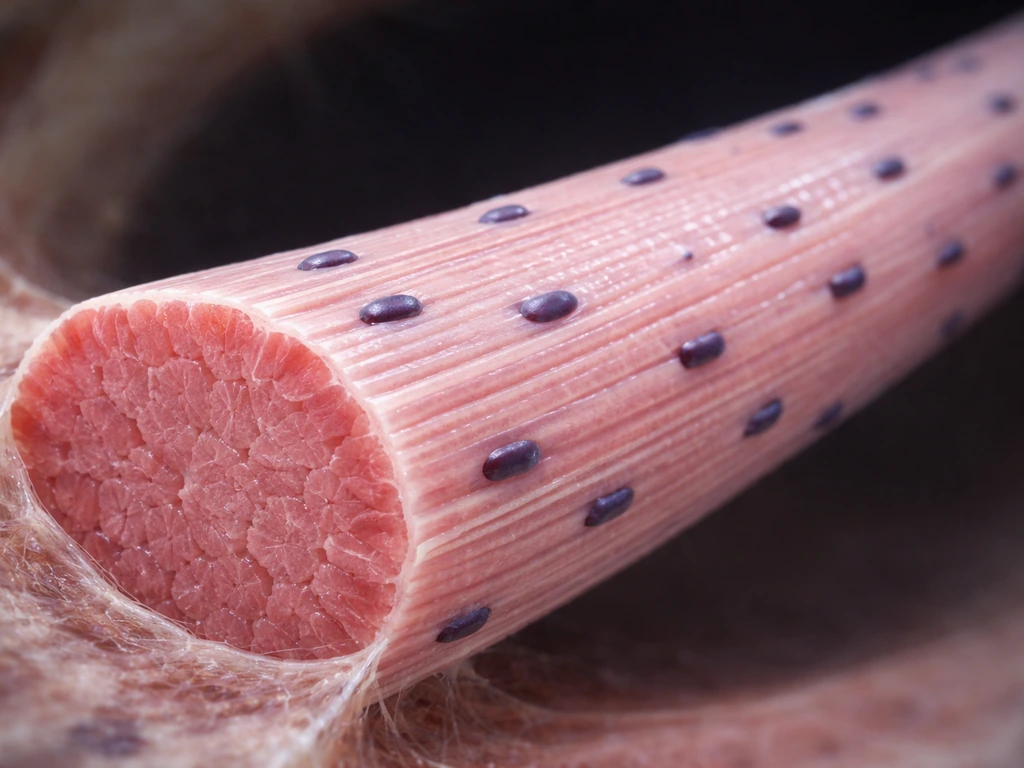
Skeletal muscle fibers are unusual cells. They're multinucleated, meaning each long fiber contains dozens to hundreds of nuclei, and they lost the ability to divide after early development. In the embryo and fetal stage, precursor cells called myoblasts fused together to form these giant, multi-nucleated fibers. Once that developmental window closed, the fibers you ended up with are essentially the ones you'll always have. That's not a flaw in the system. It's how the biology was designed to work.
This is why the idea of 'making new muscle cells' through training is a misconception worth clearing up. What training does is signal the existing fibers to remodel, add more contractile proteins, and over time, get physically larger in cross-sectional area. The fiber count may change a little in some circumstances (a concept called hyperplasia), but the evidence in humans is much weaker than hypertrophy, and it's not something you can reliably train for. how muscles grow video. In practice, most noticeable muscle growth is driven by hypertrophy rather than hyperplasia. Hypertrophy is the mechanism that matters.
How hypertrophy actually works: protein in vs. protein out

Every day, your muscle fibers are constantly building new proteins and breaking down old ones. This is called muscle protein turnover, and it never stops. Muscle protein synthesis (MPS) is the building side; muscle protein breakdown (MPB) is the demolition side. After a hard resistance training session, both go up. That might sound counterproductive, but the breakdown actually clears out damaged or older proteins so the synthesis side can replace them with more and better ones. Muscles repair damage from training through the same protein turnover process that supports growth.
Net muscle growth only happens when MPS consistently exceeds MPB over time. The key phrase is 'over time.' One session doesn't build a noticeable amount of muscle. A sustained training program with adequate nutrition shifts the daily balance in favor of synthesis, week after week, and that's when the fiber cross-section grows and you start seeing results in the mirror or on the scale.
The signaling pathway that drives this is called mTORC1. Mechanical tension from lifting, and amino acids from protein in your diet, both activate mTORC1, which then triggers downstream targets (S6K1 and 4E-BP1) that initiate protein translation inside the fiber. 4E-BP1 and S6K1 are highlighted as translational integration sites that connect nutrient and hormonal information to the protein synthesis machinery in muscle S6K1 and 4E-BP1. Think of mTORC1 as the 'go' signal that tells the fiber's protein-building machinery to ramp up. Without a training stimulus, the signal is weak. Without adequate protein, there aren't enough building blocks to act on the signal even when it fires.
Satellite cells: the support crew behind fiber growth
Here's where things get a little more nuanced. When a fiber grows significantly in size, it needs more nuclei to manage the increased volume of cellular activity. That's where satellite cells come in. Satellite cells are muscle stem cells that sit dormant just outside each fiber. When you train hard enough, they activate, multiply, and some of them fuse into the existing fiber, donating their nucleus to it. This is called myonuclear accretion.
More nuclei means more capacity for protein synthesis, which supports further growth. The myonuclear domain hypothesis explains this well: each nucleus can only manage a certain volume of cellular machinery, so as a fiber gets bigger, it eventually needs more nuclei to keep the growth going. Studies in young men doing resistance training have shown satellite cell activity picking up within 48 hours of a training session, with measurable changes in myonuclear content across weeks of training.
Critically, this process still doesn't create a new fiber. The satellite cell fuses into the existing one. The fiber grows from within. This is why 'growing muscles' and 'dividing muscle cells' are two completely different things, and only one of them actually happens in adult humans with any significance.
What training actually does to trigger all of this
Training is the primary signal that starts the whole cascade. Without a sufficient mechanical stimulus, the mTORC1 pathway stays quiet, satellite cells stay dormant, and protein synthesis doesn't get bumped up meaningfully. This reflects how mTORC1 activity is regulated by growth factors, energy status, amino acids, and mechanical stimuli, linking those signals to skeletal muscle protein synthesis via downstream translational pathways mTORC1 pathway stays quiet. So knowing what kind of training actually sends that signal is practical and important.
Progressive overload is the non-negotiable

Progressive overload means you're consistently giving the muscle more work than it's used to. That can mean adding weight, doing more reps, adding sets, or reducing rest time over weeks and months. Without progression, the muscle adapts to its current workload and stops needing to grow. This is the single most important principle in any effective training program, regardless of experience level.
Volume, intensity, and proximity to failure
Volume (total sets and reps per muscle group per week) and intensity (how close you train to failure) both matter. Research suggests most people need somewhere between 10 and 20 working sets per muscle group per week for meaningful hypertrophy, though beginners can get results on the lower end of that range. Training to within a few reps of failure on most sets appears to be important for fully recruiting the high-threshold muscle fibers that have the most growth potential. You don't always need to hit absolute failure, but you do need to push hard enough that the last few reps feel genuinely difficult.
A practical starting point for beginners: 3 full-body sessions per week, 2 to 3 sets of 8 to 12 reps per exercise, stopping 1 to 2 reps short of failure. Add small amounts of weight or an extra rep every 1 to 2 weeks. That's progressive overload in its simplest form, and it works.
Nutrition: giving your body the raw materials to actually build
Total calories matter more than most people think

You can do everything right in the gym and still undercut your results by not eating enough. Building muscle requires a positive energy balance or at least maintenance calories. A modest calorie surplus of around 200 to 300 calories above your daily maintenance is enough to support meaningful muscle gain while minimizing excess fat storage. If you're a beginner or returning after a break, you can often make good progress at maintenance calories because your body is particularly responsive at that stage.
Protein: how much, when, and what kind
Protein is the building block. The target that holds up well across the research is 0.7 to 1 gram of protein per pound of bodyweight per day (roughly 1.6 to 2.2 grams per kilogram). For a 180-pound person, that's around 130 to 180 grams per day. Older adults benefit from sitting at the higher end of that range because muscle tissue becomes less responsive to lower protein doses with age, a phenomenon called anabolic resistance.
Timing matters too, though it's less critical than total daily intake. Spreading your protein across 3 to 4 meals throughout the day tends to maximize the MPS signal better than eating it all at once. Each protein-containing meal should ideally deliver around 30 to 40 grams of protein, which is enough to robustly stimulate MPS. Including a leucine-rich protein source (chicken, eggs, dairy, whey, or soy) is useful because leucine specifically acts as a trigger for the mTORC1 pathway.
Post-workout nutrition is real and valuable. Getting 30 to 40 grams of protein within a couple of hours after training amplifies the MPS response that the workout triggered. You don't need to slam a shake the second you drop the last dumbbell, but don't skip protein for 4 to 5 hours post-training either.
| Nutrient target | General recommendation | Older adults (50+) |
|---|---|---|
| Daily protein | 0.7–1 g per lb bodyweight | 1–1.1 g per lb bodyweight |
| Protein per meal | 30–40 g per sitting | 40 g per sitting |
| Daily calories | Maintenance to +200–300 kcal | Maintenance (watch appetite decline) |
| Meals with protein | 3–4 per day | 3–4 per day, evenly spaced |
| Post-workout protein | Within 2 hours of training | Within 1–2 hours of training |
Recovery: the part most people shortchange

Muscle doesn't grow during the workout. It grows during recovery. The training session is the stimulus; sleep and rest are when the adaptation actually happens. Getting 7 to 9 hours of sleep per night is not optional if you're serious about building muscle. Growth hormone secretion peaks during deep sleep, and general cellular repair including muscle protein synthesis runs at full capacity during that time.
Chronic stress is a real muscle-building obstacle. Elevated cortisol, your stress hormone, shifts the body away from anabolic processes and toward breakdown. You don't need a stress-free life to build muscle, but if you're consistently running on poor sleep, high mental stress, and under-eating, you're fighting your own physiology.
Soreness is worth addressing briefly because it confuses people. Delayed onset muscle soreness (DOMS) is not a reliable indicator of a good workout, and the absence of soreness does not mean you didn't grow. Soreness mostly reflects unfamiliar movement patterns or unusually high eccentric loads. It fades as your body adapts, and that's normal. Managing soreness and avoiding injury means programming enough rest days, not skipping warm-ups, and not doing so much volume so fast that your joints and connective tissue can't keep up with your muscles.
For older adults specifically, recovery takes longer and matters even more. Two to three days between training the same muscle group is often better than one day, and managing training intensity carefully during high-stress life periods prevents the kind of accumulated fatigue and injury risk that derails long-term consistency.
What to realistically expect and how to adjust when progress stalls
Strength gains come faster than size gains. Most beginners notice meaningful strength improvements within 2 to 4 weeks, which comes primarily from neural adaptations (your nervous system getting better at recruiting the muscle you already have) rather than actual hypertrophy. Visible muscle size changes typically take 6 to 12 weeks of consistent training and nutrition to become noticeable, and meaningful body composition changes that others notice often take 3 to 6 months.
Older adults can absolutely build muscle. The timeline may be slower and the protein requirements are higher, but the mechanisms are identical. Studies consistently show significant hypertrophy in people in their 60s, 70s, and even 80s with resistance training. The ceiling is lower than at 25, but there's a lot of room between 'where you are now' and 'that ceiling.'
Plateaus are normal and expected. When progress stalls after weeks of doing the same thing, it usually means one of a few things: you've adapted to your current volume and need to add more, your protein intake has quietly drifted below target, sleep has been poor, or stress has been high. The fix is almost always to audit the basics before overhauling your whole program. Add a set or two per muscle group, track your protein for a week, and check your sleep before assuming you need a completely different approach.
A simple framework to move forward today
- Train each muscle group 2 to 3 times per week with 10 to 15 working sets per muscle group across those sessions.
- Use a rep range of 6 to 15 reps per set, stopping 1 to 2 reps short of failure on most sets.
- Add weight or reps every 1 to 2 weeks to maintain progressive overload.
- Hit 0.7 to 1 gram of protein per pound of bodyweight daily, spread across 3 to 4 meals.
- Eat at or slightly above your maintenance calorie intake.
- Prioritize 7 to 9 hours of sleep consistently.
- Reassess every 4 to 6 weeks: if strength and weight aren't moving, adjust calories or volume first.
The biology of muscle growth is genuinely elegant once you understand it. If you want the practical answer to how muscle grow, focus on progressive overload, enough protein, and consistent recovery muscle growth. Your fibers don't divide, but they're capable of remarkable remodeling if you give them the right stimulus, enough raw material, and time to recover. That's the whole game, and everything else is just detail.
FAQ
If muscle cells don’t divide after development, can I ever grow by making new muscle fibers?
No. In most cases, training increases the size of existing fibers (hypertrophy), not the number of fibers. You can see small changes in “fiber count” in rare or specific contexts, but for typical gym training and healthy adult skeletal muscle, new fiber formation is not the reliable explanation for growth.
Will I see muscle growth right away if my fibers get bigger from training?
Usually, yes, but it depends on what “grow” means. Your fibers can enlarge fairly quickly, while visible size changes lag because fat gain, water retention, and posture can mask or distort measurements. Many people notice strength first and muscle size later (often after weeks), even when hypertrophy is already occurring.
Can I build muscle with no calorie surplus if my workouts are hard?
Not necessarily. Your program can stimulate protein synthesis, but if you consistently fall short on calories or you under-recover (especially sleep), the overall balance can tip toward breakdown. A practical check is tracking bodyweight trends and aiming to stay near maintenance plus a small surplus if you want faster gains.
What counts as progressive overload if I can’t keep increasing weight?
You still need progression even if you are lifting “heavy.” If the stimulus is no longer increasing over time (for example, the same load and reps with full recovery for weeks), you can stall because the signaling and breakdown-remodel cycle adapts. Progressive overload can be adding reps, adding sets, or slightly increasing load, not just chasing heavier weights every session.
Do satellite cells “run” the whole time, or only when growth is big enough?
Satellite cells mainly help when fibers enlarge enough to require more nuclei. If you train lightly or with too few hard sets, you may get remodeling without enough growth to noticeably increase myonuclear accretion. This is why training intensity and effort on working sets matter, not just total volume.
Is it okay to eat most of my protein in one meal?
Yes, but the pattern matters. If you spread protein across 3 to 4 doses, you get repeated MPS “turn on” signals. If you eat a very large protein bolus once per day, MPS still happens but the excess beyond what you can use may be wasted as oxidation or stored, so daily intake effectiveness drops.
If I don’t eat protein right after training, will I lose my muscle gains?
The immediate post-workout window helps, but missing it completely doesn’t erase your progress. A larger issue is having consistently low total daily protein or long gaps between protein feedings. If you train late, prioritize hitting your daily protein and distributing it across the day.
If I have little or no soreness, does that mean my muscles are not growing?
Sometimes, but it is not guaranteed and it is not typically the first lever. Increases in fiber size are common, but muscle size can also be limited by fatigue, low protein, inadequate recovery, or program imbalance. If soreness is absent after a few weeks, that can be normal adaptation, and you should judge progress by performance, measurements, and strength trends rather than DOMS.
How close to failure should I train, and do I need to hit it on every set?
Pushing to failure on every set is not necessary and can backfire by increasing fatigue, reducing quality in later sets, and hurting recovery. A common approach is using effort that leaves about 1 to 2 reps in reserve for most sets, and using failure sparingly on the last set of an exercise when recovery and technique are solid.
How long should I rest between workouts for the same muscle group?
If you train the same muscle group too frequently without enough recovery, you may accumulate fatigue that reduces performance and effective effort. For many people, spacing sessions 48 to 72 hours apart per muscle group works well, but high-volume beginners or people with high life stress may need longer gaps.
Do older adults need different training and protein targets if muscle cells don’t divide?
Yes, but they do it in a slightly different way. Older adults often have reduced responsiveness, so protein at the higher end of the recommended range and adequate total calories become more important. Training should still include progressive overload, but volume and intensity are often better controlled to protect joints and connective tissue.
What should I check first if my size and strength plateau?
During a plateau, it often helps to audit what changed in the last 2 to 4 weeks, not only the program itself. Common fixes are adding 1 to 2 working sets per week per muscle, ensuring protein is consistently on target, checking sleep, and making sure you are still progressing reps or load in at least some exercises.
If I’m lifting hard but not growing, could my form be the problem?
Poor technique can blunt mechanical tension and reduce the ability to progressively load the muscle you intend, even if the exercise “feels hard.” If your joints hurt, your range of motion is inconsistent, or your reps drift, your stimulus may be inefficient, slowing hypertrophy.
How do stress and sleep affect hypertrophy if training is already on track?
Yes. “Muscle growth” requires recovery capacity across the whole system, so high stress, inadequate sleep, and under-eating can reduce the net muscle protein balance even when training is good. The most actionable step is prioritizing sleep first, then calibrating calories and protein.