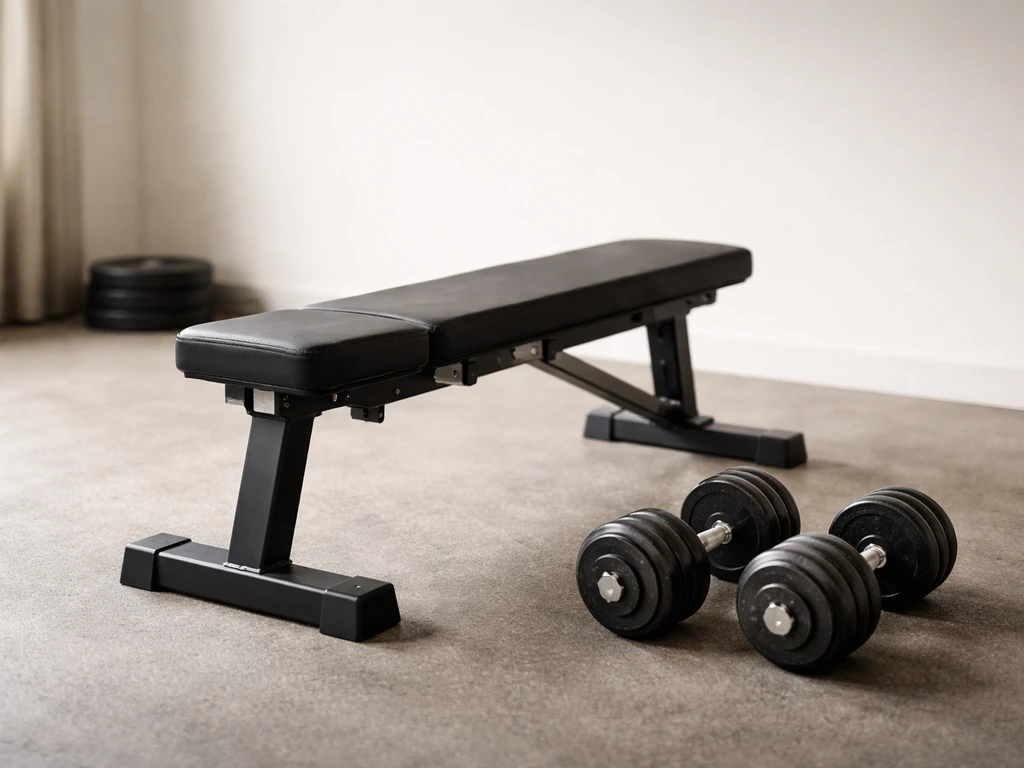
Yes, you can absolutely grow muscle by working out, but the workout itself is only one piece of the equation. Resistance training creates the stimulus, and your body responds by building new muscle tissue, but only if you also give it enough protein, enough calories, and enough rest. Skip any one of those and you'll get fitter, maybe leaner, but not meaningfully bigger. Get all three right and measurable size changes can show up in as little as four weeks.
Can You Grow by Working Out? Muscle Growth Explained

Marcus Kellerman
28 May 2026

What 'growing' actually means here
When most people ask whether they can grow by working out, they mean one of three different things: gaining muscle mass, losing fat so they look more defined, or just getting generally fitter. These outcomes are related but they are not the same thing, and confusing them leads to a lot of frustration.
True muscle growth, the kind measured in scientific studies, is called hypertrophy. It means your muscle fibers are getting physically larger, increasing their cross-sectional area. Researchers measure this with ultrasound, MRI scans, or skinfold calipers tracking muscle thickness over time. A real growth outcome looks like a thigh muscle cross-sectional area going up by 5 cm² or more, or arm and chest muscle thickness increasing noticeably after a bench press program. That is different from weight gain on the scale (which could be fat, water, or glycogen) and different from 'getting toned' (which usually means losing fat around existing muscle).
General fitness improvements, like better cardiovascular capacity, improved endurance, or more flexibility, are real and valuable. But they do not automatically mean your muscles are bigger. Cardio-only training, for example, can dramatically improve your fitness without adding meaningful muscle mass. If your actual goal is to be physically larger and stronger, you need to specifically target hypertrophy, and that requires resistance training as the foundation.
One more myth worth busting upfront: spot growth is not a thing, just like spot reduction is not a thing. You cannot do a hundred bicep curls and expect only your biceps to grow while nothing else changes. Training stimulates systemic hormonal and metabolic responses. You grow where you train consistently and progressively, but you cannot micromanage which exact area develops first.
Can workouts build muscle by themselves?

Here is the honest answer: resistance training is necessary for muscle growth, but it is not sufficient on its own. The workout creates mechanical tension in your muscle fibers, which signals your body to repair and reinforce them. But that repair requires raw materials, specifically amino acids from dietary protein, and a caloric environment that supports building new tissue rather than breaking it down. Studies that have tested protein supplementation alongside identical training programs consistently show that the group with better protein intake gains more lean mass, even when every other variable is controlled.
That said, if your nutrition is already solid and your recovery is in order, then yes, the workout is the trigger. Without the training stimulus, no amount of protein or sleep will cause hypertrophy. The two inputs, training and nutrition plus recovery, are interdependent. Think of the workout as flipping the switch and everything else as the electricity that powers what happens next.
What your training needs to include for real hypertrophy
Not all workouts are created equal when it comes to building muscle. A casual walk, a yoga class, or even a moderate cardio session can improve your health without driving meaningful hypertrophy. For actual muscle growth, your training needs to check a few specific boxes.
Progressive overload

Progressive overload is the single most important principle in muscle building. It means you need to continually increase the demand you place on your muscles over time, whether by adding weight, doing more reps, adding sets, or reducing rest periods. If you are doing the same workout with the same weights month after month, your body has no reason to adapt further. Your muscles grow as a response to a challenge they have not fully solved yet. Once they adapt, you need to raise the bar, literally or figuratively.
Sufficient volume
Volume refers to your total weekly training load, basically the number of hard sets you do per muscle group per week. The current ACSM position stand recommends training all major muscle groups at least two days per week and building volume gradually over time. Research backs up a dose-response relationship here: more weekly sets generally produce greater hypertrophy than fewer sets, up to a point. Multiple sets per exercise outperform single-set approaches for muscle growth. A practical starting target is around 10 to 20 working sets per muscle group per week, starting at the lower end and increasing as your capacity grows.
Training close to failure

Research on proximity-to-failure shows that hypertrophy depends on pushing your sets close to the point where you could not complete another rep with good form. You do not necessarily need to go to complete failure on every set, but stopping five reps short every time means you are leaving a lot of growth stimulus on the table. Aiming to finish sets within two to four reps of failure is a practical sweet spot that maximizes mechanical tension without creating so much fatigue that your recovery suffers.
Load and intensity
You do not need to lift the heaviest possible weights to grow. You can even build muscle with light weights as long as you create enough mechanical tension and progressively overload over time can you grow muscle with light weights.
Network meta-analyses comparing different training loads show that a fairly wide range of rep ranges, from roughly 5 to 30 reps per set, can drive similar hypertrophy as long as sets are taken close to failure and total volume is comparable. Heavy loads in lower rep ranges tend to produce slightly better strength gains (measured by one-rep max tests), while moderate loads in higher rep ranges can produce similar or even equivalent size gains.
Pick loads you can control safely and progressively increase over time.
For reference, the same principles apply whether you are using barbells, dumbbells, machines, resistance bands, or your own bodyweight. The stimulus that matters is mechanical tension on the muscle, not the specific tool used to create it.
The nutrition piece that turns workouts into growth
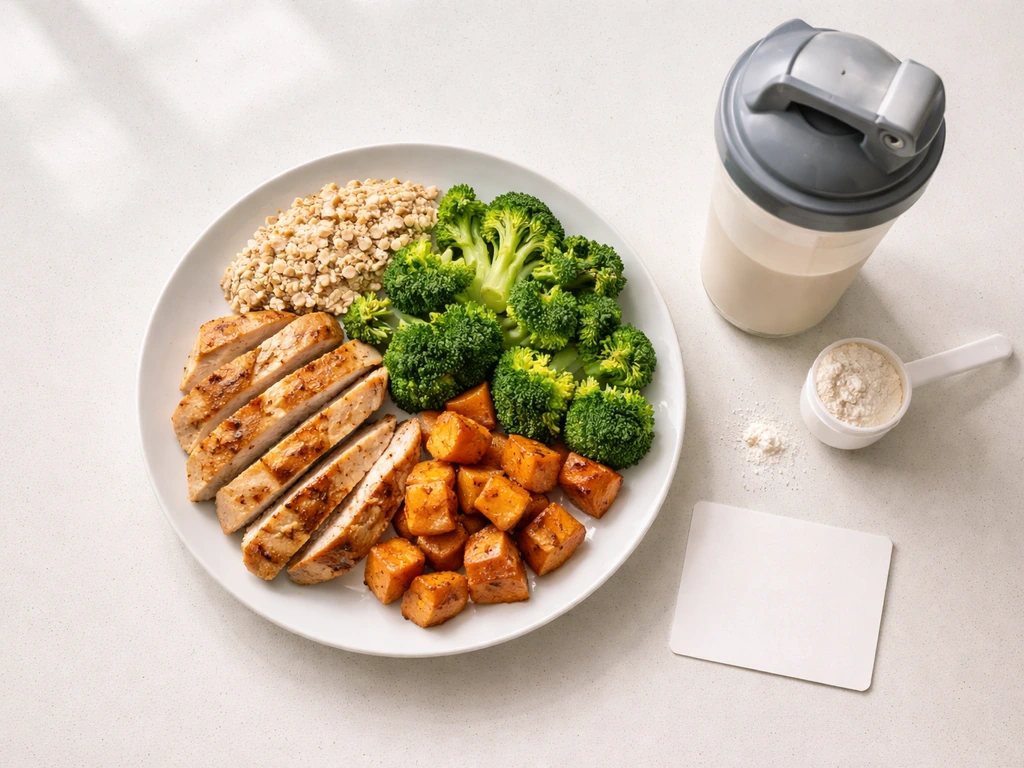
This is where a lot of people fall short. They train hard and then eat whatever, wondering why they are not growing. Here is what the research actually supports.
Protein: the non-negotiable
Protein is the raw material your body uses to build new muscle tissue. The research-backed target for most people actively trying to build muscle is around 1.6 to 2.2 grams of protein per kilogram of bodyweight per day. For a 75 kg (165 lb) person, that is roughly 120 to 165 grams of protein daily. Hitting this consistently matters more than the exact timing of when you eat it. Studies comparing pre-workout versus post-workout protein intake show similar muscular adaptation outcomes, which means your total daily intake is the priority, not stressing over a 30-minute window after your last set.
Calories: you need enough to build
You can build some muscle in a slight caloric deficit, especially if you are new to training or returning after a break. But for maximizing hypertrophy, a small caloric surplus of roughly 200 to 400 calories above maintenance gives your body the energy and substrate it needs to build new tissue efficiently. Eating well below your maintenance calories while trying to add muscle is fighting an uphill battle, your body prioritizes survival over growth when energy is scarce.
Carbohydrates: not the star, but still important
Carbohydrates fuel your training sessions by replenishing muscle glycogen, which is your muscles' preferred energy source during resistance training. The ISSN nutrient timing position stand notes that carbohydrate intake around resistance training can help reduce muscle damage and support recovery. The evidence for specific carb timing windows is mixed, but getting adequate total carbohydrates throughout the day supports training quality, which in turn supports hypertrophy. Think of carbs as the fuel that lets you actually execute the progressive overload your muscles need.
Recovery: the part most people underestimate

You do not grow during the workout. You grow during recovery. The training session creates the signal; sleep, rest, and managed stress are when your body actually acts on it. Neglect recovery and you will stall out, or worse, dig yourself into a hole that takes weeks to climb out of.
Sleep
Most of your muscle protein synthesis and hormonal support for growth (testosterone, growth hormone) peaks during deep sleep. Low testosterone can make it harder to build muscle, but you can still grow by training for hypertrophy and nailing protein, calories, and recovery. Seven to nine hours per night is not a suggestion for athletes, it is a physiological requirement. Consistently sleeping less than six hours impairs recovery, elevates cortisol, and blunts the anabolic response to training. If you are training hard and sleeping five hours, you are working against yourself.
Rest days and avoiding overtraining
Rest days are not laziness. They are when adaptation happens. Research on overreaching and overtraining syndrome shows that when training stress consistently outpaces recovery capacity, performance actually decreases and you can experience prolonged fatigue, hormonal dysfunction, and a general inability to make progress. Nonfunctional overreaching can take weeks to months to resolve. The fix is straightforward: build in at least one or two rest days per week, and consider a planned deload (reducing your training volume by roughly 50 to 75% for a week) every six to eight weeks if you are training hard.
Stress and consistency
Chronic psychological stress elevates cortisol, which is catabolic and competes directly with muscle-building processes. You cannot completely eliminate life stress, but you can protect your sleep, manage training load intelligently, and build in recovery practices that work for you. Consistency over months matters far more than any single perfect week. Missing one workout is irrelevant. Missing workouts every week for months because you burned out is not.
How long before you actually see results
This is the question everyone really wants answered, and the honest answer is: sooner than most people think for strength, and a little longer for visible size.
| Timeframe | What Typically Happens |
|---|---|
| Weeks 1 to 2 | Strength increases from neural adaptations (your brain learns to recruit muscle fibers more efficiently). Not much visible size change yet. |
| Weeks 3 to 4 | Measurable hypertrophy begins. Studies using ultrasound show significant muscle cross-sectional area increases around this point. |
| Weeks 4 to 10 | Visible changes start becoming apparent, especially in people new to resistance training. Muscle thickness measurably increases. |
| Months 3 to 6 | Clear, noticeable changes in muscle size and body composition. Strength gains compound. Older adults may benefit from extending this window to 24 weeks for meaningful muscle quantity and quality changes. |
| 6 months and beyond | Progressive gains continue with consistent training, adequate protein, and smart programming. Rate of gain slows compared to beginner phase. |
The early strength gains you feel in the first couple of weeks are real, but they are mostly neurological, your nervous system getting better at coordinating the muscles you already have. Structural hypertrophy, the actual physical enlargement of muscle fibers, becomes significant around weeks three to four based on imaging studies. The visible changes most people are after typically become clear by weeks eight to twelve, assuming training, protein, and recovery are all dialed in.
What to track so you know it's working
The scale alone is a poor measure of hypertrophy because your weight can fluctuate based on water, food volume, and glycogen. Track these instead:
- Strength on key lifts: if your squat, deadlift, bench press, or row numbers are going up over weeks and months, progressive overload is happening and hypertrophy likely follows.
- Tape measurements: measure your chest, arms, thighs, and waist every three to four weeks. Growing circumference in targeted areas alongside stable or decreasing waist is a strong hypertrophy signal.
- Progress photos: taken in consistent lighting and posture every four weeks. Visual changes are often easier to see in photos than in the mirror.
- How your clothes fit: a practical and underrated metric. Shirts getting tighter in the shoulders and arms while staying the same in the waist is a good sign.
- Training log: tracking your sets, reps, and weights week to week confirms whether progressive overload is actually happening.
Common myths worth addressing directly
You do not need to be sore after every workout to be growing. Soreness (delayed onset muscle soreness) reflects novelty and tissue disruption, not necessarily growth stimulus. As you get more trained, soreness decreases even as hypertrophy continues. Chasing soreness is not a useful proxy for effective training.
Age is not a barrier, it is context. Yes, testosterone levels and anabolic hormone responses differ with age. But research in older adults consistently shows that resistance training drives meaningful hypertrophy well into your sixties, seventies, and beyond. Older adults may need longer intervention periods (24 weeks versus 12 is a recommendation from some trials), slightly more attention to protein intake, and smarter recovery management. But the fundamental physiology of muscle growth still works. You can grow muscle at 60 or 70.
You do not need a gym or a barbell. You can apply the same principles with dumbbells to train with progressive overload and build real muscle. The principles covered in this article apply to calisthenics, resistance band training, and dumbbell-only programs just as much as barbell-focused lifting. The tool matters far less than whether you are applying progressive overload, sufficient volume, and adequate proximity to failure.
A simple starting point you can use today
If you are just starting out or trying to restart, here is a practical baseline you can act on immediately:
- Train all major muscle groups at least twice per week using compound movements (squats, hinges, presses, rows, carries). Three days per week is a solid beginner frequency.
- Do three to four working sets per exercise, taken within two to four reps of failure. Start conservatively and add weight or reps each week.
- Hit your protein target daily: 1.6 to 2.2 grams per kilogram of bodyweight. Spread it across three to four meals. Prioritize whole food sources like eggs, chicken, fish, beef, dairy, and legumes.
- Eat enough total calories to support your training. If you are not gaining any weight or strength after four weeks, eat a bit more.
- Sleep seven to nine hours per night. This is not optional if growth is the goal.
- Track your lifts every session. If you are not getting stronger over weeks, something in the training, nutrition, or recovery equation needs to change.
- Plan a deload week every six to eight weeks if you are training hard: cut your volume roughly in half for one week, then ramp back up.
That is the whole framework. It is not complicated, but it does require consistency across all three pillars: training, nutrition, and recovery. Get any one of them badly wrong and the other two cannot fully compensate. Get all three pointed in the right direction and the research, and the results people actually achieve, are clear: yes, you can grow from working out.
FAQ
How many days per week should I work out if my goal is muscle growth?
A common starting point is 3 to 4 resistance training days per week, so each major muscle group gets trained at least twice weekly. If you do full-body sessions, 3 days can work well, but you still need enough total hard sets per muscle group each week. If recovery is poor, drop frequency slightly but keep overall weekly volume in a workable range.
What if I am not gaining muscle size after 4 to 8 weeks?
First confirm you are meeting the inputs together, training stimulus plus protein plus recovery. The most common issue is underdosing volume (too few hard sets) or too much “easy” effort (too far from failure each set). Also check that you are in at least a modest surplus if you are not gaining weight, and that sleep is consistent, not just occasional long nights.
Do I need to track my progress with measurements, or is the mirror enough?
Use at least one objective method, such as monthly photos in the same lighting plus tracking waist and key muscle measurements, like upper arm and chest. Scale weight can be misleading due to water and glycogen shifts, so look for trends over 2 to 4 weeks rather than day-to-day changes.
Is it possible to grow muscle while dieting or cutting calories hard?
You can gain some muscle in a deficit, especially as a beginner or after time off, but maximizing hypertrophy usually requires a small surplus or maintenance calories. If the deficit is aggressive and training quality drops, you may notice strength stagnation and minimal visible size change. A practical approach is to cut more slowly if your main goal is growth.
How close to failure is “close enough” without getting stuck in fatigue?
A practical rule is to stop 2 to 4 reps short of failure on most sets for hypertrophy. If you are recovering poorly, reduce the number of near-failure sets rather than forcing every set close to failure. Over time, you can keep 1 to 2 “hardest” sets per exercise truly challenging and leave the others with more reps in reserve.
Should I train to soreness to know it is working?
No. Soreness can happen from novel movements or high tissue disruption, and it often decreases as you adapt. Focus on performance and stimulus, for example progressing reps, load, or total sets while staying close to failure. If you are consistently missing workouts due to soreness, your intensity or volume is probably too high for your recovery capacity.
What should I do if I can only train with machines, or only with free weights?
You can build muscle with either, as long as you can progressively overload the muscles you target. With machines, progress by increasing load and reps within the rep range you use, and keep consistent technique. With free weights, progression might be slower due to balance and stabilization demands, so use a rep scheme that lets you add reps first, then load.
Does cardio reduce muscle growth?
Cardio is not automatically harmful, but too much high-intensity endurance work can interfere with recovery and limit your ability to do enough hard sets. If muscle growth is the priority, keep cardio volume moderate and mostly low to moderate intensity, and schedule it so it does not consistently wipe out your strength training performance.
How much protein is enough if I am smaller or very lean, or if I am gaining weight easily?
The article’s range is a useful target, but consider your intake consistency and total calories. If you are under-eating, bump protein while bringing calories up gradually. If you are gaining fat too quickly, reduce the surplus slightly but keep protein steady and prioritize recovery so training stimulus stays high.
Do I need carbs to grow, or can I do low-carb and still build muscle?
Carbs can make training easier by refilling glycogen, which often improves session performance and consistency with progressive overload. You can still build muscle on lower-carb diets, but you may need to experiment to find a carbohydrate amount that preserves strength and volume. The key is that total energy intake supports your goals and training performance does not collapse.
Should I take protein before or after workouts for best results?
You do not need a precise post-workout window for hypertrophy to happen. What matters most is daily protein total and hitting your training and recovery. If you want a simple tactic, distribute protein across 3 to 4 meals, and include a serving within a few hours of training to make daily targets easier.
How often should I do a deload if I feel run down?
A planned deload often helps every 6 to 8 weeks for people training hard, but use your body as the guide. If performance drops for more than 1 to 2 weeks, soreness is unusually high, or motivation and sleep degrade, a deload sooner can prevent a longer recovery spiral. Deload by reducing volume roughly 50 to 75% for about a week while keeping movement patterns consistent.
Can you grow muscle with bodyweight alone?
Yes, but only if you can progressively increase difficulty over time, such as adding reps, slower tempos, harder variations, or external loading. If you can do high-rep versions easily, you likely need a harder progression to maintain mechanical tension close to failure. Map bodyweight progress to the same principles of volume and proximity to failure used for weights.
How long until visible muscle size changes, and why does it vary?
Strength can improve in 2 to 4 weeks due to nervous system adaptation, but visible size usually takes longer. Differences usually come from total weekly volume tolerance, how close sets get to failure, calorie and protein adequacy, and recovery quality like sleep consistency. If you are not gaining at least some strength over time, size gains will be unlikely.