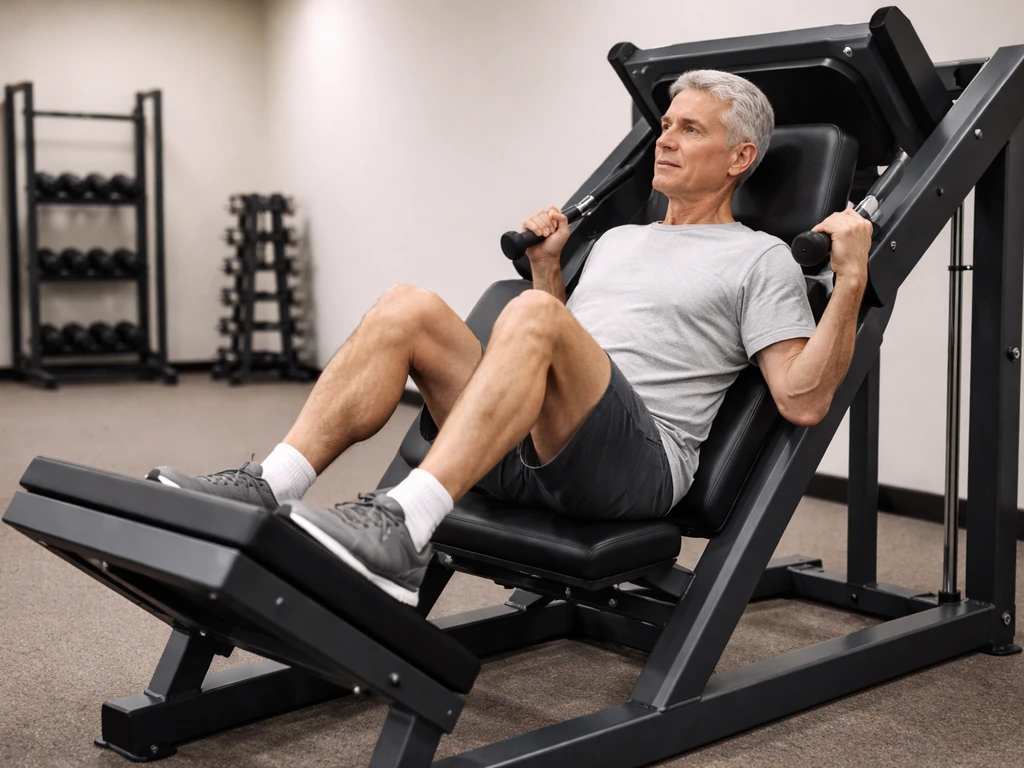
Yes, you can absolutely build muscle with light weights. The key is not how heavy the load is, but how much effective stimulus you create. Research consistently shows that loads as low as 30 to 60 percent of your one-rep max can drive meaningful hypertrophy when you push sets close enough to failure, hit sufficient weekly volume, and eat to support growth. A systematic review and meta-analysis similarly found that when volume is matched, training to failure versus non-failure produces only small or uncertain pooled hypertrophy differences, supporting the idea that proximity to failure matters more when load and stimulus per rep are low blank" rel="noopener noreferrer">small or uncertain pooled hypertrophy differences when volume is matched. Heavy weights are not a prerequisite for muscle adaptation. Effort, volume, and consistency are.
Can You Grow Muscle With Light Weights? How To


How your muscles actually respond to light loads

Muscle growth, or hypertrophy, is driven primarily by mechanical tension. When muscle fibers are forced to generate force under load, especially as they fatigue, they receive a signal to repair and grow slightly larger. This signal does not care whether the load is 20 kg or 100 kg. What it cares about is whether enough fibers are being recruited and stressed. That is where proximity to failure becomes critical when you are using light weights.
Here is the physiological logic: when a load is light, your nervous system initially only recruits your smaller, lower-threshold motor units. But as those fibers fatigue over a longer set, your body has no choice but to bring in the larger, higher-threshold fibers to keep the movement going. By the time you are 3 to 5 reps from failure on a high-rep set, a large portion of your muscle fibers are working hard. That is the effective stimulus window. Stopping the set at 10 reps when you had 15 left? You have mostly just tired your slow-twitch fibers without giving the growth-driving fibers much to do.
Metabolic stress also plays a supporting role with lighter loads. The buildup of metabolites like lactate and hydrogen ions during long, hard sets contributes to the hypertrophy signal, which is why that burning sensation at the end of a high-rep set is not just suffering for suffering's sake. It is part of the mechanism. But mechanical tension at or near failure is still the primary driver, so do not confuse burning with building.
A 2017 meta-analysis comparing low-load (defined as 60 percent of 1RM or less) versus high-load training found that when sets are taken to momentary muscular failure, hypertrophy outcomes are comparable across the loading spectrum. A later 2023 systematic review reinforced this, finding no clear advantage of heavy loads over light ones when other training variables were appropriately managed. A 2023 systematic review and meta-analysis similarly found no overall hypertrophy advantage for training closer to failure versus not necessarily to failure when other factors like volume load were appropriately handled A later 2023 systematic review reinforced this, finding no clear advantage of heavy loads over light ones when other training variables were appropriately managed.. The science is settled enough on this: load range matters less than whether you are actually training hard enough.
How to set up your training for light-weight hypertrophy
The structure of your training matters more when weights are light because you need volume and effort to compensate for lower per-rep mechanical stimulus. Here is how to organize it.
Rep ranges and sets
With light weights, you will naturally land in the 15 to 30 rep range per set, and that is fine. Aim to end each set within 1 to 3 reps of failure, sometimes hitting true failure on your last set for a given exercise. For weekly volume, target 10 to 20 hard sets per muscle group per week. Beginners can start at the lower end (10 to 12 sets) and build from there. More experienced trainees may need to push toward 15 to 20 sets to keep progress moving.
Training frequency

Training each muscle group 2 to 3 times per week is generally optimal for hypertrophy. With lighter weights, muscle soreness tends to clear faster, which can make higher frequencies (3 times per week) more manageable. A simple full-body routine three days per week works well, as does an upper/lower split four days per week. Both allow enough frequency and recovery.
Tempo and time under tension
Slow your reps down deliberately. A 3-second lowering phase (eccentric) followed by a 1-second pause and a controlled 1 to 2 second lifting phase dramatically increases time under tension and makes a light weight feel genuinely hard. This is not just a trick: the eccentric phase under load is one of the most potent hypertrophy signals you have, and slowing it down maximizes its effect. A tempo like 3-1-2 (3 seconds down, 1 second hold, 2 seconds up) on exercises like squats, rows, and presses is a practical starting point.
Exercise selection
Choose exercises that put the target muscle under tension throughout a full range of motion. For light-weight training, this matters more than it does with heavy compound lifts where the sheer load creates stimulus regardless. Exercises like Romanian deadlifts, incline dumbbell curls, cable flyes, Bulgarian split squats, and lat pulldowns all create excellent stretch-mediated tension and work well with moderate to light loads. Avoid exercises where the muscle is only loaded in a shortened position, like standard concentration curls at the top of the movement, when load is already limited.
Progressive overload when you can't just add more weight

Progressive overload is non-negotiable for long-term muscle growth. If you are always doing the same thing, your body adapts and stops responding. The good news is that overload does not require adding plates. Here are the methods that actually work when weight is capped or limited.
- Add reps: If you did 3 sets of 15 this week, aim for 3 sets of 17 or 18 next week with the same weight. More reps under the same load is a direct form of progressive overload.
- Add sets: Increase weekly volume by adding a set per exercise over time. Going from 3 sets to 4 sets of a movement adds roughly 33 percent more volume for that muscle.
- Decrease rest periods: Shortening rest from 2 minutes to 90 seconds increases the metabolic demand and makes the same workload harder.
- Slow the tempo: Add a second to your eccentric, introduce a pause at the bottom of the movement, or slow the concentric. This increases time under tension without changing the load.
- Change leverage or angle: Elevating your feet in a push-up, switching from a flat to an incline, or using a longer limb position increases how hard the muscle works even with the same external load.
- Improve technique: Achieving a deeper range of motion with better muscle activation is a real form of progression. A squat with better depth and braced core at the same weight is a harder set for the target muscles.
- Use intensity techniques: Rest-pause sets, drop sets, and slow negatives extend the effective stimulus of a light-weight set without needing heavier dumbbells.
- Scale weight when possible: Even if you are constrained to light weights, small incremental increases (0.5 to 1 kg) whenever possible should still happen. Never leave a weight increase on the table if you can do it with good form.
Track your sets, reps, and tempo in a simple log. If those numbers are not improving over weeks, your training is not progressing, and that is the first thing to fix before adjusting diet or anything else.
How to know your light-weight training is actually working
Soreness is not the signal to chase. You can be sore without growing and growing without being sore. What actually tells you the stimulus is working is a combination of effort, performance, and body composition changes over time. If your testosterone is low, you can still build muscle with the same light-load principles, but it is especially important to train close to failure and address the hormone issue with a clinician low testosterone and muscle growth.
- Effort level: Each working set should feel genuinely hard. If you are finishing sets and could comfortably do 6 to 8 more reps, you are leaving too much in the tank. Your last set of each exercise should be a real struggle to complete.
- Proximity to failure: Aim to end most sets 1 to 3 reps shy of failure. On your final set of an exercise, going to or very close to true failure ensures you are recruiting enough high-threshold fibers.
- Rep and volume progression: Your training log should show you doing more reps, sets, or harder variations over weeks and months. If it does not, something in your training or recovery needs adjusting.
- Performance between sessions: If you are recovering well and training enough, you should feel slightly stronger or more capable on the same exercises over a 4 to 8 week window.
- Body composition over 8 to 12 weeks: Muscle growth is slow. Expect visible or measurable changes over 2 to 3 months, not 2 to 3 weeks. Take monthly progress photos and track tape measurements at the chest, arms, thighs, and waist.
The most common mistake is training too comfortably and then assuming light weights do not work. They work. But only if you push. If you finish every session feeling fresh and easy, you have not done enough to trigger adaptation.
Nutrition and recovery to make the stimulus stick
Training creates the signal for muscle growth. Nutrition and recovery are what let your body act on that signal. Get this wrong and even a perfect training program will stall.
Protein
Protein is the structural material for muscle repair and growth. Aim for 1.6 to 2.2 grams of protein per kilogram of bodyweight per day. For a 75 kg person, that is roughly 120 to 165 grams of protein daily. Spreading intake across 3 to 4 meals of 30 to 50 grams each maximizes muscle protein synthesis throughout the day. Leucine-rich sources like chicken, eggs, Greek yogurt, cottage cheese, fish, and whey protein are particularly effective.
Calories
You need to be eating at or slightly above your maintenance calories to support muscle growth. A modest surplus of 200 to 300 calories per day above maintenance is usually enough to drive gains without excessive fat accumulation. If you are significantly underweight or returning from a break, a more aggressive surplus may be appropriate short-term. For older adults or those with slower metabolisms, staying closer to maintenance with high protein is often the smarter strategy.
Carbohydrates
Carbohydrates fuel your working sets and support recovery. Higher-rep light-weight training actually burns more glycogen per session than heavy low-rep training because of the longer time under tension. Make sure you are eating enough carbohydrates (think oats, rice, potatoes, fruit) to feel energized in sessions. Eating carbohydrates within a couple of hours post-training helps restore muscle glycogen and supports the recovery process.
Supplementation
Most supplements are unnecessary. The one worth taking seriously is creatine monohydrate, 3 to 5 grams daily. Creatine is the most well-researched muscle-building supplement available, and it is particularly useful for higher-rep training because it replenishes phosphocreatine stores between sets, letting you squeeze out more quality reps. It works regardless of whether you are using light or heavy loads. A protein powder like whey is useful if hitting protein targets from food alone is difficult, but it is not magic.
Sleep and recovery
Most of your muscle repair happens during sleep. Aim for 7 to 9 hours per night consistently. Growth hormone secretion peaks during deep sleep, and protein synthesis from a training session stays elevated for 24 to 48 hours post-workout. Cutting sleep short cuts that recovery window. If life makes this hard, protect even one consistent habit: a fixed wake time. Better sleep architecture follows from that alone over time.
Who light-weight training is best for (and where people go wrong)
Light-weight hypertrophy training is not a compromise. It is a genuinely effective strategy that suits certain people particularly well.
Beginners
If you are new to lifting, almost any load will trigger muscle growth because your body is highly sensitive to the novel stimulus. Light weights let you learn movement patterns safely and build connective tissue tolerance before adding heavy loads. The key for beginners is to actually challenge yourself within that light load, not use it as a reason to coast. Progression matters even more in the early weeks because the returns are fastest then.
Older adults
Older adults often have joint sensitivities, lower bone density concerns, or prior injuries that make heavy loading impractical or risky. Light-weight, higher-rep training is genuinely well-suited here and still drives meaningful hypertrophy and functional strength improvements. Research shows that muscle can grow in your 60s, 70s, and beyond with consistent training. The physiology responds, it just does so a little more slowly, which makes consistency even more critical than in younger people.
Anyone training around an injury
If a heavier load causes pain in a joint or aggravates a tendon, dropping to a lighter load and increasing reps is a smart way to maintain training stimulus without aggravating the injury. This is not the same as avoiding training. It is managing it intelligently.
Common pitfalls to avoid
- Stopping sets too far from failure: The most common reason light-weight training fails. If you stop at 15 reps because it is the number you had in mind, but you had 10 more in the tank, you have done very little for hypertrophy.
- Using light weights as an excuse to avoid hard work: Light weights are not easier training. They require just as much effort, just expressed over more reps.
- Underestimating total volume: Light-load training tends to need more sets to accumulate adequate stimulus. Doing 2 sets of 12 and calling it a workout is not enough.
- Poor exercise selection: Choosing movements where the target muscle is barely involved, or where the range of motion is restricted, wastes your sets. Choose exercises where you feel the muscle working throughout.
- Neglecting nutrition: Training hard without eating enough protein or calories means you are breaking tissue down without giving your body the tools to rebuild it. No training approach, light or heavy, overcomes a protein deficit.
A practical starting point
If you want a simple framework to get started today, here is one that works. Train 3 days per week, full body. For each session, pick 4 to 6 exercises covering your major muscle groups (push, pull, hinge, squat pattern). Do 3 to 4 sets per exercise. Use a weight where you reach 15 to 25 reps before failure, and end each set 1 to 2 reps shy of true failure on your first two sets, then go to or very close to failure on the last set. Resistance bands can be a practical way to train to near failure, which is the key to stimulating muscle growth. Use a 3-second lowering phase on every rep. Rest 90 seconds to 2 minutes between sets. Every week, try to do at least one more rep per set across the board, or add a set to one exercise. Eat 1.6 to 2 grams of protein per kilogram of bodyweight daily, eat enough to support energy and slight weight gain, and sleep 7 to 9 hours. If you do this consistently for 12 weeks and track your progress, you will see real muscle growth.
| Variable | Light-Weight Hypertrophy Target |
|---|---|
| Load | 30 to 60% of 1RM (working to near failure) |
| Reps per set | 15 to 30 |
| Sets per muscle per week | 10 to 20 hard sets |
| Training frequency | 2 to 3 times per week per muscle group |
| Proximity to failure | 1 to 3 reps in reserve; last set at or near failure |
| Tempo | 3 seconds eccentric, 1 second pause, 1 to 2 seconds concentric |
| Protein intake | 1.6 to 2.2 g per kg bodyweight per day |
| Calorie target | Maintenance plus 200 to 300 calories |
| Sleep | 7 to 9 hours per night |
| Creatine | 3 to 5 g daily (optional but evidence-backed) |
Light weights work. And if you’re consistent about pushing close to failure, you can grow by working out even with lighter loads Light weights work. The physiology is clear, the research supports it, and plenty of people have built strong, well-developed physiques without ever touching a heavy barbell. If your goal is can you grow muscle with calisthenics, you are making the same bet on stimulus, effort, and progression without needing heavy barbells never touching a heavy barbell. What they did not do is train lazily. They trained hard, tracked progress, ate well, and recovered properly. That combination is what actually builds muscle, regardless of the load on the bar.
FAQ
How light is “light weight” for muscle growth, and how do I know my load is in range?
A practical target is roughly 30 to 60% of your one-rep max (or a weight that lets you reach about 15 to 30 reps per set). The real check is effort, you should be ending most sets 1 to 3 reps from failure, with the last set going to or very near failure.
What if I can’t reach 1 to 3 reps from failure because my form breaks down?
Use a form-friendly variation or shorten the range to a pain-free, stable setup, then rebuild range over time. You can also switch to an exercise that keeps the target muscle under tension longer, like cable or machine versions, so the last reps are challenging without turning the set into sloppy reps.
Is training to true failure necessary with light weights?
Not every set. A good approach is leaving 1 to 2 reps in reserve for most sets early in the workout, then going to or very near failure on the final set for an exercise. Reserve failure for later sets, and limit it across your week to avoid excessive fatigue.
How do I progress if I’m already doing 25 to 30 reps and can’t add more reps?
Use one of the overload levers that does not require heavier plates: add a set, increase tempo (more controlled eccentric and pauses), reduce rest time slightly, increase range of motion, or use a harder variation (for example incline angle changes, longer lever for rows, or more tension in cable flys).
Will I grow muscle if I’m not very sore afterward?
Yes. Soreness is not a reliable indicator of hypertrophy. Track performance (reps or sets with the same tempo), and body changes over 4 to 8 weeks. If effort is high and volume is adequate, muscle can still grow even with minimal soreness.
How much weekly volume is enough when using light weights?
A useful starting point is 10 to 20 hard sets per muscle group per week. If progress stalls for 2 to 4 weeks, add sets gradually (for example +2 sets/week for the lagging muscle) or improve how close you get to failure, rather than increasing weight.
Does slowing down the reps work for everyone, or is there a limit?
Slower tempos can increase effective stimulus, especially when loads are light. However, extremely long eccentrics can reduce total reps and recovery. If performance collapses, shorten the tempo to a manageable eccentric (around 2 to 3 seconds) while keeping the set close to failure.
What should rest times look like for light-weight hypertrophy?
A common effective range is 90 seconds to 2 minutes between sets. If you rest much longer, you may feel better but lose some of the metabolic burn and pacing needed to reach near failure. If you rest too little and reps tank early, you may not get enough high-quality work close to failure.
Do bands work the same as light weights for building muscle?
They can, if resistance and tension allow you to reach near failure in the target rep range. Because bands can get easier at certain joint angles, choose setups that keep tension high throughout the full range, and monitor effort so the last reps still require major effort.
How should beginners apply this without overdoing it?
Start with the lower end of weekly volume (about 10 to 12 hard sets per muscle group), keep most sets at about 1 to 2 reps in reserve, then progress volume or reps each week. If you recover poorly, reduce the number of near-failure sets rather than stopping training.
Can light-weight training build strength, or is it only for aesthetics?
It can build strength too, but it may feel more “endurance-like” because higher reps are common. If you want more strength carryover, use slightly lower reps within the light-load range (for example 10 to 15), maintain near-failure effort, and keep technique crisp.
If I’m injured or dealing with joint pain, when should I use lighter weights vs skipping an exercise entirely?
Lighter weights are a smart adjustment when pain is reduced and you can still train close to failure with good control. If pain changes your movement pattern, worsens during sets, or lingers and escalates day to day, switch exercises or consult a clinician rather than forcing the load-rep scheme.