Yes, your waist can get slightly larger when you gain muscle, but in most cases the increase is temporary and driven by water retention, glycogen storage, food volume, or posture changes, not actual fat gain. A small, lasting waist increase from muscle growth in the core and obliques is also possible, though rarely dramatic. The real question is whether your waist is growing because of lean mass and normal physiological noise, or because you're gaining more fat than muscle. Those two scenarios call for completely different responses, and this guide will help you figure out exactly which one is happening.
Does Your Waist Grow When You Gain Muscle? How to Tell

Marcus Kellerman
29 Apr 2026

Why your waist might increase during muscle gain
When you start a serious muscle-building program, your body goes through a lot of changes that have nothing to do with fat. The most common reason for an early waist increase is that you're eating more food. A bigger training volume means more calories, more carbohydrates, and often more sodium. All three can temporarily increase abdominal girth by a measurable amount, sometimes an inch or more, without a single gram of new fat being stored.
Muscle growth itself can also add width to the midsection if you're training your core heavily. Your transverse abdominis, obliques, and erector spinae all sit around your waist. Heavy compound lifts like squats, deadlifts, and overhead presses require substantial core bracing, and over months of progressive overload, those muscles genuinely thicken. Because those deeper core muscles are also part of how your body grows muscle over time, consistent training can make your midsection measure a bit higher even without fat gain core bracing. For most people this is modest, but for beginners doing a lot of core work, it can add a centimeter or two to the tape measure even as body fat stays flat.
There's also a posture effect that gets overlooked. Many beginners start lifting with an anterior pelvic tilt, which pushes the lower abdomen forward and inflates waist measurements without any change in tissue composition. As you get stronger and your hip flexors and lower back adapt, posture often improves and that false measurement bump disappears.
Lean mass vs fat gain: how to tell what's actually happening
The clearest signal is your strength trend. If your waist is up half an inch but your squat, deadlift, or bench have gone up over the last four to six weeks, that waist change is almost certainly driven by muscle, glycogen, and water, not fat. Strength doesn't trend upward when you're gaining meaningful fat without building muscle.
Body weight rate of gain matters too. In a well-structured muscle-building phase, a natural lifter should be gaining roughly 0.25 to 0.5 percent of body weight per week. For a 180-pound person, that's about 0.5 to 1 pound per week. If you're gaining faster than that, some of the excess is likely fat, and a growing waist starts to make more sense as a fat signal rather than a lean-mass signal.
Your waist-to-height ratio is a useful reference point. A ratio below 0.5 is generally considered a low-risk range. If your height is 70 inches, you'd want your waist under 35 inches. Tracking this number over time gives you a better health-relevant signal than obsessing over weekly tape-measure changes.
| Signal | Points to lean mass/water | Points to fat gain |
|---|---|---|
| Strength trend | Going up over 4-6 weeks | Flat or declining |
| Rate of weight gain | 0.25-0.5% of bodyweight/week | More than 1% of bodyweight/week consistently |
| Waist change timing | Fluctuates day to day, higher after meals/weekends | Slowly and steadily climbing week over week |
| How clothes fit | Waist up but shoulders, arms, legs fitting tighter too | Waist and belly only getting tighter |
| Mirror/visual check | More muscle definition visible elsewhere | Soft look increasing across the midsection |
| Energy levels | Maintained or improved | Sluggish, particularly after meals |
What's actually driving waist changes: water, glycogen, digestion, and posture
Water retention

Sodium intake has a direct effect on how much water your body holds, and higher-calorie eating phases almost always come with more sodium. Even without eating junk food, the simple act of eating more whole food means more natural sodium, and your kidneys temporarily hold more water to maintain fluid balance. This can add a noticeable puffiness to the midsection that shows up on the tape measure but fades within a day or two when intake normalizes. Sodium is not the villain here, but it is a variable worth being aware of.
Glycogen storage
Every gram of glycogen stored in muscle tissue holds roughly 3 grams of water alongside it. When you increase your carbohydrate intake to fuel harder training, your muscles and liver fill up with glycogen. This is physiologically desirable. It makes you stronger and more explosive. But it also adds intramuscular fluid volume, which means your body looks and measures slightly larger. For someone coming from a low-carb background who starts a proper muscle-building diet, the first two to three weeks can involve meaningful waist increases purely from glycogen supercompensation.
Gut volume and digestion
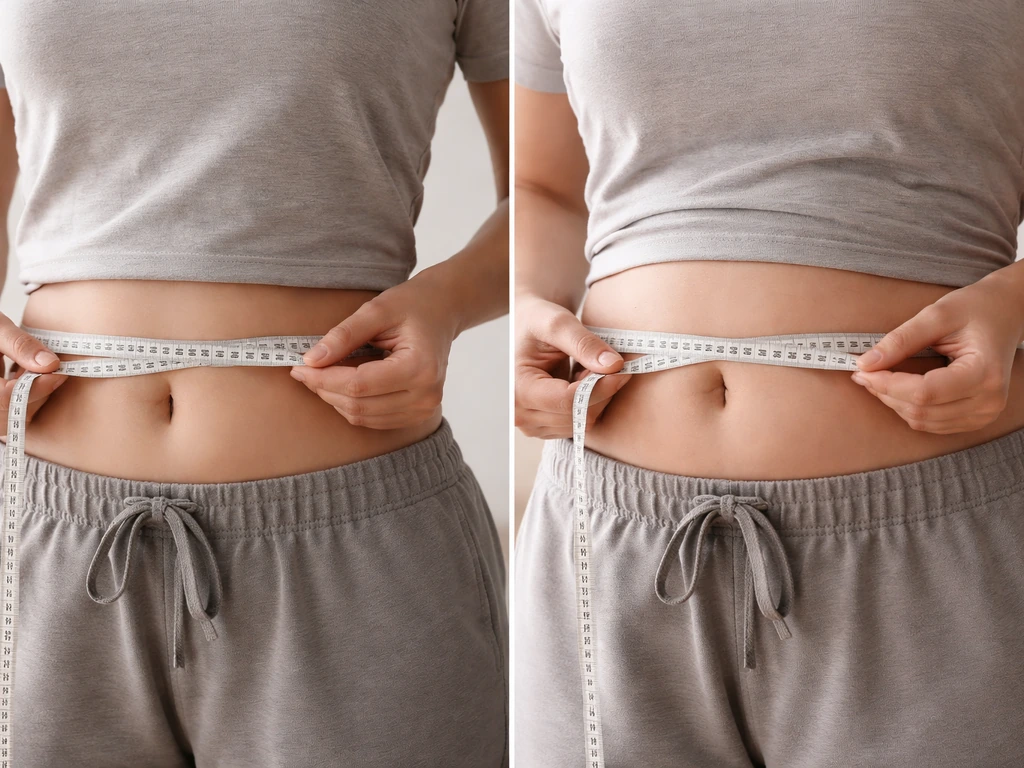
When you eat more total food to support muscle growth, your gut simply has more material in it at any given time. Measuring your waist after a big training day meal versus first thing in the morning can easily produce a one-to-two inch difference. Bowel habits also matter: research has linked chronic constipation with higher waist-circumference-based obesity metrics, so if your digestion is sluggish after increasing food volume, that alone can inflate your readings. Getting enough fiber and staying well hydrated usually resolves this quickly.
Posture and breathing
Most people measure their waist inconsistently. Measuring while holding a breath, after a big exhale, standing with a slight lean, or with the tape angled even slightly can produce differences of an inch or more. Posture changes during a training program, both structural and habitual, also affect where the tape sits and how the abdomen presents. This is not a minor detail.
How to measure correctly and track progress without panic

blank" rel="noopener noreferrer">The standard protocol recommended by the WHO is to measure at the midpoint between the bottom of your lowest rib and the top of your hip bone (iliac crest), with the tape held horizontally and parallel to the floor. Measuring at the belly button is a common alternative (used in studies like the Framingham Heart Study), but it can run slightly larger in people carrying more abdominal fat because the navel migrates downward. For waist circumference, one recommended approach is to measure at the midpoint between the lowest rib and the iliac crest, as compared with alternatives like the superior border of the iliac crest. Pick one site and stick with it every single time.
- Measure first thing in the morning, before eating or drinking anything
- Use the toilet first so gut volume is as low as possible
- Stand relaxed with feet together, not sucking in or pushing out
- Exhale normally and take the measurement at the end of a normal breath, not a forced exhale
- Keep the tape snug but not compressing the skin
- Measure at least twice and average the readings
- Record the number and date, and only compare measurements taken under the same conditions
Don't measure every day. Weekly measurements generate too much noise and create unnecessary anxiety. Every two weeks is a reasonable cadence during a muscle-building phase. What you're looking for is a trend over eight to twelve weeks, not a single number. A waist that's up 0.5 inches in week two but back to baseline in week four is normal fluctuation. A waist that trends upward consistently over ten to twelve weeks while strength is flat is a signal worth acting on.
Nutrition adjustments to build muscle without gaining unwanted fat
The most common mistake in a muscle-building phase is eating too aggressively. A modest calorie surplus of around 200 to 300 calories per day above your maintenance level is enough to support meaningful muscle growth in most people, and it keeps fat gain minimal. Larger surpluses, the classic 'dirty bulk,' accelerate fat gain without proportionally accelerating muscle growth, because muscle protein synthesis has a physiological ceiling regardless of how many extra calories you throw at it.
Protein is the non-negotiable anchor of the diet. Aim for around 0.7 to 1 gram of protein per pound of body weight per day. This range supports maximum muscle protein synthesis while also being satiating, which naturally limits fat gain by keeping appetite in check. Whether you get that protein from whole food, whey protein, or a combination depends on preference, but the total daily target matters far more than timing or source.
Carbohydrate timing can help keep waist measurements from spiking unnecessarily. Concentrating the majority of your carbohydrates around your training window, before and after workouts, means glycogen gets stored directly in active muscle tissue rather than floating around driving water retention in non-target areas. It also improves training performance, which compounds into better muscle growth over time.
Fiber is worth paying specific attention to during a muscle-building phase. When you're eating more total food, digestive transit time can slow down, and that shows up on the tape measure. Aiming for at least 25 to 35 grams of fiber per day from vegetables, legumes, and whole grains keeps things moving and prevents gut-volume inflation from distorting your waist readings.
- Keep the calorie surplus modest: 200-300 calories above maintenance, not 500-1000
- Hit 0.7-1g of protein per pound of bodyweight daily
- Front-load carbohydrates around training sessions
- Aim for 25-35g of fiber per day to support gut health and reduce bloating
- Monitor sodium from processed foods if you're retaining visible water in the midsection
- Drink enough water (roughly half your bodyweight in ounces daily) to support kidney function and reduce water-retention spikes
Training and recovery for lean muscle growth
The training approach that best supports lean muscle gain without unnecessary fat accumulation is one built around progressive overload with compound movements and adequate, but not excessive, volume. You don't need to be in the gym six days a week with marathon sessions. Three to four sessions per week, each hitting major muscle groups with compound lifts progressed over time, builds muscle effectively while keeping caloric burn high and metabolic rate elevated.
Rep ranges between 6 and 20 all produce meaningful muscle growth when sets are taken close to technical failure. What matters more than the specific rep range is that you're consistently adding load, reps, or sets over weeks and months. This progressive overload is the primary driver of muscle growth, and it's also what distinguishes a muscle-driven waist change from a fat-driven one. If you're not progressing in your lifts, any waist increase you're seeing deserves closer scrutiny.
For older adults, recovery becomes a more significant variable. Muscle protein synthesis is still fully achievable at 50, 60, and beyond, but the window for recovery is often longer and the sensitivity to sleep and stress is higher. Prioritizing seven to nine hours of sleep per night, managing life stress where possible, and not programming more training volume than you can recover from all directly affect body composition. Chronically under-recovered muscles don't grow efficiently, and elevated cortisol from overtraining or poor sleep actively promotes fat storage in the midsection.
One myth worth killing here: spot reduction of waist fat through core exercises doesn't work. You can't train your obliques into burning the fat sitting over them. If you want to know whether ashwagandha can help you grow muscle, it is important to look at the evidence for strength and hypertrophy rather than relying on training myths core exercises don't work. Core training strengthens and slightly thickens the muscles underneath the fat, which can actually make the waist look slightly wider if body fat hasn't decreased. This is normal and not a reason to avoid core work, but it is a reason to understand that waist fat requires a systemic caloric deficit to reduce, not targeted ab exercises.
Another common myth: muscle turns to fat when you stop training. Muscle and fat are completely different tissue types and cannot convert into each other. What actually happens when someone stops training is that muscle mass slowly decreases through atrophy, and if caloric intake doesn't adjust downward to match the lower energy demands, fat accumulates. The waist grows because of caloric surplus and lost muscle mass, not because tissue transformed.
Beginners vs intermediates: the experience gap matters
Beginners are in a uniquely favorable position. In the first several months of consistent training, a beginner can build muscle and lose fat simultaneously, even in a slight caloric surplus, because the stimulus for muscle growth is so novel and powerful. This means a beginner's waist may actually shrink or stay flat even while body weight and muscle mass increase. If you're a beginner and your waist is growing meaningfully in the first few months, it's more likely a nutrition issue than a training response.
Intermediates and advanced lifters don't have that luxury to the same degree. Once you've been training consistently for a year or more, building muscle requires a genuine caloric surplus, and some fat gain during a building phase is essentially unavoidable. The goal becomes minimizing that fat gain through precise nutrition, not eliminating it entirely. Expecting your waist to stay completely flat during an effective intermediate muscle-building phase is unrealistic, and chasing that goal often means undereating, which just stalls muscle growth.
When to troubleshoot: red flags and a step-by-step fix
If your waist has been trending upward consistently for eight or more weeks and your strength hasn't improved, that's the clearest red flag that your surplus is too aggressive or your training isn't providing enough stimulus to direct those calories into muscle tissue. Here's how to work through it methodically.
- Audit your actual calorie intake for one week using a food tracking app. Most people significantly underestimate how much they're eating, especially on weekends and around training days.
- Compare your tracked intake to your estimated maintenance calories. If you're consistently more than 400-500 calories over maintenance, pull back to a 200-300 calorie surplus.
- Check your protein numbers. If you're under 0.7g per pound of bodyweight, increase protein first before cutting anything else. Higher protein is satiating and supports muscle growth simultaneously.
- Review your training logs. If you haven't added load, reps, or sets to your major lifts in the last four weeks, your program isn't providing enough progressive overload. Either add weight, add a rep, or add a set.
- Assess your sleep. If you're consistently getting under seven hours, cortisol is likely elevated and fat storage in the midsection is an expected physiological response. Sleep is not optional for lean muscle growth.
- Measure your waist under standardized conditions (morning, post-toilet, normal breath, same site) for two consecutive weeks. If it's still rising after the above adjustments, reduce your surplus by another 100-150 calories and retest in four weeks.
- If waist circumference continues to rise despite a controlled surplus, good protein intake, progressive training, and adequate sleep, consider getting a comprehensive bloodwork panel. Thyroid dysfunction, elevated cortisol, and hormonal imbalances can all drive central fat accumulation independent of diet and training behavior.
Realistic timeline expectations: in the first two to four weeks of a new muscle-building program, waist fluctuations of up to an inch in either direction are entirely normal and mostly reflect glycogen and water changes. By weeks six to eight, you should have a clearer signal. Over a twelve-week building phase done correctly, a natural lifter might see their waist stay flat, increase by half an inch, or even decrease slightly, depending on starting body composition and how precisely nutrition is managed. Major waist increases over that window, more than an inch or two with no corresponding strength gains, are a sign to troubleshoot, not a sign that muscle building is impossible.
The bottom line is this: some waist change during a muscle-building phase is expected, usually temporary, and often not fat at all. Track systematically, compare trends not single measurements, keep your surplus conservative, hit your protein target, and make sure your training is actually progressing. If you’re wondering, "does bcaa grow muscle," the answer is that BCAAs alone are not a substitute for adequate protein and training stimulus your protein target. Those four things solve the vast majority of unwanted waist growth during a building phase.
FAQ
How much waist gain is “normal” during a muscle-building phase?
Short-term swings are normal, especially in the first 2 to 4 weeks (up to about an inch up or down). A more actionable cutoff is consistent growth over 8 to 12 weeks without matching strength progress, where more than roughly 1 to 2 inches total suggests the surplus may be too aggressive or training stimulus is insufficient.
If my strength went up but my waist also increased, should I cut calories?
Not automatically. First verify measurement consistency (same time, same tape position, no breath-holding) and check weekly training load progression. If strength continues rising and body weight gain stays within about 0.25 to 0.5% per week, the increase is more likely water, glycogen, or muscle/core thickening.
What is the best way to tell whether waist changes are fat versus water or glycogen?
Look for how quickly the waist changes after diet and sodium/carbohydrate variations. Water and glycogen effects often shift readings within 24 to 72 hours, while fat gain is slower and persists week to week. Also compare photos or waist trend averages across multiple weeks, not a single daily measurement.
Should I measure my waist in the morning or after meals?
Pick one and stick to it. Morning, before a large meal and after using the bathroom, gives the most stable baseline. Measuring after a heavy training-day meal can inflate results by 1 to 2 inches, which can confuse your trend.
Does constipation or bloating make my waist measurements misleading?
Yes. If you notice digestive sluggishness after increasing food volume, your tape measurement can rise even without fat gain. Prioritize 25 to 35 grams of fiber daily and adequate hydration, then re-check using the same measurement protocol over the next 1 to 2 weeks.
Can training your abs make your waist look bigger even if I’m losing fat?
It can. Core thickness and stronger bracing can change the way the abdomen “fills out,” so your waist may rise slightly even when fat is stable or dropping. The deciding factor is body weight trend and circumferences over time, plus whether strength is improving.
How do I adjust my surplus if my waist is growing but strength is flat?
Make a small, reversible change first, reduce your intake by about 100 to 200 calories per day and keep protein the same. Reassess over 2 to 4 weeks using trend data. If strength still stalls, also check whether training volume and progression are adequate, not just calories.
What if my body weight is staying the same but my waist is going up?
That often means recomposition is not going your way (or measurement noise). Confirm that your tape method is consistent and that you are not seeing short-term bloating. If the waist trend continues for 8+ weeks with no strength gains, it can indicate a slightly higher effective surplus than you think, even if scale weight seems stable.
Do men and women differ in how much their waist may change from muscle gain?
The direction and size of change can be similar, but fat distribution patterns differ. Even with similar training, women may experience different water and bloating effects across the cycle, so averaging measurements across weeks and being consistent with timing becomes even more important.
Is it possible for my waist to shrink while I gain muscle?
Yes, especially for beginners. Early on, muscle can grow while fat decreases even during a slight surplus, so waist can stay flat or drop. In intermediates, some waist increase is more common, so a consistent shrink typically indicates your surplus is conservative or you are in near maintenance.
If I take creatine, will it make my waist bigger on the tape?
It can indirectly, because creatine increases intramuscular water, which can slightly change appearance and measurements. The key is the trend: creatine-related water changes are usually more stable after the initial loading period, whereas fat gain will keep accumulating over weeks.
Should I avoid core training if my waist measurement is creeping up?
Generally no. Core training supports bracing and performance, and it can thicken the muscles underneath the fat. Instead, determine whether the creep is temporary (water, glycogen, digestion) or persistent alongside stalled strength, then adjust nutrition and training accordingly.