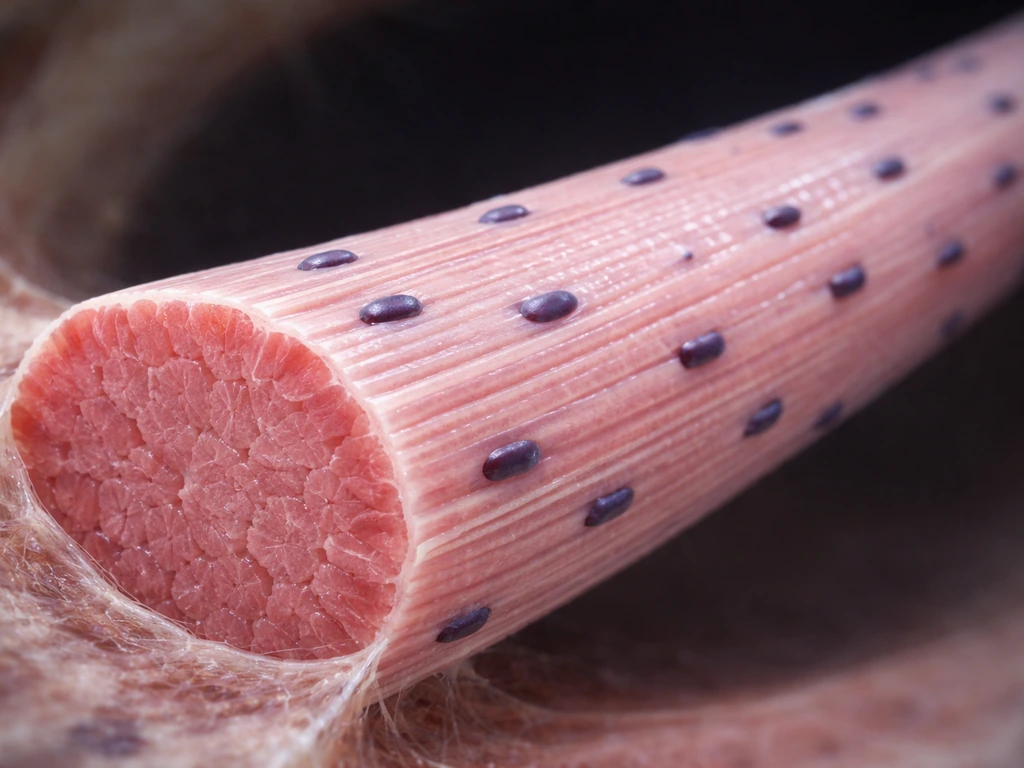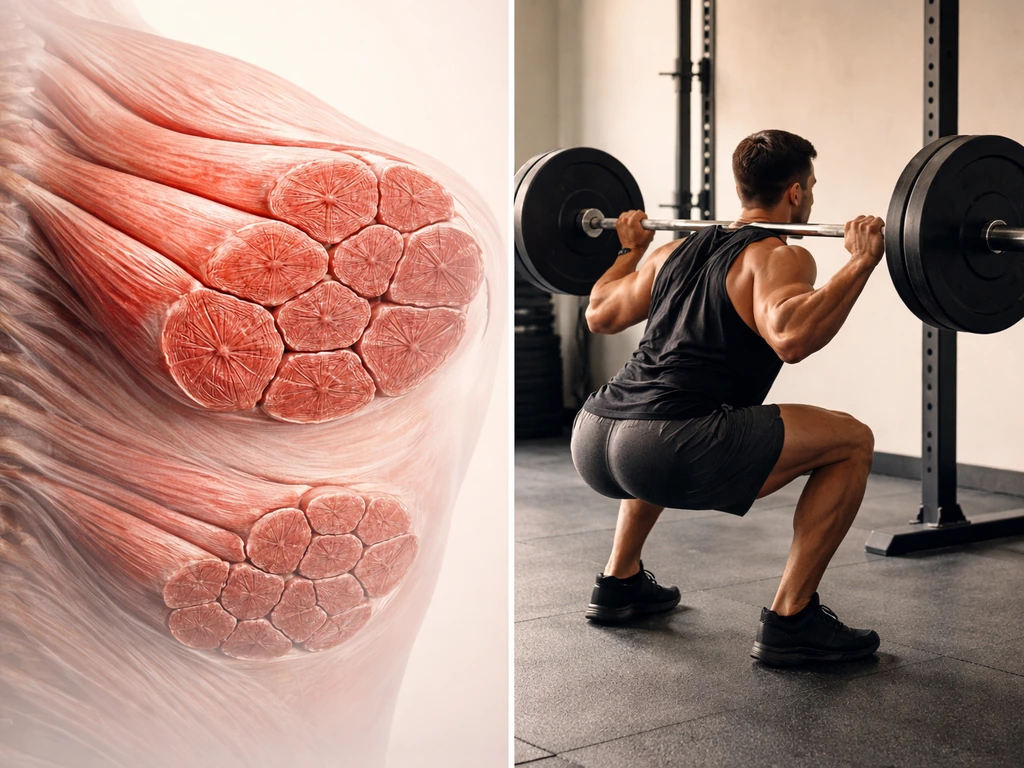
Muscles grow almost entirely through hypertrophy, meaning your existing muscle fibers get bigger. Hyperplasia, the idea that you grow brand-new muscle fibers, is well-documented in animal studies but remains controversial and likely minimal in adult humans. So if you're training to get bigger and stronger, hypertrophy is the mechanism you're actually working with, and the good news is that you can drive it very effectively with the right training, nutrition, and recovery.
How Do Muscles Grow Hyperplasia or Hypertrophy? Practical Guide

Marcus Kellerman
31 May 2026

Hypertrophy vs hyperplasia: what they actually mean
Hypertrophy simply means your individual muscle fibers increase in size. The cross-sectional area of each fiber grows as more contractile proteins (actin and myosin) are added, the supporting structural matrix expands, and the fiber becomes physically thicker. You end up with the same number of fibers, just bigger ones. This is what resistance training reliably produces in humans, and it's why a well-trained lifter's muscle looks denser and fuller even when their fiber count hasn't necessarily changed.
Hyperplasia means an actual increase in the number of muscle fibers, not just their size. In animal models, particularly with extreme loading, fiber splitting and branching have been observed as real physiological adaptations. But in adult humans, the evidence is genuinely thin. Some research notes that any fiber branching seen in human muscle may reflect regeneration from damage rather than a clean adaptive gain in fiber number. The honest answer is: hyperplasia might occur in humans under very specific, extreme conditions, but it's not something you can reliably target or count on as a meaningful contributor to your muscle size. Hypertrophy is your engine.
How hypertrophy actually happens
At the cellular level, hypertrophy is driven by a positive balance between muscle protein synthesis and muscle protein breakdown. To understand how do muscle cells grow, focus on the balance between building new muscle proteins and breaking them down, which training helps shift in your favor. When synthesis consistently exceeds breakdown over time, fibers grow. Training is the trigger that tips that balance in your favor by creating a mechanical and metabolic signal that tells your body to build more contractile tissue.
Mechanical tension: the main driver

Mechanical tension is the most important stimulus for hypertrophy. When a muscle fiber is loaded under tension, especially through its full range of motion, mechanoreceptors inside the fiber activate signaling cascades (most notably the mTOR pathway) that ramp up protein synthesis. Higher loads create more tension per fiber, which is why progressive overload, gradually lifting more weight or doing more work over time, is non-negotiable for long-term growth.
Metabolic stress and muscle damage: supporting roles
Metabolic stress, the burning, pumped feeling from higher-rep sets, contributes to growth through mechanisms like cell swelling, hormonal responses, and oxygen restriction within the muscle. Muscle damage (the microtrauma that causes soreness) was once thought to be essential for growth, but current thinking is more nuanced. Some damage is probably unavoidable, but deliberately chasing soreness is not the goal and can actually slow recovery. You can absolutely grow without being sore after every session.
What rep ranges and load actually do
Research has made this clearer in recent years: a fairly wide range of loads (roughly 5 to 30+ reps per set) can produce hypertrophy as long as sets are taken close to muscular failure. Heavy sets (5 to 8 reps) emphasize tension and mechanical stress. Moderate sets (8 to 15 reps) are the sweet spot for combining tension with metabolic stress. Higher rep sets (15 to 30) can work well, especially for isolation movements, but they require pushing close to failure to match the stimulus of heavier work. Most well-designed programs use a mix.
The real story on hyperplasia in adults

Here's where things get genuinely uncertain, and it's worth being straight about that. Animal research, particularly on birds and rodents subjected to extreme mechanical overload, has shown clear fiber splitting and branching, which is true hyperplasia. Some of those fibers appear to be functional additions, not just damage artifacts. That's interesting and biologically plausible.
In adult humans, though, demonstrating blank" rel="noopener noreferrer">a real increase in fiber number is methodologically difficult. Studies using muscle biopsies have measurement limitations that make it hard to cleanly blank" rel="noopener noreferrer">distinguish fiber number increases from changes in fiber size, architecture, or sampling variability. The current scientific consensus is that, even if hyperplasia occurs in humans at all, it contributes very little to total muscle mass compared to hypertrophy. Satellite cells (muscle stem cells that are activated by training) do play a role in muscle repair and possibly in adding new nuclei to growing fibers, which supports hypertrophy rather than hyperplasia per se. That repair process is driven by training-related signaling and protein availability, which helps your muscles recover and grow again muscle repair.
A few plausible pathways where hyperplasia might be a minor factor: very extreme, prolonged mechanical overload (think competitive bodybuilders training for decades); developmental stages in younger individuals; and possibly very high-volume eccentric training. But none of these are reliably demonstrated in healthy adult humans under normal training conditions. If someone tells you they've found a training protocol that specifically induces hyperplasia in humans, ask them to show the fiber count data. It's a short conversation.
How to train for maximum hypertrophy
This is where things get practical. The variables below are what actually move the needle. Whether you're a beginner or an experienced lifter, these are the levers you're adjusting.
Volume: sets per muscle group per week

Volume, measured as total sets per muscle group per week, is one of the strongest predictors of hypertrophy. Beginners respond well to 10 to 15 working sets per muscle group per week. Intermediate and advanced lifters often need 15 to 20 or more sets to keep progressing. More isn't always better, though. Going beyond what you can recover from just creates fatigue without additional stimulus. Start conservatively and add volume over weeks and months as your capacity increases.
Intensity and progressive overload
Intensity in this context means how close you train to failure, not just how heavy the weight is. Sets taken within 1 to 3 reps of failure are consistently associated with greater hypertrophy than sets stopped far short of failure. Progressive overload means that over time, you're doing more work: adding weight to the bar, doing more reps with the same weight, or adding sets. Without progression, adaptation stalls. Track your lifts so you know when you're progressing and when you're not.
Frequency and exercise selection
Training each muscle group at least twice per week tends to outperform once-per-week for hypertrophy, likely because you're distributing the protein synthesis stimulus more evenly across the week. Exercise selection matters for ensuring full range of motion and adequate stretch under load, which appears to be a particularly strong hypertrophic stimulus based on newer research. Compound lifts (squats, rows, presses, deadlifts) are efficient and should form the backbone of most programs. Isolation work (curls, lateral raises, leg extensions) is a useful supplement, especially for lagging muscle groups.
Rest periods
Longer rest periods (2 to 3 minutes between sets) generally allow for better performance on subsequent sets, which supports more total volume and more tension per set. Shorter rests (60 to 90 seconds) increase metabolic stress but may limit how much weight you can lift. For most hypertrophy-focused training, resting 90 seconds to 3 minutes is a reasonable default. Don't rush rest periods to the point where your performance drops significantly.
A beginner starting point

If you're new to lifting, keep it simple: 3 full-body sessions per week, 2 to 3 sets per exercise, 8 to 12 reps per set, focusing on the big compound movements. Aim to add a little more weight or one more rep every week or two. You'll gain strength fast in the first few months (largely from neural adaptations), and visible muscle size will follow within 6 to 12 weeks of consistent training. Don't overcomplicate it early.
Nutrition: feeding the growth
Protein: how much and when

Protein is the raw material for muscle protein synthesis, so getting enough is non-negotiable. For most people actively training for hypertrophy, 0.7 to 1 gram of protein per pound of bodyweight per day (roughly 1.6 to 2.2 grams per kilogram) is the evidence-supported target range. Older adults generally benefit from landing toward the higher end of that range because muscle protein synthesis becomes slightly less sensitive to protein intake with age. Spreading protein across 3 to 5 meals, each containing 30 to 50 grams, is a practical way to keep synthesis elevated throughout the day.
Calories: surplus vs maintenance
You can build muscle in a slight caloric surplus, at maintenance, or even in a modest deficit (especially if you're a beginner or returning to training after a break). For consistent hypertrophy gains, a modest surplus of 200 to 400 calories above your maintenance needs supports muscle building without excessive fat gain. If you're gaining more than about 0.5 to 1 pound per week as a natural trainee, you're likely adding more fat than muscle. Aggressive bulking rarely produces proportionally better muscle gain; it mainly produces more fat.
Carbohydrates and fats
Carbohydrates fuel training performance and replenish muscle glycogen, which matters for training quality and therefore indirectly for hypertrophy. Getting adequate carbs around training (before and after) supports better sessions and recovery. Dietary fat supports hormone production, including testosterone, which plays a role in muscle building. Don't drop fat below about 20% of total calories. Beyond those minimums, the split between carbs and fat is fairly flexible as long as total calories and protein targets are met.
Supplements worth knowing about (and what to skip)
The supplement industry is full of overpromising, so let's keep this grounded in what actually has meaningful evidence behind it.
| Supplement | Evidence Level | Practical Use |
|---|---|---|
| Creatine monohydrate | Strong | 3 to 5g daily; improves strength and power output, supports volume over time |
| Protein powder (whey, casein, plant) | Strong (as a food source, not magic) | Convenient way to hit daily protein targets; no special muscle-building effect beyond food protein |
| Caffeine | Moderate | Pre-workout performance aid; 3 to 6mg per kg body weight before training |
| Beta-alanine | Moderate | May help with muscular endurance in higher-rep ranges; causes harmless tingling |
| BCAAs | Weak (if protein needs are met) | Redundant if you're eating enough total protein; not worth prioritizing |
| Testosterone boosters / most 'muscle builders' | Negligible | Skip them; the evidence doesn't support the marketing claims |
Creatine is the standout here. It's one of the most researched supplements in sports science, it's safe for most healthy adults, and it works by increasing the availability of phosphocreatine in muscle, which lets you do slightly more work per session. Over months and years, that adds up to meaningful extra volume and stronger progressive overload. Take 3 to 5 grams daily, consistently. No loading phase required.
Recovery: where growth actually happens
Sleep is non-negotiable
Muscle protein synthesis peaks during sleep, and growth hormone release is heavily concentrated in deep sleep stages. Adults need 7 to 9 hours per night for optimal recovery and adaptation. Chronic sleep restriction (under 6 hours) measurably blunts muscle gain, increases cortisol, and impairs the hormonal environment for hypertrophy. If you're training hard but sleeping poorly, you're undermining a huge part of the process.
Managing fatigue between sessions
More training is only better until it isn't. Accumulated fatigue masks fitness and, if left unaddressed, leads to a performance plateau or regression. Signs you're accumulating too much fatigue include persistent soreness that doesn't resolve between sessions, declining performance in the gym, disrupted sleep, and low motivation. A planned deload every 4 to 8 weeks (reducing volume and/or intensity by about 40 to 50% for a week) lets your body absorb the training stimulus and come back stronger.
Troubleshooting a plateau
If you've been training consistently for a few months and progress has stalled, run through this checklist before overhauling your whole program:
- Are you actually tracking your lifts? Perceived effort isn't the same as real progressive overload.
- Is your protein intake at 0.7 to 1g per pound of bodyweight? Undereating protein is probably the most common nutrition mistake.
- Are you sleeping 7 to 9 hours consistently? Even a few nights of bad sleep compounds quickly.
- Have you been doing the same exercises at the same weights for months? Rotate in new variations or adjust rep ranges to introduce a new stimulus.
- Are you training sets close enough to failure? Half-hearted effort produces half-hearted results.
- Have you taken a deload recently? Sometimes the answer is less training, not more.
Plateaus are normal and expected. They're not a sign that you've hit your limit; they're a sign that your body has adapted to your current program and needs a new challenge. The fix is almost always adjusting one of the key variables: more volume, heavier loads, a new exercise, better sleep, or more calories. Rarely do you need to scrap everything and start over.
What changes first, and how long does it take
In the first 4 to 8 weeks of training, most of the strength gains you see come from neural adaptations: your nervous system gets better at recruiting and coordinating muscle fibers. Actual measurable hypertrophy typically becomes noticeable around weeks 6 to 12, depending on training frequency, nutrition, and individual genetics. By 3 to 6 months of consistent training, meaningful visible changes in muscle size are the norm for most people who are eating and sleeping well. Beyond that, progress slows but doesn't stop. Advanced lifters might gain 1 to 3 pounds of muscle per month under ideal conditions; more experienced lifters might gain 1 to 2 pounds over several months. That's not failure, that's the biology of a body that's already well-adapted.
The bottom line is simple: hypertrophy is the mechanism driving virtually all meaningful muscle growth in adult humans. Hyperplasia is real in animals and theoretically possible in humans under extreme conditions, but it's not a practical target for training. While fiber count changes are unlikely to be a reliable training goal in adults, it is possible to grow more muscle fibers in theory under extreme conditions. Focus your energy on progressive overload, sufficient volume, high protein intake, a modest caloric surplus, and consistent sleep. If you want a quick visual overview of how muscles grow, this how muscles grow video is a great related option to pair with these hypertrophy basics. That means you should think of muscle growth as hypertrophy, where fibers get bigger and fuller. That's the entire game, and it works whether you're 25 or 65.
FAQ
Can I deliberately train for hyperplasia instead of hypertrophy?
In healthy adult humans, you cannot reliably target or measure fiber-number increases. Training can occasionally involve mechanisms that look like repair and regeneration, but your best practical outcome comes from hypertrophy inputs you can control (progressive overload, sufficient volume, proximity to failure, protein, and sleep).
How would I know if my muscle growth is from hypertrophy or hyperplasia?
You generally cannot tell by appearance alone. Fiber hyperplasia would require direct assessment, such as muscle fiber counts from specialized biopsy and analysis, which is not something you can do as a routine training check. In real-world settings, changes in size and strength are overwhelmingly driven by hypertrophy.
Does soreness mean I’m getting more growth (and more likely hyperplasia)?
Not necessarily. Soreness can reflect microtrauma, but chasing it can hurt recovery and make you regress in performance. Growth can happen without noticeable soreness, and the more reliable signal is whether you are steadily increasing training quality and progressing over weeks.
Are high-rep workouts more likely to cause hyperplasia than heavy lifting?
Higher reps can produce hypertrophy effectively, but that is still growth in fiber size, not proven fiber-number expansion in adults. The key driver is getting enough hard sets close to failure, regardless of whether those sets are 5 reps or 25 reps.
If I train with very heavy, extreme loads, will that switch on fiber splitting in humans?
Heavy and extreme loading can increase tissue stress, but it does not guarantee fiber splitting or fiber-number gains in adult humans in a predictable, trainable way. Extreme intensity also raises the risk of form breakdown and recovery issues, which can reduce total high-quality volume.
How close to failure should I train if my goal is maximum muscle growth?
A practical target is stopping each set with about 1 to 3 reps in reserve for most working sets, especially on isolation work. If you are consistently missing that range (stopping too far from failure), hypertrophy stimulus will likely be weaker even if the weight is heavy.
What should I do if I’m gaining weight but my muscles look like they are not growing?
Check whether you are actually increasing training stimulus (more hard sets, more reps, or more load over time). Also review protein intake and sleep. If scale weight is rising quickly (for natural trainees, often more than about 0.5 to 1 lb per week), you may be adding mostly fat, which can mask muscle gains visually.
Is muscle growth possible without a caloric surplus?
Yes. You can grow at maintenance and even in a modest deficit, especially if you are a beginner or returning after a break. The limiting factor is often how well you can recover and how close you can consistently train to failure while maintaining performance.
How much protein is enough if I train hard and my appetite is low?
You generally want the 1.6 to 2.2 g/kg/day range. If appetite limits you, prioritize protein-dense meals, consider 1 to 2 higher-protein servings per day, and spread intake across 3 to 5 meals to keep synthesis elevated.
Does taking creatine mean I will gain more muscle fibers (hyperplasia)?
Creatine is mainly expected to boost performance and allow slightly more training work over time, which supports hypertrophy. It is not used to promote fiber-number growth. Track your training progression while on creatine to see the main benefit.
How long does it take before I can expect visible changes in muscle size?
Many people notice clear changes around weeks 6 to 12 with consistent training, nutrition, and sleep. Strength changes can show up earlier because of nervous system adaptations, so don’t judge progress only by how much muscle you see in the first few weeks.
If I plateau, how do I choose what to change first?
Start with the most common controllable bottlenecks: volume (add working sets), load progression (ensure you are getting stronger), exercise execution and range of motion, and sleep. If all those are solid, then consider a small caloric increase and a deload to reset accumulated fatigue before rewriting your entire program.
Is training frequency always better at 2x per week per muscle group?
2x per week often outperforms 1x because it distributes the stimulus, but the real goal is total quality volume per week and sufficient proximity to failure. If a 1x schedule is well-structured and you recover well, it can still work, especially for beginners.
Do shorter rest times prevent muscle growth?
They can limit how much weight or reps you can maintain, which can reduce total mechanical tension per session. If you want shorter rests for metabolic stress, keep an eye on performance drop, total weekly sets, and whether you can still progress across weeks.