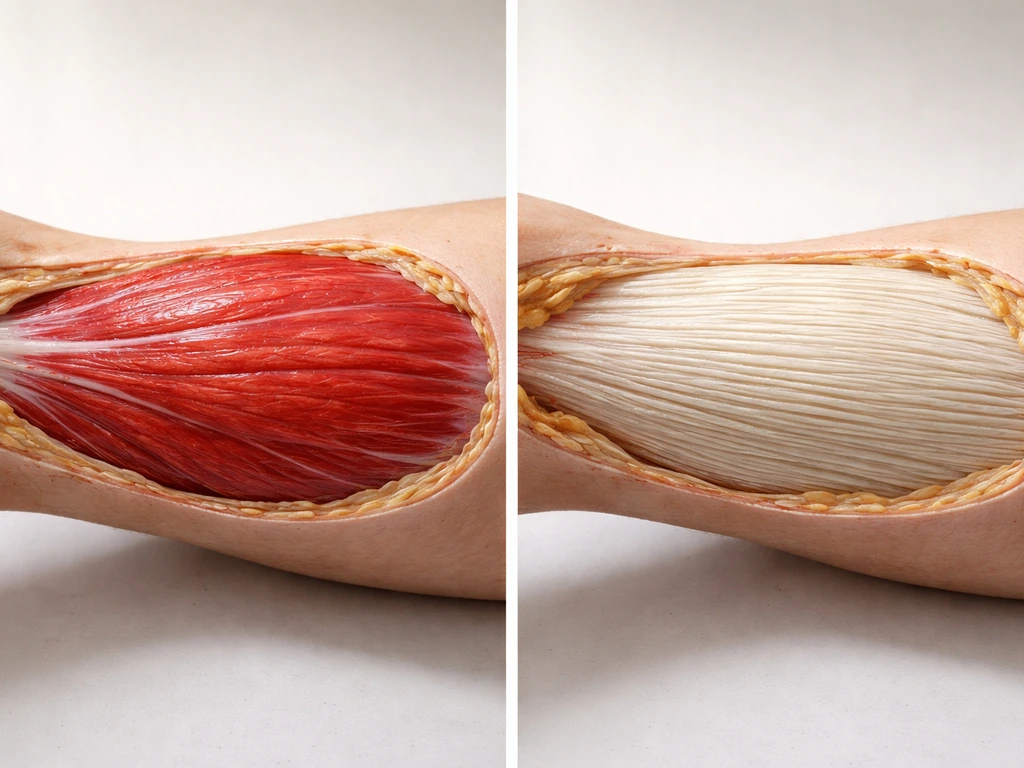
You won't build a pound of new muscle tissue in seven days. But that doesn't mean this week is wasted. In one week of focused training, you can trigger real muscle protein synthesis, improve neuromuscular recruitment (meaning your existing muscle fires harder and more efficiently), increase glycogen and water storage inside muscle cells that makes them look and feel fuller, and lay the cellular groundwork for visible size gains that show up in weeks two and three. That's not spin. That's how muscle physiology actually works, and understanding the difference changes how you approach this week.
How to Grow Muscle in a Week: 7-Day Plan and Reality Check

Marcus Kellerman
11 May 2026

Reality check: what can actually happen in 7 days
True hypertrophy, meaning new contractile protein added to muscle fibers, takes longer than a week to become measurable in most people. But 'longer than a week' doesn't mean nothing is happening. Research on untrained participants doing resistance training found detectable lean mass changes as early as 72 to 96 hours post-training in controlled settings. Satellite cells, the repair and growth cells that muscle tissue relies on, begin responding within 24 to 72 hours after a training session. That machinery is spinning up fast. What you won't get is a dramatic visual transformation. What you can get is a meaningful first week of real biological progress.
The visible changes most people notice in week one are largely pump and glycogen. When you train hard and eat enough carbohydrates and protein, your muscles store more glycogen (the carbohydrate energy reserve inside muscle), and water follows glycogen into the cell. That makes muscles look rounder and fuller, sometimes noticeably so. This isn't fake progress. It's real, it feels good, and it supports further training. Weak muscles improve when you focus on progressive overload, sufficient protein, and consistent training that builds strength first. Just don't confuse it with the 2 to 4 pounds of actual muscle tissue that takes consistent months to accumulate.
For beginners, week one also delivers a neurological bonus that experienced lifters don't get. Your nervous system gets dramatically better at recruiting motor units in the first few weeks of training, which means strength goes up fast even before muscle size changes. Older adults see the same adaptation, though recovery between sessions may need a bit more time. If you're looking at a longer timeline, the one-month trajectory gives you a much clearer picture of what real size changes look like. With consistent training and smart nutrition, you can also learn how to grow muscles in 1 week in a way that sets you up for bigger gains afterward real size changes.
Best 7-day workout plan for fast muscle stimulation
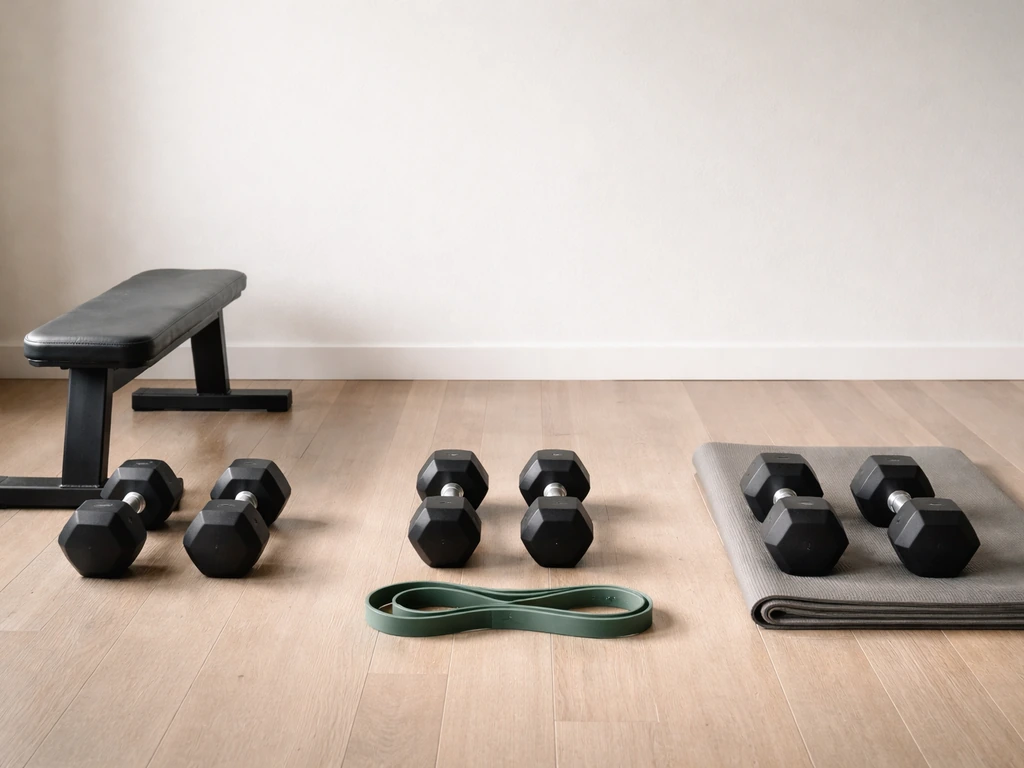
The goal this week is to hit every major muscle group at least once, ideally twice, with enough mechanical tension and volume to stimulate protein synthesis without destroying your recovery. A hypertrophy-style approach works best here: moderate to heavy loads, controlled tempo, and enough total sets per muscle group to matter. Below is a practical structure that works for most people starting this week.
| Day | Focus | Session Type |
|---|---|---|
| Day 1 (Monday) | Push (chest, shoulders, triceps) | Strength/hypertrophy training |
| Day 2 (Tuesday) | Pull (back, biceps) | Strength/hypertrophy training |
| Day 3 (Wednesday) | Legs (quads, hamstrings, glutes, calves) | Strength/hypertrophy training |
| Day 4 (Thursday) | Active recovery or rest | Light walk, mobility, stretching |
| Day 5 (Friday) | Push + Pull (upper body repeat) | Hypertrophy training |
| Day 6 (Saturday) | Legs + core repeat | Hypertrophy training |
| Day 7 (Sunday) | Full rest or light activity | Rest, walk, sleep focus |
This is a 5-day training week with two sessions per muscle group, which is the sweet spot most research supports for hypertrophy. You're not overtraining in a week. You're creating enough stimulus frequency to keep protein synthesis elevated across multiple muscle groups for the full seven days.
Exercise selection, sets, reps, and intensity for beginners vs. intermediate
If you're a beginner
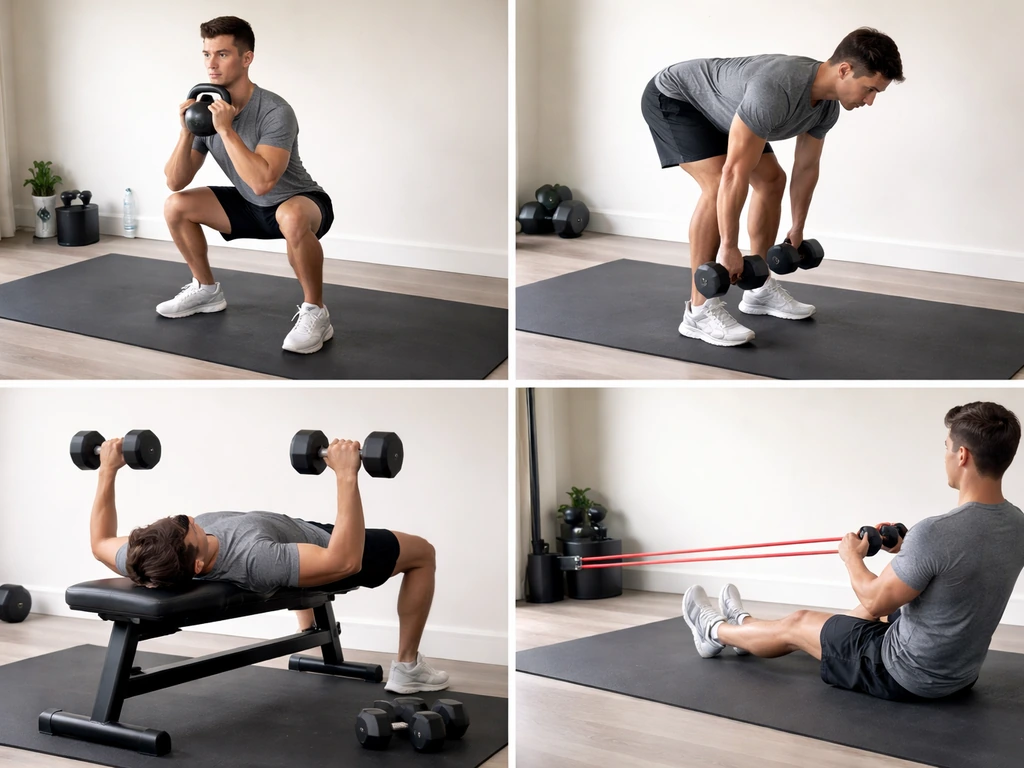
Keep it compound and simple. You don't need twelve exercises. You need the ones that load the most muscle mass and are easy to learn safely. Stick to goblet squats, Romanian deadlifts, dumbbell bench press, dumbbell rows, overhead press, and bodyweight or assisted pull-ups. For sets and reps, aim for 3 sets of 10 to 12 reps per exercise, leaving about 2 reps in the tank at the end of each set. That means you should be working hard but not grinding. Rest 60 to 90 seconds between sets. Pick a weight that feels challenging by rep 10 but allows good form. Choose 3 to 4 exercises per session to keep total volume manageable.
Progression this week for a beginner is simple: if you complete all reps with solid form on a given weight, add 5 pounds (or 2.5 kg) next session. Don't overthink it. The beginner neurological adaptation means you'll get stronger noticeably fast, and that's exactly what you want to build on.
If you're intermediate (6+ months of consistent training)
You need more mechanical tension and probably more total volume to drive a strong stimulus. Use barbell squats, deadlifts, barbell bench press, weighted pull-ups, barbell rows, and overhead press as your primary lifts. Add one or two isolation exercises per session (cable flyes, lateral raises, bicep curls, leg curls) at the end. Aim for 4 sets of 6 to 10 reps on your compound lifts using around 70 to 80 percent of your one-rep max, and 3 sets of 12 to 15 reps on isolations. Rest 90 to 120 seconds between compound sets. Intensity should be genuine: you should be within 1 to 2 reps of failure on your last set.
For intermediate lifters, the most important progression lever this week is increasing load or total reps compared to last week, not adding more exercises. More isn't always more. One extra quality rep on a hard set beats an extra mediocre exercise every time.
A note for older adults
If you're over 50, the plan above still applies, but your recovery between sessions matters more. You may do better with a Day 4 rest day that's fully passive rather than active, and you might push the Day 5 session to Day 6 if your legs are still significantly sore from Day 3. Age is context, not a barrier. And yes, can women grow muscles like men is also a real possibility, as long as training and nutrition create the stimulus for muscle growth. The stimulus and nutrition principles are the same. The recovery timeline is just a bit longer, and that's worth planning around rather than ignoring.
Nutrition for muscle gain this week
Protein: your most important lever

Aim for 0.7 to 1 gram of protein per pound of bodyweight daily (roughly 1.6 to 2.2 grams per kilogram). For a 170-pound person, that's 120 to 170 grams of protein per day. Research on protein dose responses shows that muscle protein synthesis has saturation kinetics, meaning there's a ceiling effect per meal. Practically, this means you want to spread your protein across 3 to 5 meals rather than trying to hit your full daily target in two big ones. Roughly 30 to 50 grams per meal, depending on your body size and meal frequency, keeps synthesis elevated consistently across the day.
Peri-workout protein matters, but don't obsess over the window. Research suggests that as long as you're not going more than 3 to 4 hours without protein during and around your training session, timing effects are minor compared to total daily intake. Have a protein-rich meal or shake within a couple of hours before or after training, and you're covered.
Practical high-protein food options
- Chicken breast (31g protein per 100g cooked)
- Greek yogurt (17 to 20g per cup, plain)
- Eggs (6g each, and the yolk adds healthy fats and leucine)
- Canned tuna or salmon (25g per 100g drained)
- Cottage cheese (14g per half cup)
- Lean ground beef or turkey (22 to 26g per 100g cooked)
- Tofu or tempeh (great plant-based options at 15 to 20g per 100g)
- Whey or plant-based protein powder (20 to 25g per scoop, convenient gap-filler)
Calories: a slight surplus helps
In a single week, you don't need to be in a large surplus, and a big surplus just adds unnecessary fat. Aim for roughly 200 to 300 calories above your maintenance level. If you're not sure what your maintenance is, use your bodyweight in pounds multiplied by 15 as a rough estimate. For most people, hitting protein targets is actually harder than hitting calorie targets, so if you're meeting your protein and eating regular balanced meals with carbohydrates and fats, you're probably close. Don't undereat. Low-calorie dieting while trying to maximize muscle stimulus in a single week is counterproductive.
Recovery: the part most people get wrong
Sleep is non-negotiable

Most muscle protein synthesis happens during sleep. Pre-sleep protein ingestion has been shown to stimulate blank" rel="noopener noreferrer">overnight protein synthesis, and it may be insufficient to rely on habitual intake plus evening protein unless the timing and dose are appropriate. A review on sleep and muscle protein synthesis notes that blank" rel="noopener noreferrer">sleep restriction models can reduce muscle protein synthesis rates in human data. Target 7 to 9 hours per night. If you're averaging 6 hours, you're leaving a measurable amount of your week's gains on the table. Growth hormone peaks in the early hours of sleep, and muscle repair is prioritized during that window. This week, treat sleep like a training variable, not a luxury.
Soreness doesn't equal growth
Delayed onset muscle soreness (DOMS) is caused by inflammation and micro-damage, not the growth stimulus itself. You can get an excellent hypertrophy session with minimal soreness, especially once you're past your first week or two. Don't chase soreness as a metric. Chase progressive overload and consistent protein. If you're very sore heading into Day 5 or 6, it's okay to reduce intensity slightly or shift the session by a day. Grinding through severe soreness with full intensity often produces worse results than a slightly lower-intensity session with good form.
Stress and active recovery
Chronic psychological stress elevates cortisol, which competes with anabolic signals and slows recovery. You can't eliminate life stress in a week, but you can manage it: keep sessions to 45 to 60 minutes, avoid training late at night if it disrupts sleep, and use your Day 4 recovery session as genuine recovery rather than a hidden cardio session. A 20 to 30 minute walk, light stretching, or a yoga session improves blood flow to sore muscles without adding recovery debt.
Common recovery mistakes to avoid this week

- Skipping sleep to train longer or earlier (the tradeoff is almost never worth it)
- Adding intense cardio on rest days thinking it 'helps' (it competes with muscle recovery)
- Drastically undereating on rest days because you didn't train (your muscles are still rebuilding)
- Using alcohol heavily, which measurably suppresses protein synthesis
- Neglecting hydration, which affects cellular function and training performance
Supplements: what's actually worth it in a week
Most supplements are irrelevant over a seven-day window. But a few have enough short-term evidence to be worth considering, and a few popular ones are a waste of money right now.
| Supplement | Short-term value | Verdict |
|---|---|---|
| Whey or plant protein powder | Helps hit daily protein targets conveniently | Worth it if whole food protein is hard to get |
| Creatine monohydrate | Increases intramuscular phosphocreatine, supports higher training volume from day one | Worth it. 3 to 5g daily. No loading phase needed. |
| Caffeine (pre-workout) | Improves training performance acutely | Worth it situationally. Watch sleep timing. |
| BCAAs | Redundant if you're already hitting protein targets | Skip it. Spend the money on food. |
| Testosterone boosters | No meaningful effect in short-term or typically at all | Skip it. |
| Mass gainers (high-calorie shakes) | Adds calories, but mostly sugar and carbs at high cost | Use real food instead unless appetite is a genuine issue |
Creatine is the one supplement with a strong enough evidence base to recommend confidently here. It doesn't cause magical muscle growth on its own, but it supports better training performance from the first week, which compounds over time. Take 3 to 5 grams daily with water. You don't need to load. You don't need the expensive branded versions. Plain creatine monohydrate is fine.
Your action plan starting today
This week matters because it's the foundation week, not because you'll look dramatically different by Sunday. What you build this week, in terms of habit, stimulus, and nutritional consistency, is what makes months two and three produce visible results. The people who build impressive muscle over time are the ones who treat every week exactly like this one: structured training, sufficient protein every day, and real sleep.
- Choose your workout split today and put the five sessions in your calendar as fixed appointments
- Calculate your daily protein target (bodyweight in pounds x 0.8 as a minimum starting point) and plan your meals around hitting it
- If you don't already take creatine, pick some up and start 3 to 5g daily from today
- Protect 7 to 9 hours of sleep every night this week, treating it as seriously as the training itself
- Track your lifts (weights and reps) so you can see progression within the week and carry it into week two
- On your Day 4 recovery day, go for a walk rather than sitting still, and eat your full protein target even though you didn't train
One week of doing this right won't transform your physique, but it absolutely will change your trajectory. The cellular machinery you activate this week stays in motion if you keep feeding it. And if you're curious about what becomes possible when this compounds over four weeks, the one-month muscle growth timeline shows exactly how the picture changes. If you want, you can apply the same principles to a teen schedule too, including how to grow muscle as a teenager one-week muscle growth timeline.
FAQ
If I want to “grow muscle in a week,” what should I measure to know it’s working?
Track performance and recovery, not just the mirror. Use at least two of these: (1) total reps or load on key lifts, (2) whether you can repeat the same workout with less effort (lower RPE) while keeping form, (3) reduced soreness week to week, and (4) consistent pump plus bodyweight trend when calories are slightly above maintenance.
How should I handle the fact that DOMS can be minimal or extreme during week one?
Minimal soreness is fine, it often means you chose a manageable progression. Severe soreness, especially before later sessions, usually signals you did too much intensity or volume. Keep your plan, but if you feel beat up, reduce sets by 1 to 2 or drop load by about 5 to 10% for the next session and prioritize clean reps.
Can I train every day to maximize muscle growth in seven days?
Daily training is usually not the best option for a beginner plan because recovery caps your volume quality. The article’s structure works because it spreads protein synthesis stimulation across the week while limiting fatigue. If you train more than described, keep each session shorter and reduce total sets so you do not turn it into an exhausting full-body routine.
What if I only have time for 3 or 4 days this week instead of 5?
You can still create the needed stimulus by hitting each major muscle group at least once and adding quality sets, not extra exercises. Aim for 10 to 16 total hard sets per muscle group across the week, then distribute them into your available sessions (for example, 2 sessions for upper and 1 to 2 sessions for lower, depending on your schedule).
Should I do the exact same exercises and reps all week, or change them?
Keep exercise selection stable for the week so progression is measurable. Changing exercises midweek makes it harder to know whether you improved due to training or novelty. If you must swap (pain, equipment, or form breakdown), switch within the same movement pattern (for example, barbell row to dumbbell row) and keep the set and rep targets similar.
How close to failure should I go on each set during this one-week push?
Use the “reps in reserve” idea consistently. If you are within about 1 to 2 reps of failure on the last set of each movement, you generally get enough tension without trashing recovery. If your performance drops sharply set-to-set (for example, you lose several reps before reaching the target), stop earlier and do not chase failure on every set.
Does the 5 to 8 pound water gain from glycogen mean I’m actually gaining muscle tissue?
No. Fuller muscles in week one are largely glycogen plus water, which reflects training stress and diet consistency. That said, it is still useful because it helps you show better performance in subsequent weeks. Muscle tissue changes lag behind, so the mirror effect is not the same thing as new contractile protein.
Do I need a calorie surplus in week one to see any “progress”?
You do not need a huge surplus, but avoiding under-eating matters. If you are below maintenance or crash dieting, your workouts can feel harder and recovery worsens, even if protein intake is high. A modest surplus for the week (the article suggests a small calorie buffer) is the practical approach for maximizing training quality.
How strict do I need to be with protein timing and pre or post-workout shakes?
Timing is helpful but secondary to daily totals. A practical rule from the article is not going more than about 3 to 4 hours without protein around training. If you cannot get a shake, just ensure you eat a protein-rich meal within a couple hours before or after your session and spread protein across 3 to 5 meals.
What protein amount should I use if I’m cutting, not bulking?
Use the same target per bodyweight as long as you are not severely dieting. For muscle retention and growth stimulus, keep protein around 0.7 to 1.0 g per pound daily and maintain regular balanced meals. If calories are tight, prioritize training quality and sleep even more than the exact calorie math.
If I’m over 50, should I change the plan or just rest more?
Rest and fatigue management matter more, and the same exercise principles still apply. A common adjustment is keeping the day-to-day effort slightly lower (fewer hard sets, more conservative progression) and ensuring you are not carrying severe soreness into the next leg session. Also consider swapping in more joint-friendly variations (tempo, machines, or supported rows) if recovery is slower.
Is creatine safe to take during this week, and do I need to cycle?
Creatine monohydrate at 3 to 5 g daily is the simple, no-cycle approach. It is not a magic muscle pill, but it can improve training output. If you have kidney disease or a medical condition, confirm with a clinician first, and take it consistently with water.
What’s the biggest mistake people make when trying to grow muscle in one week?
Treating it like a transformation goal instead of a training and recovery goal. The most common failure modes are (1) doing too much volume because they feel motivated, (2) under-eating because of stress or dieting, (3) sacrificing sleep, and (4) skipping progressive overload so performance does not improve.
After week one, how should I progress without losing the gains trajectory?
Keep the core structure but continue progressing load or total reps, and gradually accumulate more total weekly sets as long as recovery stays solid. If week one performance improved and soreness is manageable, you can maintain similar exercises and increase effort slightly next week, rather than drastically changing everything.