Yes, you can build muscle without a calorie surplus, but how well it works depends heavily on who you are and how you set things up. If you're asking, "can you grow muscle while cutting," the short answer is yes for many people, but the size of the deficit and your training quality determine how much. Beginners, people returning after a break, and anyone carrying extra body fat can make real, measurable muscle gains while eating at maintenance or even in a modest deficit. More advanced, already-lean lifters will find muscle growth slows considerably without extra calories, and a large deficit (around 500 kcal/day or more) can actively block lean mass gains even with solid training and high protein. So the honest answer is: sometimes yes, sometimes a hard no, and the details matter a lot.
Can You Grow Muscle Without a Calorie Surplus?


When you can (and can't) build muscle without a surplus
The idea that you must bulk to build any muscle is one of the most persistent myths in fitness, and it's just not accurate for everyone. The reason it exists is that for trained lifters who are already lean, a surplus genuinely does accelerate hypertrophy. But the physiology is more nuanced than "surplus in, muscle out."
Your body can simultaneously break down fat for energy while using dietary protein and training stimulus to drive muscle protein synthesis. This is body recomposition, and research confirms it's very real under the right conditions. A 2026 trial comparing a modest energy deficit against isocaloric eating (both with high protein and resistance training) found fat-free mass increases alongside body fat reductions in both groups, which is about as clean a demonstration of recomp as you'll find.
Where things break down is with large deficits. A meta-analysis on energy deficits and resistance training found that a deficit of around 500 kcal/day suppressed lean mass gains even when participants were lifting. The mechanism is partly hormonal and partly about raw energy availability for muscle protein synthesis. One mechanistic study found resting muscle protein synthesis dropped by roughly 19% during an energy deficit even when protein intake was held constant. Your body downregulates anabolic signaling when calories are low, which is why protein alone can't fully compensate for a severe cut.
The practical takeaway: if you're new to lifting, returning after time off, or have meaningful body fat to lose, eating at maintenance or a small deficit (roughly 200-300 kcal/day) while training hard and hitting your protein targets can absolutely produce muscle growth. If you're already lean and experienced, you'll likely need to accept either modest surplus eating, slower gains, or the trade-off of prioritizing fat loss now and muscle gain later.
Calorie surplus vs. maintenance vs. deficit: what actually changes for muscle
Think of calories as the resource budget your body works with. Muscle protein synthesis is energetically expensive, and your body is conservative about spending that budget when energy is scarce. Here's how the three calorie states compare in practice:
| Calorie State | Muscle Growth Potential | Fat Change | Who It Works Best For |
|---|---|---|---|
| Surplus (+200 to +500 kcal/day) | Highest, fastest gains | Some fat gain likely | Experienced lifters focused on maximizing hypertrophy |
| Maintenance (roughly TDEE) | Moderate, slower gains | Neutral to slight loss | Beginners, intermediates, people managing weight |
| Modest deficit (-200 to -300 kcal/day) | Possible, especially for beginners or high body fat | Gradual fat loss | People in recomp phase, moderate fat to lose |
| Aggressive deficit (-500+ kcal/day) | Significantly impaired or zero lean mass gain | Faster fat loss | Fat loss priority only; muscle preservation, not growth, is the goal |
One nuance worth knowing: strength gains are far less energy-sensitive than lean mass gains. The same meta-analysis that found a 500 kcal deficit blocked lean mass gains showed strength improvements were comparatively preserved. So if you're cutting and notice you're still getting stronger, that doesn't necessarily mean you're building muscle tissue, especially not at the rate you would in a surplus.
The non-negotiables: training has to be hard enough

No calorie strategy substitutes for an adequate training stimulus. Muscle grows in response to mechanical tension and metabolic stress, primarily when you train close to failure and progressively overload over time. If you're not getting stronger or adding volume week to week, hypertrophy stalls regardless of what you're eating.
Progressive overload means consistently giving your muscles more than they're used to: more weight, more reps, more sets, or less rest over time. Without it, your body has no reason to build new muscle tissue. This is even more critical when you're eating at maintenance or below, because the anabolic signal from training is one of the few levers you can fully control when calories are constrained.
For hypertrophy specifically, training volume matters. Dose-response research points toward a favorable relationship between weekly sets per muscle group and muscle growth, with most intermediate lifters responding well to roughly 10 to 20 working sets per muscle group per week. ACSM's updated resistance training guidelines reinforce load and volume specificity for hypertrophy goals, emphasizing that moderate loads taken close to failure across multiple sets are the practical standard. You don't need extreme volume, but you do need consistent, challenging work.
One more thing: research on lean mass sparing during caloric restriction found that training experience and pre-diet training volume both affect how much muscle you retain or gain while cutting. If you've been lifting consistently and you maintain that volume during a cut (rather than dropping it), you're in a much better position than someone who slashes their training load while dieting.
Protein and calorie targets to actually hit
Protein is where you have the most control during a deficit or at maintenance. It's the raw material for muscle protein synthesis, and higher intakes actively counteract the anabolic resistance that energy restriction causes. Getting this right is probably the single most impactful nutrition variable when you're not in a surplus.
How much protein
A large meta-analysis on protein supplementation during resistance training found that benefits plateau around 1.6 g per kg of body weight per day for muscle and strength gains in most people. The ISSN recommends 1.4 to 2.0 g/kg/day for exercising individuals in general, and pushes toward the higher end (up to 2.4 g/kg/day) during energy restriction. A controlled trial that put people on a 40% calorie cut with intense exercise found the group eating 2.4 g/kg/day gained lean mass while the 1.2 g/kg/day group did not. That's a striking difference and it makes the case for erring toward higher protein when calories are lower.
In practical terms: if you weigh 80 kg (about 175 lbs), you're aiming for roughly 130 to 190 g of protein per day, with the higher end being more protective during a cut. Spread it across 3 to 5 meals. Protein timing matters less than total daily intake, but hitting consistent doses of around 30 to 40 g per meal helps optimize muscle protein synthesis across the day.
How to set your calories
For recomp or modest-deficit muscle building, start by estimating your total daily energy expenditure (TDEE) using a calculator based on your weight, height, age, and activity level. Then position yourself based on your goal. For pure recomp, eat at or within 100 to 200 kcal of maintenance. For fat loss while preserving or growing muscle, target a deficit of 200 to 300 kcal/day and hold protein at the higher end of the range. If you want the best shot at growing muscles in a calorie deficit, aim for a small deficit, train close to failure, and prioritize enough protein. Avoid going beyond a 500 kcal deficit if muscle growth is a goal, because that threshold is where lean mass gains are consistently suppressed in the research.
Body recomposition: who succeeds and what timeline to expect
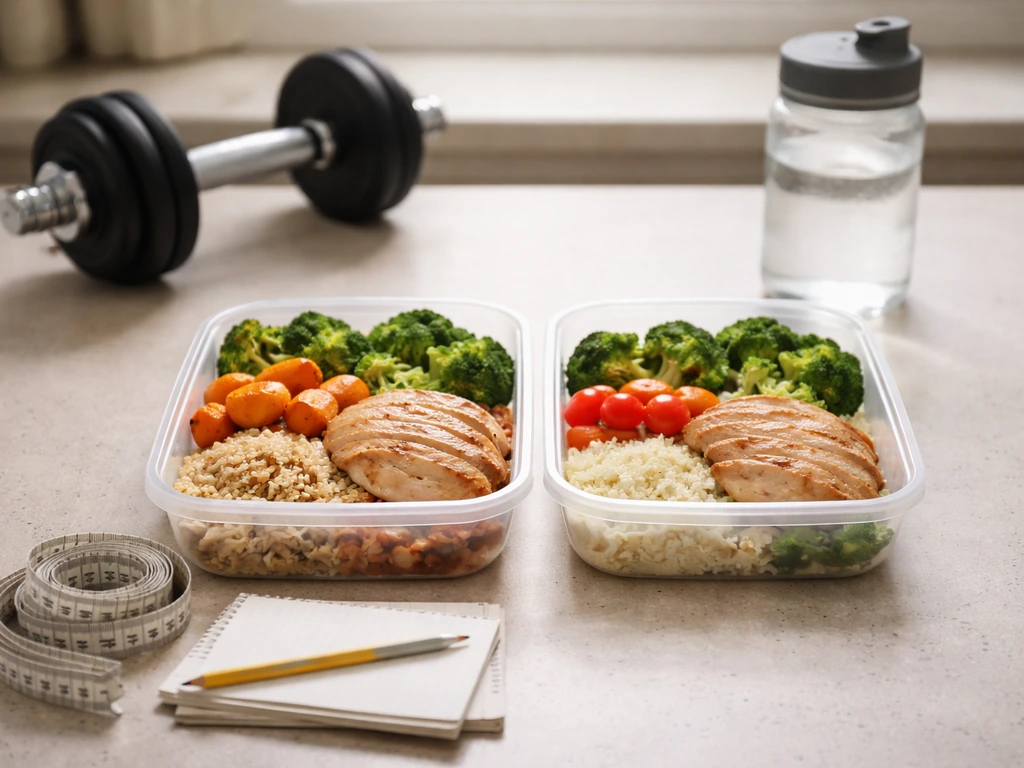
Body recomposition, gaining muscle while losing fat simultaneously, is most accessible to a specific group of people. Knowing whether you're in that group saves a lot of frustration.
- Beginners (less than 1-2 years of consistent resistance training): muscle-building machinery is highly responsive to new training stimulus, even without extra calories
- People returning after a break: muscle memory allows faster re-gain of lost tissue, often at maintenance or below
- Individuals with higher body fat (roughly 20%+ for men, 28%+ for women): stored fat provides an internal energy buffer that partially offsets the need for dietary surplus
- Younger adults: anabolic hormone environment tends to be more favorable
- Anyone transitioning from untrained to trained, or from sedentary to active
For experienced, already-lean lifters, recomp is real but very slow. Expect gains measured in fractions of pounds of muscle per month rather than the faster accumulation possible during a deliberate surplus phase. That's not failure, it's just the honest rate.
Timeline expectations: beginners eating at maintenance with consistent training can often add 1 to 2 lbs of lean mass per month in early months, sometimes more. Those in a modest deficit might see 0.5 to 1 lb per month. Experienced lifters in recomp might see 0.25 to 0.5 lbs per month, if that. Fat loss during the same period can run 0.5 to 1 lb per week at a 300-500 kcal deficit, but muscle gain won't match that pace, so patience matters.
Related to this: the same question comes up when people are actively cutting or using approaches like intermittent fasting or ketogenic dieting. The core principles apply across all those scenarios, though the practical execution differs. Intermittent energy restriction, where you cycle between deficit and maintenance periods, has shown some advantage for preserving fat-free mass compared to continuous deep restriction in resistance-trained adults, which is worth knowing if you're planning a longer cut.
Running calories in real life: tracking, adjustments, and weight trends
The biggest mistake people make with calorie management is reacting to single-day scale readings. Body weight fluctuates 1 to 3 lbs (sometimes more) day to day due to water, glycogen, sodium, and digestion. A single morning weigh-in tells you almost nothing useful. What tells you something is a 7 to 14 day average. Use that average to decide whether you're where you want to be calorically.
- Weigh yourself at the same time each morning (after waking, before eating) for at least 7 days
- Calculate the weekly average and compare it week over week
- If weight is dropping faster than 1% of body weight per week, calories are likely too low for muscle gain; increase by 100-150 kcal
- If weight is holding steady or creeping up when fat loss is the goal, reduce by 100-150 kcal
- Track protein intake directly, not just calories, since most people underestimate protein without logging it
- Reassess every 2 to 4 weeks and adjust based on trend, not on any single day
You don't have to track forever, but doing it for 4 to 8 weeks when you first set up your plan gives you calibrated baseline data that makes future adjustments much easier. Most people discover they're significantly underestimating protein or overestimating portion sizes before they have any tracking experience.
One practical note on carbohydrates: even when you're not focused on carb intake specifically, keeping carbohydrate levels adequate (not keto-low) supports training performance and glycogen availability, both of which affect how hard you can train. Training quality is a multiplier on everything else in this plan, so don't let an overly restrictive carb approach undermine your sessions.
What to expect and how to troubleshoot

Strength keeps going up but body composition isn't changing
This is common and not a bad sign. Strength gains during a deficit are mostly driven by neuromuscular adaptations (better motor unit recruitment, coordination, technique) rather than new muscle tissue. You can get noticeably stronger without gaining much lean mass, especially in the first several months. If you are considering a keto diet, you may wonder, can you grow muscle on keto while staying in a deficit or maintaining your calories? If you've been in a deficit for 8 to 12 weeks and your measurements and body weight have shifted but you're not seeing visual muscle growth, that's the likely explanation. It's not wasted effort, it's laying groundwork. But if you want more visible hypertrophy, you may need to move toward maintenance or a slight surplus.
Progress has completely stalled

If strength, measurements, and body weight have all plateaued for 3 to 4 weeks: first check protein (is it actually at target?), then training (are you progressively overloading or just going through the motions?), then calories (are you in too deep a deficit?). A common culprit is metabolic adaptation during extended cuts, where your body reduces energy expenditure over time, effectively deepening your deficit beyond where you set it. If you've been in a deficit for more than 10 to 12 weeks, a brief diet break at maintenance for 1 to 2 weeks can restore anabolic signaling and help you continue making progress when you return to a deficit.
Recovery feels off or training quality has dropped
Poor recovery is often the first symptom that your deficit is too aggressive. Energy restriction reduces the substrate available for tissue repair and blunts the hormonal environment needed for muscle protein synthesis. If you're consistently sore between sessions, fatigued, or performance is declining week over week, that's a signal to either reduce deficit depth, increase calories around training (meal timing can matter more in a deficit), or cut training volume temporarily. Trying to push harder through poor recovery during a deficit is one of the fastest ways to spin your wheels.
When to switch to a true surplus
If you've been at maintenance or in a modest deficit for 3 to 6 months and you've hit a consistent plateau in lean mass despite solid protein and progressive training, it's probably time to shift into a deliberate surplus. A modest surplus of 200 to 300 kcal/day above maintenance is enough to meaningfully accelerate muscle protein synthesis without excessive fat gain. This is sometimes called a "lean bulk" and it's the right call once you've extracted most of the recomp benefit available to you. Think of maintenance and modest deficit eating as tools with a useful window, not permanent strategies if muscle growth is the long-term goal.
FAQ
Can I build noticeable muscle while losing weight (not just getting stronger)?
Yes, but only if your deficit is small and your training is truly hypertrophy-focused. If you are in a deeper cut, you can still gain strength and some lean mass early on, but visible muscle growth usually slows a lot.
If I already hit my protein target, why am I not growing muscle in a small deficit?
Set protein, then adjust deficit depth. When people feel “stuck” at maintenance or a small deficit, the most common nutrition issue is that protein was estimated too low, not that protein was too high.
Is calorie-free muscle gain possible if I’m already lean and experienced?
Very lean beginners and anyone returning after a layoff can recomp, but if you are already lean and have trained for a long time, you often need either a longer time horizon or a later shift to maintenance or a modest surplus to keep muscle gains moving.
Can I grow muscle without a calorie surplus on keto or very low carbs?
Yes, but the risk is that low carbs reduce training quality for some people. If your performance drops, your mechanical tension stimulus drops too, which is often why “it’s not working” on paper.
How long should I stay in a small deficit before I decide it’s not working?
Use weekly averages of scale weight and measurements, then compare them to your target trend. Small deficits can be masked by water and glycogen swings, so short-term results can be misleading.
I’m getting stronger but my body looks the same, does that mean I’m not gaining muscle?
If your strength rises while scale weight stays flat and your measurements do not, that often means neural adaptations with limited new muscle. To check, look for stable or slowly improving muscle measurements over 4 to 8 weeks, not just rep PRs.
Is it better to cut harder to force muscle gain without a surplus?
Be careful with “under-eating on purpose.” If you repeatedly overshoot your deficit (for example, by skipping meals too aggressively), recovery usually degrades first, then performance and lean mass gains follow.
Can I do intermittent fasting and still grow muscle without a calorie surplus?
Yes, but your body needs enough energy to train hard. If you train at the same intensity and volume, fasting can still work for recomp, but if fasting reduces your ability to get close to failure, muscle growth stalls.
What’s a common training mistake that prevents muscle gain during a deficit?
If you reduce training volume during a cut, muscle protein synthesis cannot “catch up” on its own. A common mistake is dropping sets because you feel tired, then assuming the nutrition is the problem.
How can I tell if my deficit is interfering with hypertrophy versus just slowing it down?
Aim to progress in at least one variable each session or week, load, reps, sets, or reduced rest. If your performance is trending down for 2 to 3 weeks despite adequate protein, your deficit is probably too aggressive or your recovery is insufficient.
Do diet breaks help with muscle retention and growth in the middle of a long cut?
A short maintenance break can help, especially after 8 to 12 weeks of dieting, but it is not a permanent fix. Think of it as resetting performance and recovery, then returning to a small deficit if your goal is still fat loss.
My maintenance calories seem wrong, how should I adjust without ruining recomp?
If your workouts feel good but scale weight and measurements do not move as expected, your estimate of maintenance is likely off. Recalibrate using a 4 to 8 week trend average, then adjust calories by about 100 to 200 per day.
Why do I look smaller some days and not others, even when I’m dieting?
Yes, but the “plateau” may be the mirror and lighting, not your muscle. Track at consistent times, use 7 to 14 day averages, and rely on repeated measurements rather than single-day looks.
If I want both fat loss and muscle gain, what calorie deficit depth is safest for recomp?
Probably not at the rate you want. Even with high protein, going much beyond a moderate deficit tends to suppress lean mass gains, so the best strategy is a modest deficit first, then transition to maintenance or surplus for more visible hypertrophy.