Yes, you can absolutely build muscle with dumbbells only. The equipment is not the limiting factor. What drives muscle growth is mechanical tension, sufficient training volume, progressive overload, and eating enough to support new tissue. Dumbbells check every one of those boxes. Research comparing free weights to machines finds no meaningful difference in hypertrophy when training variables are matched. A pair of adjustable dumbbells and a bench is genuinely all you need to build a complete physique from scratch.
How to Grow Muscle With Dumbbells Only: A Guide

Marcus Kellerman
22 May 2026
The three things that actually drive muscle growth
Before diving into exercises and schedules, it helps to understand what your body actually responds to. Muscle grows when you repeatedly expose it to enough mechanical tension and metabolic stress to trigger muscle protein synthesis above your baseline. You do not need barbells or machines for that. You need volume, proximity to failure, and progressive overload over time.
Volume: how many sets per muscle group
Weekly volume is probably the most important training variable to get right. The evidence points to a dose-response relationship, meaning more sets per muscle group per week generally produces more growth, up to a point. A solid starting target is around 10 sets per muscle group per week, and research suggests you can push toward 18 to 20 sets per week as you adapt. As a beginner, 8 to 10 sets per muscle group per week is plenty and will produce real results. You can add volume over months as recovery improves.
Proximity to failure: working hard enough
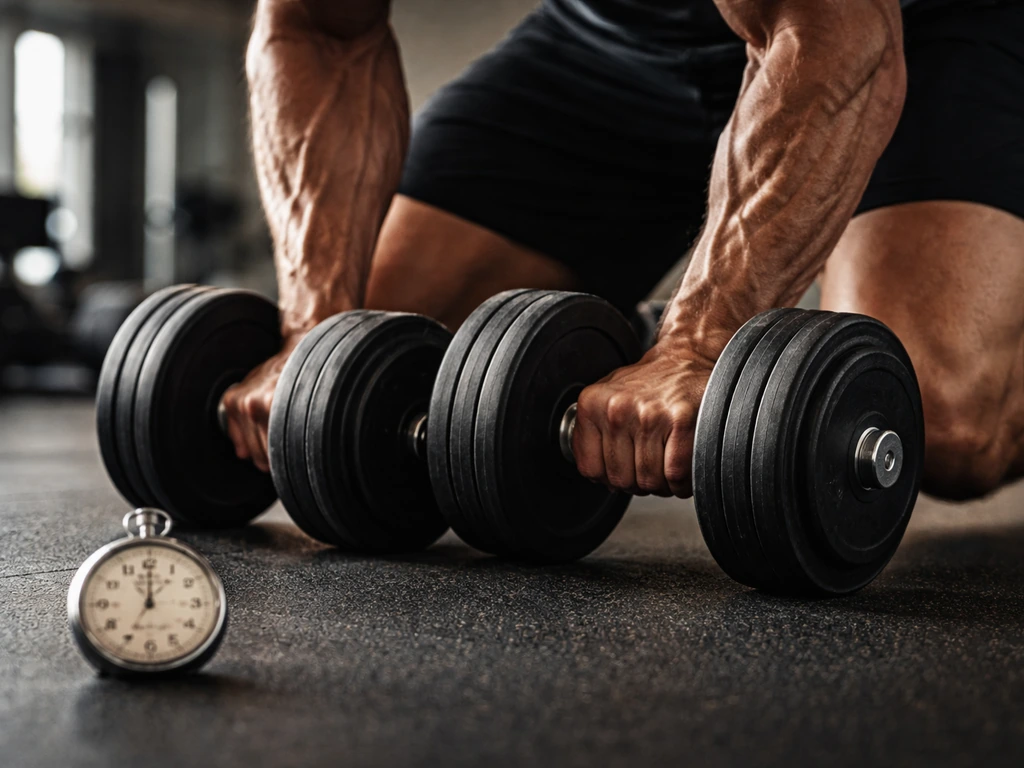
Volume only works if your sets are actually challenging. Research on proximity to failure makes it clear that sets need to be taken close to muscular failure to drive meaningful hypertrophy. That does not mean you have to grind out every rep to complete failure on every set. Stopping 1 to 3 reps short of failure, what coaches call leaving 1 to 3 reps in reserve, is effective and safer for joints and tendons. If you can crank out 20 reps with a dumbbell without much effort, that weight is not heavy enough. Pick a weight where the last 2 to 3 reps of your target rep range feel genuinely hard.
Progressive overload: the non-negotiable
Your muscles adapt to a given stimulus and stop growing if nothing changes. Progressive overload means you consistently increase the challenge over time. With dumbbells, that means adding reps within your target range, then moving up to a heavier dumbbell once you hit the top of that range. For example, if you are targeting 8 to 12 reps and you can do 12 clean reps, move to the next dumbbell weight. Track your workouts so you always know exactly where you left off.
Best dumbbell exercises for every major muscle group
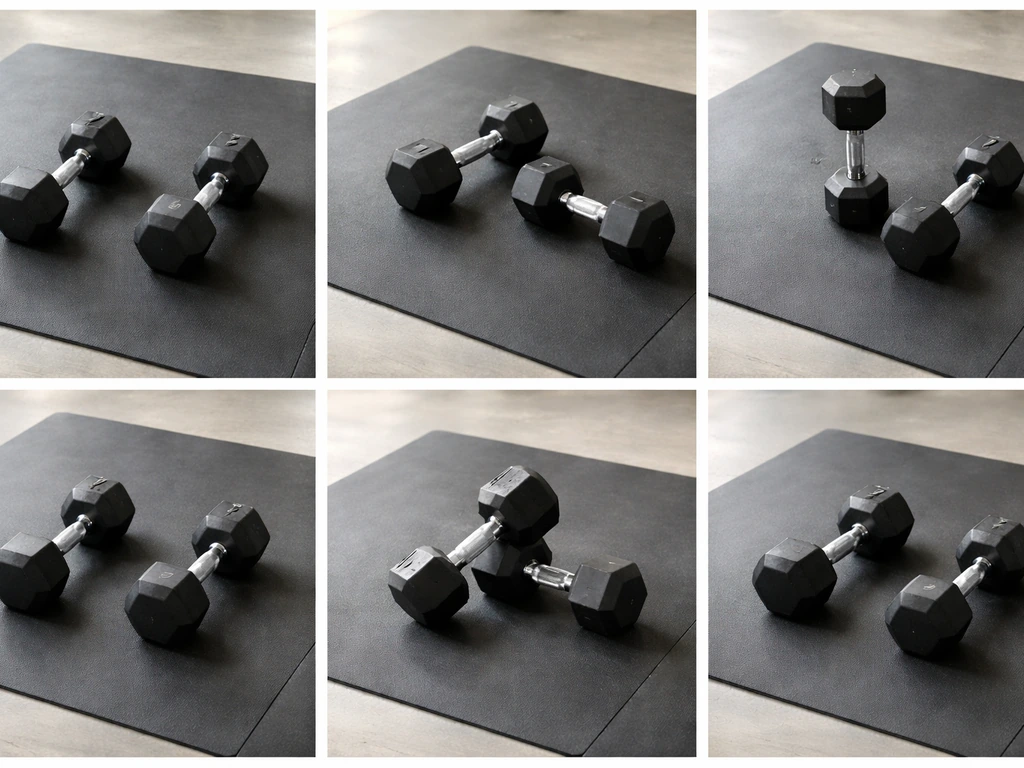
Dumbbells cover every major muscle group well. The key is selecting compound movements that move multiple joints (more muscle mass, more stimulus, more efficiency) and filling in with isolation work where needed. Here is a practical list organized by muscle group.
| Muscle Group | Primary Exercise | Supplemental Exercise |
|---|---|---|
| Chest | Dumbbell bench press (flat or incline) | Dumbbell fly / floor press |
| Back (lats/rhomboids) | Dumbbell row (single arm or chest-supported) | Dumbbell pullover |
| Shoulders | Dumbbell overhead press | Lateral raise / rear delt fly |
| Biceps | Dumbbell curl (supinating grip) | Hammer curl / incline curl |
| Triceps | Dumbbell overhead tricep extension | Dumbbell kickback / skull crusher |
| Quads | Dumbbell goblet squat / Bulgarian split squat | Dumbbell lunge (reverse or walking) |
| Hamstrings / Glutes | Dumbbell Romanian deadlift | Dumbbell hip hinge / sumo squat |
| Calves | Single-leg standing calf raise (holding dumbbell) | Seated calf raise (dumbbell on knee) |
| Core / Abs | Dumbbell side bend / weighted crunch | Farmer carry / plank with dumbbell drag |
If you only have a flat surface and no bench, the floor press replaces the bench press well for chest and triceps, and the goblet squat and reverse lunge cover legs thoroughly. You do not need every exercise on that list. Pick one or two per muscle group and get really good at them before rotating.
How to structure your dumbbell-only weekly plan
Two to four training days per week works for most people. The goal is to hit each muscle group at least twice per week, which the evidence consistently supports as more effective than once-a-week training. Here is a practical 3-day full-body template and a 4-day upper/lower split, either of which can be done with dumbbells alone.
Option 1: 3-day full-body (Mon / Wed / Fri)
- Day A: Dumbbell bench press, single-arm row, goblet squat, Romanian deadlift, overhead press, bicep curl
- Day B: Incline dumbbell press, chest-supported row, Bulgarian split squat, dumbbell lunge, lateral raise, overhead tricep extension
- Day C: Floor press, dumbbell pullover, goblet squat, Romanian deadlift, rear delt fly, hammer curl
- Rest days: Tuesday, Thursday, Saturday, Sunday
Option 2: 4-day upper/lower split
- Monday (Upper A): Dumbbell bench press, single-arm row, overhead press, bicep curl, overhead tricep extension
- Tuesday (Lower A): Goblet squat, Romanian deadlift, reverse lunge, calf raise
- Thursday (Upper B): Incline dumbbell press, chest-supported row, lateral raise, hammer curl, skull crusher
- Friday (Lower B): Bulgarian split squat, sumo squat, dumbbell hip hinge, calf raise
- Wednesday, Saturday, Sunday: rest or light activity
Sets, reps, and rest
| Goal | Reps per Set | Sets per Exercise | Rest Between Sets |
|---|---|---|---|
| Hypertrophy (main goal) | 8 to 15 | 3 to 4 | 60 to 90 seconds |
| Strength-focus sets | 5 to 8 | 3 to 5 | 2 to 3 minutes |
| Higher-rep endurance sets | 15 to 20 | 2 to 3 | 45 to 60 seconds |
For most beginners, 3 sets of 8 to 12 reps per exercise, taken to 1 to 2 reps short of failure, is the sweet spot. That gets you to roughly 9 to 12 sets per muscle group per week across a 3-day full-body plan, which sits right in the evidence-supported range. Once you have been training consistently for 3 to 6 months, you can push toward 4 sets per exercise or add an extra exercise per muscle group.
Nutrition: what you actually need to eat to grow

Training is the stimulus. Food is the raw material. You can do every exercise perfectly and still spin your wheels if nutrition is off. Three things matter most: total protein, total calories, and a rough understanding of where those calories come from.
Protein: the non-negotiable number
Aim for 1.6 to 2.2 grams of protein per kilogram of bodyweight per day. The ISSN recommends 1.4 to 2.0 g/kg as a general range for exercising individuals, and most practical recommendations for muscle building land at the higher end. For a 75 kg (165 lb) person, that is roughly 120 to 165 grams of protein per day. Spread it across 3 to 5 meals rather than loading it all in one sitting. Getting some protein in before sleep also has direct research support: one RCT found that consuming protein before sleep increased muscle mass and strength gains in young men doing resistance training, compared to not eating before bed.
Calories: surplus, maintenance, or deficit?
If building muscle is your main goal and you are not significantly overweight, eating in a modest caloric surplus works best. A surplus of 200 to 300 calories above your maintenance level gives your body the energy to build new tissue without excessive fat gain. Beginners can often make solid gains at or near maintenance for the first few months because the body is highly responsive early on. If you are unsure where to start, track your food for a week at your current eating habits to get a baseline, then add a small surplus on top.
Carbohydrates: not the enemy
Carbohydrates fuel your workouts and support recovery. Research shows that carbohydrate intake before or during resistance training can help you complete more total volume in longer sessions, particularly when you are doing 8 or more sets per muscle group in a session. You do not need to carb-load before every workout, but making sure you are not training on empty and that your overall carbohydrate intake is sufficient matters for training quality. A rough guide: fill roughly half your plate with complex carbs like rice, oats, potatoes, or fruit across your meals.
Recovery and supplements worth your attention
Sleep is the most underrated muscle-builder
Muscle is not built in the gym. It is built during recovery, and sleep is where the bulk of that happens. Research looking at acute sleep deprivation shows it directly reduces skeletal muscle protein synthesis and disrupts the hormonal environment needed for muscle growth. If you are wondering whether low testosterone changes your ability to build muscle, can you grow muscle with low testosterone is a useful related guide hormonal environment. Seven to nine hours per night is the practical target. If you are sleeping 5 to 6 hours and wondering why your progress has stalled, that is likely a major piece of the puzzle. There is also evidence that resistance training itself improves sleep quality over time, so the relationship goes both ways.
Creatine: the supplement with the strongest evidence
Creatine monohydrate is the most well-researched performance supplement in existence. The ISSN position stand on creatine summarizes decades of evidence supporting its safety and efficacy. A 2024 systematic review and meta-analysis specifically found that creatine supplementation combined with resistance training produced significantly greater strength gains than training alone in adults under 50. For muscle building, 3 to 5 grams of creatine monohydrate per day is the standard maintenance dose. You can do a loading phase of 20 grams per day (split into 4 doses of 5 grams) for 5 to 7 days to saturate muscle stores faster, then drop to 3 to 5 grams daily. Or just start with 5 grams a day from the beginning. Both approaches work.
Protein powder: a tool, not a requirement
Protein supplements are not magic, but they are convenient. A meta-analysis of protein supplementation and resistance training outcomes found that adding protein supplements augmented muscle mass and strength gains compared to controls, particularly when total daily protein intake would otherwise fall short. Use protein powder (whey, casein, or a plant-based option) if you are struggling to hit your protein targets through whole foods alone. It is just food in a faster format.
Caffeine: worth a mention
If you want a performance boost before training, caffeine has real evidence behind it. Research shows ergogenic effects on resistance training performance even at relatively modest doses. A cup of coffee or a caffeine supplement 30 to 45 minutes before your session can help you push harder and complete more volume. This is optional, not essential, and not something to use if it disrupts your sleep.
Soreness is not a progress indicator
One of the most persistent myths in training is that soreness equals growth. It does not. Delayed onset muscle soreness (DOMS) is a side effect of unfamiliar stress on the muscle. You will be sore as a beginner. You will be less sore after a few weeks on the same program even as you continue making progress. That is normal. Chasing soreness by constantly switching exercises is one of the most common ways people accidentally stall their results. Stick with your core exercises long enough to actually progress on them.
Common mistakes and realistic timelines
Mistakes that kill progress
- Using weights that are too light: if you can do 15 reps without struggling, go heavier
- Not tracking progress: without a log, you have no way to ensure progressive overload is happening
- Changing your program every two weeks: muscle adaptation takes months, not days
- Under-eating protein: most people who are not seeing results are simply not eating enough protein
- Treating rest days as optional: recovery is when growth happens, not an obstacle to it
- Skipping legs: lower body training is critical for overall muscle development and hormonal response
- Expecting spot reduction: you cannot choose where fat comes off; body composition changes happen systemically
What a realistic timeline looks like
In the first 4 to 8 weeks, most of your strength gains are neurological. Your nervous system is learning to recruit muscle more efficiently, not necessarily building new tissue. You will feel stronger and your technique will improve rapidly. Visible muscle changes typically start becoming noticeable around 8 to 12 weeks of consistent training and eating, though this varies significantly by individual. By the 6-month mark, assuming consistent training and adequate nutrition, beginner gains are often genuinely impressive: 2 to 4 kilograms of lean muscle in 6 months is realistic for many people, with some gaining more depending on genetics, age, and training quality. After the beginner phase, progress slows. That is not failure, it is just how physiology works.
Are dumbbells really enough compared to other methods?
The honest answer is yes, for the vast majority of people. The science comparing free weights to machines shows no consistent superiority for hypertrophy when training volume and effort are matched. Dumbbells offer a range of motion advantage over many machines and train stabilizer muscles more effectively than fixed-path equipment. They are also more accessible and versatile than barbells for home training. If you are curious how this compares to other equipment-light approaches, training with resistance bands or bodyweight through calisthenics can also drive muscle growth, though progressing load is more straightforward with dumbbells than with either of those options. Bodyweight calisthenics can also be enough to build muscle, especially if you use progressive overload like harder variations and more total volume. Adjustable dumbbells (like a 5 to 52.5 lb set) give you enough range to train your full body across every rep range from beginner through intermediate level without needing anything else.
Your first step starting today
Pick the 3-day full-body template above, choose one or two exercises per muscle group from the exercise table, and do 3 sets of 10 reps per exercise with a weight that makes the last 2 reps challenging. Write down every weight and rep count after your session. Show up again two days later and try to beat what you did. Eat 1.6 to 2.0 grams of protein per kilogram of bodyweight every day. Sleep at least 7 hours. Do that for 12 consistent weeks before you make any major changes to the plan. That is genuinely it.
FAQ
How heavy should my dumbbells be when I’m trying to grow muscle?
For the first few weeks, prioritize good form and controlled reps, then choose a dumbbell weight where you can complete the full set but only 2 to 3 reps before failure (stop with 1 to 3 reps left in reserve). If you can exceed the top of your rep range for all sets with the same control, increase weight next session. If you cannot hit the bottom of the rep range for most sets, reduce weight and rebuild from there.
If I can do more reps than the plan says, should I add weight immediately?
Yes. Instead of chasing a specific rep target every week, use a “rep range” and progress by reps first, then load. Example, for 8 to 12 reps, stay at the same weight until you can perform 12 clean reps on your working sets, then move up. Keep your rest periods consistent, commonly 1.5 to 3 minutes for compound dumbbell lifts, because longer rests can let you hit higher-quality reps.
How close to failure do I actually need to train with dumbbells?
Do not. For hypertrophy, the goal is consistent near-failure sets across weeks, not turning every workout into a maximal effort grind. A practical rule: aim to stop most sets with 1 to 3 reps in reserve, use slightly harder efforts on your last set for each exercise if recovery is good, and deload if performance drops for 2 straight weeks (for example, reduce sets by about 30 to 50% while keeping the same technique).
What goes wrong if I train to true failure constantly?
If you hit failure every set, fatigue accumulates and volume drops, which can slow growth even if intensity is high. The article’s approach, leaving reps in reserve, helps you sustain weekly volume. If you are not recovering, reduce volume first (fewer sets per week), then reduce closeness to failure, because those changes usually improve results faster than swapping exercises.
How fast should I add more volume with dumbbells?
Best results typically come from increasing weekly sets and training frequency steadily, then letting recovery catch up. If you are currently doing 8 to 10 sets per muscle group, try adding 2 sets per week total for that muscle group by adjusting either one extra set per exercise or an extra exercise variation. If your performance or sleep worsens, keep the set increase smaller, for example add 1 set per week.
What if I can only work out 2 days per week?
You can grow with 2 days per week per muscle group, as long as total weekly sets and effort are sufficient. The common sweet spot used for planning is hitting each muscle group about twice weekly, but the key is reaching your weekly set target. If you can only train 2 or 3 full-body sessions, use 2 to 3 exercises per workout per major muscle group and keep the reps and effort within your established rep range.
Should I slow down my reps or use strict tempo for dumbbell muscle growth?
It depends on the lift. For dumbbell rows, overhead pressing, and lunges, use control and a pause if needed, but avoid long isometric holds that turn the set into endurance work. A simple cue that works: 2 to 4 seconds on the lowering (eccentric), and drive up with intent without bouncing. If you cannot control the lowering, use a lighter weight so the stimulus stays on the target muscle.
What if my adjustable dumbbells have jumps that are too big between weights?
Yes, but the progression method matters. For muscle building with dumbbells, “more reps” is usually easiest early on, then you switch to a heavier dumbbell when you top your rep range. If you can only make small weight jumps, use options like partials only at the end of the set (not as your main range), more total sets, or slightly longer time under tension while still keeping the same proximity to failure.
How should I track workouts if I’m using only dumbbells?
Track performance in a way that supports progression. For each exercise, write the weight and reps for every set, plus any notes about form breakdown (for example, “rows slowed at rep 10” or “lunges felt unstable”). Use those notes to decide whether to stay at the same weight next week or reduce weight and refine technique.
When should I change exercises instead of sticking with the same plan?
Switching exercises can help prevent boredom, but constant swapping is a common reason progress stalls. A practical approach is to keep 1 to 2 core exercises per muscle group for at least 6 to 10 weeks, then swap one movement if you plateau or if a joint issue appears. Choose replacements that maintain the same movement pattern and training intent, like swapping dumbbell bench press for floor press if shoulder comfort is the limiting factor.
Can I grow muscle with dumbbells while dieting or cutting calories?
A calorie deficit makes building harder because you provide less raw material for tissue repair and you often reduce training quality. If you are trying to lean out and gain some muscle at the same time, aim for a small deficit or maintenance, keep protein high, and expect slower muscle gain. If strength is dropping for 2 weeks, that is a sign the deficit is too aggressive.
Does protein timing matter, or is daily protein enough?
Protein is the priority, but meal timing is mainly a support tool. A useful detail for consistency: distribute protein across 3 to 5 meals and include a protein serving before sleep if you struggle to meet daily totals, because some studies show it can improve gains when paired with training. If you are already hitting your daily protein target, changing timing usually matters less than total intake and resistance training effort.
How do I know when to deload, and what should I do during a deload week?
A full shutdown is not required, but you should plan a deload if symptoms show up. Signs include steadily worsening performance (for example, you cannot reach rep targets at the same weights), persistent soreness that never fades, irritability, or sleep getting worse. A common deload is reducing sets by 30 to 50% for about 5 to 7 days while keeping the same exercises and rep ranges.
Do I need to cycle creatine or use a loading phase for results?
Creatine is the most useful supplement for many people because it supports higher training output over time. For most, 3 to 5 grams daily is enough, and you do not need cycling. If you are sensitive to stomach discomfort, start with 3 grams, split into 1 to 2 doses, and take it with food. Hydration and overall calorie intake still matter for training quality.
What’s the simplest way to start if I’m overwhelmed by all the variables?
If you want a simple starting point, 3 sets per exercise with 8 to 12 reps, stop 1 to 2 reps short of failure, and rest long enough to keep reps high quality. Keep most of your sessions in that “repeatable” zone. Then adjust one variable at a time after 12 consistent weeks, for example add 1 set per exercise, or increase weekly sets for a lagging muscle rather than changing everything at once.
Citations
In a systematic review/meta-analysis comparing free-weight vs machine-based resistance training (minimum 6 weeks, adults), there were no significant differences between training modes for hypertrophy when studies were appropriately compared (i.e., muscle hypertrophy did not differ meaningfully overall).
https://pubmed.ncbi.nlm.nih.gov/34609100/
A 2023 systematic review/meta-analysis (BMC Sports Science, Medicine and Rehabilitation) investigating free-weights vs machines reported muscle hypertrophy effects in both modalities and discussed that differences, where present, were not consistent enough to conclude one modality is inherently superior when training variables are matched.
https://link.springer.com/article/10.1186/s13102-023-00713-4
ACSM’s 2026 resistance training position stand overview indicates a dose-response for hypertrophy with weekly volume: “~10 sets per muscle group” and a dose-response up to roughly “18–20 sets per week” across multiple reviews (evidence synthesis basis described in the overview).
https://www.acsm.org/wp-content/uploads/2026/03/Resistance-Training-Position-Stand-infographic.pdf
A key meta-analysis of weekly resistance training volume and muscle hypertrophy (Schoenfeld, Ogborn, Krieger 2017) found a graded dose-response relationship between weekly sets and increases in muscle mass (with returns diminishing at higher volumes).
https://pubmed.ncbi.nlm.nih.gov/27433992/
A systematic review/meta-analysis on proximity-to-failure and skeletal muscle hypertrophy (published on PMC) synthesizes trials that varied how close sets were taken to muscular failure; it emphasizes that hypertrophy results depend on the reached proximity-to-failure (and calls for better reporting/quantification of the proximity achieved).
https://pmc.ncbi.nlm.nih.gov/articles/PMC9935748/
The ISSN position stand on protein and exercise (2017) recommends most exercising individuals consume approximately 1.4 to 2.0 g protein/kg/day to optimize training-induced adaptations.
https://jissn.biomedcentral.com/articles/10.1186/s12970-017-0177-8
The Ergogenic Effects of Acute Carbohydrate Feeding on Resistance Exercise Performance systematic review/meta-analysis found that carbohydrate ingestion before/during resistance training can enable greater volume completion during longer sessions (noting conditions like ≥8–10 sets).
https://pmc.ncbi.nlm.nih.gov/articles/PMC9584980/
ISSN’s creatine safety/efficacy position stand (2017) states the most effective way to increase muscle creatine stores is ingesting 5 g creatine monohydrate (or ~0.3 g/kg) four times daily for 5–7 days (loading phase), and summarizes safety/efficacy evidence across durations and markers.
https://jissn.biomedcentral.com/articles/10.1186/s12970-017-0173-z
Creatine supplementation in adults undergoing resistance training has systematic review/meta-analysis evidence for strength benefits (example: a 2024 systematic review/meta-analysis reported larger strength gains vs placebo across upper and lower-body strength outcomes).
https://pmc.ncbi.nlm.nih.gov/articles/PMC11547435/
A systematic review/meta-analysis on protein supplementation and resistance training-induced gains in muscle mass and strength (2018; on PMC) evaluated whether adding protein supplements augments training outcomes compared with placebo/no supplementation.
https://pmc.ncbi.nlm.nih.gov/articles/PMC5867436/
A systematic review/meta-analysis of caffeine on resistance exercise outcomes found evidence of ergogenic effects across small doses (reviewed as 0.9–2 mg/kg in the included studies) on resistance training performance metrics.
https://pubmed.ncbi.nlm.nih.gov/35203046/
Resistance training improves measured sleep-related outcomes in at least some populations; e.g., an RCT in maintenance hemodialysis patients reported improvements in sleep quality along with other recovery/physiology markers after a training period.
https://www.nature.com/articles/s41598-020-68602-1
A randomized controlled trial found protein ingestion before sleep can increase muscle mass and strength gains during prolonged resistance-type training in healthy young men (supports practical meal timing for beginners who struggle to hit daily protein).
https://pubmed.ncbi.nlm.nih.gov/25926415/
ACSM’s 2016/2026-era positioning emphasizes volume as a principal driver; ACSM’s resistance training prescription guidance (overview document/infographic) supports starting with at least 2 days/week per muscle group and gradually building total weekly volume toward ~10 sets per muscle group.
https://www.acsm.org/resistance-training-guidelines-update-2026/?nocache=1775184380
A randomized controlled trial’s mechanistic evidence links sleep restriction to reduced anabolic/protein synthesis signaling; for example, a study examined the impact of acute sleep deprivation on skeletal muscle protein synthesis and hormonal environment (anabolic resistance after deprivation).
https://pubmed.ncbi.nlm.nih.gov/33400856/