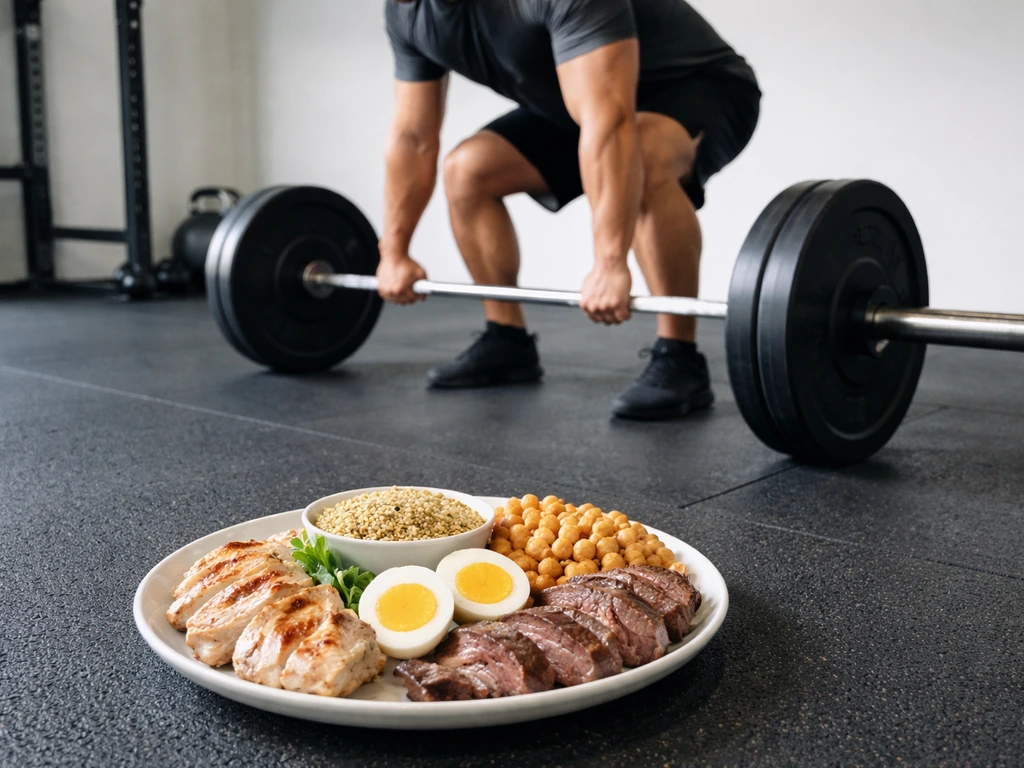
Yes, you can absolutely build muscle without supplements. Protein powders, creatine, and pre-workouts are convenient, but they are not the engine behind muscle growth. The engine is progressive resistance training paired with enough calories and protein from real food. Supplements can add a small edge at the margins, but the two things that actually drive hypertrophy, mechanical tension on your muscles and enough raw material to repair and build new tissue, are fully available to you through a barbell, a pair of dumbbells, your own bodyweight, and a well-stocked kitchen. Plenty of people build impressive physiques without ever opening a tub of protein powder, and the physiology backs that up.
How to Grow Muscle Without Supplements or Steroids

Marcus Kellerman
28 Apr 2026

Can you actually build muscle without supplements?
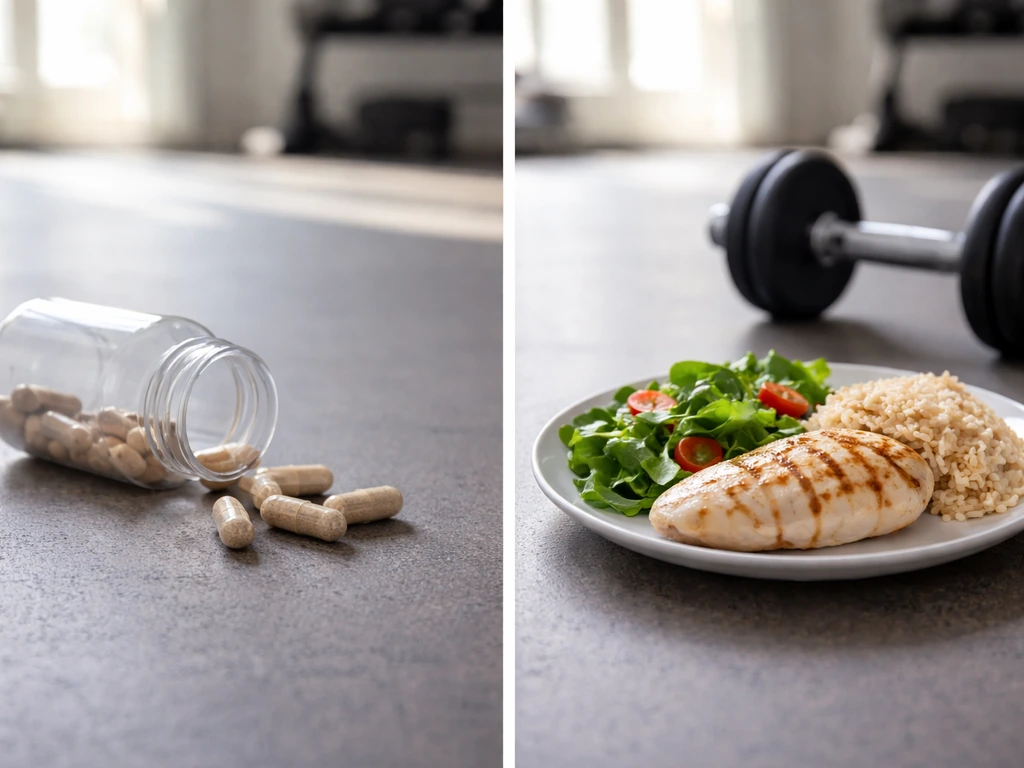
The short version of the science: protein supplementation during resistance training does produce greater gains in muscle size and strength compared to not supplementing, according to a 2018 meta-analysis in the British Journal of Sports Medicine. But the same research found that beyond roughly 1.6 g of protein per kilogram of bodyweight per day, additional protein stops contributing meaningfully to muscle gains. That threshold is entirely reachable through food. A 180-pound (82 kg) person needs about 130 g of protein a day to hit it, the equivalent of a couple of chicken breasts, a few eggs, some Greek yogurt, and a handful of beans across your meals. No powder required.
Creatine is genuinely useful, it is one of the most well-researched and effective ergogenic supplements available, and if you are curious whether it's worth adding later, that's a separate conversation worth having. But creatine does not build muscle on its own. For most people asking can you grow muscle without creatine, the key is making sure your training stimulus and food intake are already on point. It helps you train harder, which then drives muscle growth. If your training and nutrition are solid, creatine adds a small boost. If your training and nutrition are not solid, creatine changes nothing meaningful. The same logic applies to every other supplement on the market: they work around the edges of a process that is fundamentally driven by training stimulus and food.
Training for muscle growth: stimulus, effort, and progressive overload
Muscle grows when it is exposed to a stimulus it cannot comfortably handle, forced to repair, and then exposed to a slightly harder stimulus the next time. That is the whole game. Everything in training comes back to three things: are you giving your muscles enough mechanical tension, are you doing enough total volume each week, and are you making it progressively harder over time?
Intensity and effort

For most people, training in the range of roughly 70 to 85 percent of your one-rep max is a solid target for hypertrophy. That usually translates to sets of 8 to 15 reps where the last few reps genuinely challenge you. But here is what the research actually shows: hypertrophy can happen across a wide range of loads, from lighter weights to near-maximal loads, as long as you are working with real effort. A lot of people also use bodyweight movements and progressive overload to learn how to grow muscles without weights hypertrophy can happen across a wide range of loads. A related option is learning how to grow muscle without weights using bodyweight movements and progressive overload. Sets taken close to failure tend to be more productive for muscle growth than sets where you stop when it feels easy. You do not always need to train to complete failure, but you need to push close enough that the muscle is actually being challenged.
Weekly volume
Research shows a clear dose-response relationship between weekly training volume (measured in sets per muscle group per week) and hypertrophy, with diminishing returns at higher volumes. For most people, 10 to 20 sets per muscle group per week is a reasonable productive range. Beginners see excellent results at the lower end because any sufficient stimulus is novel. More advanced lifters tend to need more volume to keep progressing. Start conservatively and add sets over weeks and months rather than going overboard from day one.
Training frequency
Training each muscle group at least twice a week appears to produce better hypertrophy outcomes than once a week, assuming total weekly volume is matched. The practical reason: spreading your volume across multiple sessions lets you do quality work per session rather than crushing a muscle with 20 sets in one brutal workout. A full-body routine three days a week or an upper/lower split four days a week both work well for this.
Progressive overload
Progressive overload does not just mean adding weight to the bar every week. You can also progress by adding reps at the same weight, adding sets over time, reducing rest periods, or improving technique so a given load becomes more effective. What matters is that the demand on your muscles is gradually increasing. If you are doing the same workout with the same weight for months on end and not progressing in any measurable way, your muscles have little reason to adapt further.
How fast can you actually gain muscle?
Let's be direct here: muscle growth is slow, and anyone promising dramatic results in two weeks is selling something. Measurable increases in muscle cross-sectional area typically start showing up after 8 to 10 weeks of consistent resistance training. Studies using imaging have confirmed meaningful hypertrophy over 8 to 10-week training blocks, but visible changes in the mirror and meaningful strength increases often come earlier, partly because of neural adaptations that make you stronger before your muscles actually get bigger.
Realistic rates of muscle gain for natural trainees (no performance-enhancing drugs) are roughly 1 to 2 pounds of muscle per month for beginners, and considerably less as you get more advanced. Men tend to gain faster than women due to hormonal differences, and younger adults gain faster than older adults, though older adults absolutely can and do build muscle with consistent training. What "fast" means in a supplement-free, steroid-free context is maximizing your rate within natural limits: training consistently, eating enough, sleeping enough, and not leaving obvious gains on the table by under-eating or under-training.
The good news for beginners is that the first 6 to 12 months of serious training typically produce the fastest gains you will ever experience. Your body is highly responsive to a new training stimulus and has not yet adapted to the pattern. That window is worth taking seriously.
Eating for muscle growth without supplements
Two things need to be right with your nutrition: total calories and total protein. Everything else, meal timing, food quality, macronutrient ratios beyond those two anchors, is secondary. Get these two right and you will grow muscle. Miss them and no supplement in the world will fully compensate.
Calories: you need to eat enough
Building muscle requires energy. If you are in a significant calorie deficit, your body does not have the surplus resources needed to build new tissue, and it may even break down muscle to fuel itself. For most people trying to gain muscle efficiently, eating at or slightly above your maintenance calories (a modest surplus of around 200 to 300 calories per day) is the practical target. This keeps fat gain minimal while giving your body what it needs to build. Eating at a large surplus will not make you gain muscle faster, it will mostly make you gain more fat.
Protein: the target and how to hit it from food
The ISSN recommends a daily protein intake of roughly 1.4 to 2.0 g per kilogram of bodyweight for most exercising adults, and the research ceiling for muscle gain benefits sits at around 1.6 g/kg/day. Practically, aiming for 1.6 to 2.0 g/kg/day gives you a comfortable buffer. For a 170-pound (77 kg) person, that works out to about 123 to 154 grams of protein per day. Here is what that looks like from real food:
| Food | Serving Size | Approximate Protein |
|---|---|---|
| Chicken breast (cooked) | 4 oz (113g) | ~35g |
| Eggs | 3 large | ~18g |
| Greek yogurt (plain) | 1 cup (227g) | ~20g |
| Canned tuna | 1 can (5 oz drained) | ~25g |
| Cottage cheese | 1 cup (226g) | ~28g |
| Lentils (cooked) | 1 cup (198g) | ~18g |
| Salmon (cooked) | 4 oz (113g) | ~30g |
| Ground beef 90% lean (cooked) | 4 oz (113g) | ~30g |
| Black beans (cooked) | 1 cup (172g) | ~15g |
| Whole milk | 1 cup (240ml) | ~8g |
Spreading protein across 3 to 4 meals throughout the day is a reasonable approach, with each meal containing around 30 to 40 grams of protein. The idea of a tight post-workout "anabolic window" is less important than the research once suggested, the window for muscle protein synthesis to benefit from protein intake is likely several hours wide, so just make sure you are eating enough total protein across the day rather than stressing about eating within 30 minutes of a workout.
Recovery is where the growth actually happens
Training breaks your muscles down. Recovery is when they rebuild stronger. Skipping recovery is like planting seeds and never watering them, the stimulus happened, but the growth did not.
Sleep is non-negotiable
Sleep deprivation is genuinely damaging to muscle building. One study found that acute total sleep deprivation reduced muscle protein synthesis by approximately 18% and created a more catabolic hormonal environment. A separate systematic review confirmed that sleep loss causes measurable reductions in strength-related outcomes. Aim for 7 to 9 hours of quality sleep per night. This is not a soft recommendation, it is one of the highest-leverage things you can do for muscle growth, and it costs nothing.
Rest days and managing soreness
Delayed onset muscle soreness (DOMS) typically peaks around 24 to 48 hours after training and usually clears up within 72 hours. Some soreness is normal, especially when you train a new movement or increase volume. But soreness is not a reliable indicator that you are growing muscle, and lack of soreness does not mean the training was ineffective. You do not need to be wrecked after every session. Rest days are where adaptation consolidates, so treat them seriously. Most people do well with 1 to 2 rest days per week, and at minimum you should avoid training the same muscle group two days in a row when doing higher volumes.
Stress and cortisol
Chronic psychological stress elevates cortisol, which opposes muscle protein synthesis and can impair recovery. This does not mean you need to meditate for an hour a day, but it does mean that if your life is extremely stressful, your gains will likely suffer even if your training and eating are solid. Managing stress, through whatever practical means work for you, is a legitimate part of a muscle-building program.
Deloads
After several weeks of hard training, a planned deload, a week where you reduce volume and intensity significantly, helps manage accumulated fatigue without losing muscle. Research on deload practices among coaches typically describes deloads involving reduced session frequency (1 to 2 sessions per week), fewer sets (1 to 3), and lower intensities (around 60 to 84% of 1RM). You do not need to deload every month, but if you feel consistently beat up and performance is declining, taking a lighter week is a smart move rather than grinding through.
Why you might not be gaining muscle (and how to fix it)
Most people who are not gaining muscle are running into one or more of these problems. Being honest about which one applies to you is usually the fastest way to start making progress.
- Under-eating: This is the most common blocker. If you are not in a calorie surplus or at least at maintenance, muscle growth stalls. Track your intake for a few days and compare it to your estimated maintenance calories. Many people consistently eat less than they think.
- Not enough protein: Hitting 1.6 g/kg/day of protein from food takes deliberate planning. If you are only getting 0.6 to 0.8 g/kg, you are leaving a significant amount of potential growth on the table regardless of how hard you train.
- Training without real progression: Doing the same weights, reps, and sets month after month gives your muscles no new reason to adapt. Progressive overload is mandatory, not optional.
- Too little volume: A single set of each exercise once a week is not enough to drive meaningful hypertrophy for most people. If your weekly set count per muscle group is very low, gradually increasing it will directly increase growth.
- Poor technique: Bad form reduces tension on the target muscle and increases injury risk. A deadlift done with a rounded lower back, or a bench press where your elbows flare out uncontrollably, means the right muscles are not being loaded properly. Technique investment pays off directly.
- Not training consistently enough: The research is clear that for many adults, the biggest gap is simply not doing resistance training regularly enough. Two or three consistent sessions per week over months and years outperforms any sophisticated program you do sporadically.
- Expecting results too fast: If you are checking the mirror after two weeks and concluding it is not working, you are looking too early. Muscle growth is measured in months, not days. Consistent effort over 8 to 12 weeks will show you real results.
A simple no-supplement muscle-building plan you can start today
This plan covers all the essentials without a single supplement. It works for beginners and is a solid reset for anyone who has been spinning their wheels.
Training: 3 days per week, full body
Train on non-consecutive days (Monday, Wednesday, Friday or similar). Each session should include a lower body push (squat or lunge pattern), a lower body pull (deadlift or hip hinge), an upper body push (bench press, overhead press, or push-up), an upper body pull (row or pull-up), and a core exercise. Do 3 sets of each exercise for 8 to 12 reps, stopping 1 to 2 reps short of failure on most sets. Rest 2 to 3 minutes between sets for compound exercises. Track your weights and reps every session, and aim to add a rep or a small amount of weight each week.
Nutrition: daily targets from real food
- Calculate your approximate maintenance calories using your bodyweight in pounds multiplied by 15 (a rough starting estimate for moderately active adults). Add 200 to 300 calories to get your daily muscle-building target.
- Hit 1.6 to 2.0 g of protein per kilogram of bodyweight each day using meat, fish, eggs, dairy, and legumes. Use the food table above as a reference for portion sizes.
- Spread protein across 3 to 4 meals, aiming for roughly 30 to 40 grams per meal.
- Eat enough carbohydrates to fuel your training — rice, oats, potatoes, fruit, and bread are all fine. Low-carb approaches work for some people, but carbs support training performance and recovery.
- Do not obsess over meal timing. Eat enough across the day and make sure at least one solid meal lands within a few hours of your training session.
Recovery: the basics
- Sleep 7 to 9 hours per night. Prioritize this the same way you prioritize training.
- Take 1 to 2 full rest days per week. Active recovery (walking, light stretching) is fine on those days.
- If you feel consistently overtrained after 6 to 8 weeks of consistent effort, take a deload week where you cut your sets in half and reduce intensity.
- Manage stress with whatever works for you — walking, proper sleep, limiting caffeine late in the day, or simply keeping your schedule manageable.
What to expect
In the first 4 weeks, strength will increase noticeably as your nervous system adapts. By weeks 6 to 10, you will start seeing actual muscle size changes if your nutrition is on point. By month 3 to 6, the results become genuinely visible. Stick with this framework and you will be building real, lasting muscle, entirely without supplements, entirely without steroids, and entirely within what your body can naturally and sustainably do.
FAQ
If I skip supplements completely, do I still need to hit a specific protein target every day?
Yes. Even without powders, protein adequacy matters because it supplies the amino acids your body needs for repair. Use a daily target (around 1.6 to 2.0 g per kg) and prioritize consistency, because missing multiple days is harder to “make up” than having a slightly smaller meal. If you struggle to reach the number, add high-protein foods to existing meals rather than trying to force a large single serving.
What if I cannot eat enough calories for a muscle-building surplus without gaining lots of fat?
Aim for a small surplus (about 200 to 300 calories/day) and adjust weekly based on your scale trend and waist. If weight is not rising after 2 weeks, add 100 to 150 calories. If you are gaining too fast or waist is creeping up quickly, reduce slightly. Also choose calorie-dense whole foods like olive oil, nuts, rice, potatoes, and full-fat dairy to increase intake without huge meal volumes.
How close to failure should I train if I want muscle growth without supplements?
Use effort, not soreness, as your guide. On most sets for hypertrophy, stop about 0 to 2 reps short of failure (meaning you could do 0 to 2 more reps with good form). If you never reach that level, training may be under-stimulating even if you “feel tired.” A good check is whether your top sets slow down noticeably or whether you struggle to keep the same rep range week to week.
Do I need to train with heavy weights to grow muscle, or can I use mostly moderate and light loads?
You can grow with a wide load range as long as sets are challenging. Lighter work requires more reps and closer proximity to failure to create enough mechanical tension. A practical approach is to keep most training in rep ranges that let you reach near-failure (for example, 8 to 15 on many sets), while occasionally using heavier sets (lower reps) to improve strength and exercise quality.
Is it a problem if I do not experience DOMS after workouts?
Not necessarily. DOMS is an imperfect sign of growth, some sessions especially with experienced lifters may cause little soreness. Focus on progressive overload and making sets hard enough. If strength and rep performance are moving upward over weeks, lack of soreness usually means you are recovering well, not that the workout failed.
How many sets per week should I do if I am not using supplements and I am trying to maximize progress?
A good starting range is 10 to 20 hard sets per muscle group per week, then adjust based on results. If you are a beginner, you can often grow on the lower end. If progress stalls for 3 to 6 weeks, add sets gradually (for example, +2 to 4 per week) rather than doubling volume overnight.
Should I train the same muscle group twice a week or is once enough?
Twice per week often works better when total weekly volume is matched, because it lets you spread work and recover between sessions. If you prefer once weekly, it can still work, but you usually need a higher per-session volume and you must manage fatigue so your later sets remain high quality.
What does progressive overload look like if I am using mostly bodyweight or home equipment?
Progression can be reps, sets, range of motion, tempo, or leverage. For bodyweight, use harder variations (for example, incline push-ups to deficit push-ups), add reps until you hit the top of your rep range, then add a set or slow the lowering phase. You can also add resistance with a backpack or bands if the variation progression stalls.
How long should it take before I can tell my plan is working without supplements?
You should usually see strength improvements within the first 4 weeks, with more visible muscle size changes starting around 6 to 10 weeks if nutrition is adequate. Major changes typically become more obvious by 3 to 6 months. If nothing is improving by about 8 to 12 weeks, review training effort, weekly volume, calorie intake, and sleep before assuming the plan cannot work.
Can creatine-free training still support performance and recovery enough for muscle gain?
Yes. Creatine mainly provides an additional performance edge, it is not a requirement for hypertrophy. If you are not gaining, the most common causes are insufficient training stimulus (not close enough to failure, too little volume) or under-eating protein and calories, rather than the absence of creatine.
How should I structure rest days and deload weeks to avoid stalling without relying on supplements?
If performance is declining or joints feel beat up, take a planned deload by reducing sets and intensity for about a week. A deload often helps more than pushing through indefinitely, especially when you have been training hard for several weeks. For rest, aim for at least one or two rest days per week, and avoid training the same high-volume muscle group on consecutive days when you are pushing the top end of weekly volume.
Do I need an exact post-workout meal or “anabolic window” to grow muscle naturally?
No exact timing is required, as long as you eat enough total protein and calories across the day. Post-workout, it helps to include protein in the next meal, but the priority is hitting your daily totals. If your schedule is tight, plan protein distribution across 3 to 4 meals so you average out intake rather than stressing about minutes.
What are the most common reasons people fail to gain muscle without supplements?
The usual culprits are not eating enough calories, not reaching protein targets, training too far from failure, doing too few total hard sets per week, and poor sleep. A less obvious issue is lack of measurable progression, if weights and reps do not move for weeks, the plan needs adjustment even if the workouts “feel” hard.