The easiest muscle to grow for most people is the one their body is already primed to respond to, which for the majority of beginners and intermediate lifters tends to be the glutes, quads, or lats. But that answer only holds up if you understand what "easy" actually means in this context, because genetics, training age, and muscle architecture all factor in. This article gives you the direct answer, a quick way to figure out which muscle is easiest for your specific body, and a practical plan for training it starting today.
What Is the Easiest Muscle to Grow? How to Pick Yours

Marcus Kellerman
10 Apr 2026

What "easiest to grow" really means
When people ask which muscle is easiest to grow, they usually mean: which one will show visible size and strength gains the fastest with the least frustration? That's a fair question, but it's worth unpacking, because "easy" is doing a lot of work in that sentence.
Ease of growth comes down to three things: your anatomy, your training age, and where your current weaknesses are. Anatomy matters more than most people think. Muscle architecture variables like fascicle length and pennation angle differ substantially between individuals and even between muscles within the same person. These differences affect how a muscle generates force and how it responds to loading. A muscle with longer fascicles tends to have more contractile tissue in series, which can mean greater potential for hypertrophy under the right loading conditions. Your tendon length, joint structure, and limb proportions all influence this, and they're set by your biology.
Training age matters enormously. If you've never trained before, almost every muscle group is "easy" to grow in the first few months because your nervous system and muscle tissue are highly responsive to new mechanical stress. After a few years of consistent training, the picture changes and some muscles plateau while others keep responding. And your current weaknesses, meaning muscles you've barely trained, are often your fastest growers the moment you start loading them properly. This is sometimes called a "training stimulus naivety" advantage.
One important thing to keep in mind: research has shown enormous variability in how individuals respond to resistance training. In one study comparing training adaptations, strength gains ranged from 17% to 47% and muscle fiber size changes ranged from -19% to +22% across participants doing the same program. That spread isn't explained by muscle fiber type differences alone. It's partly genetic, partly mechanical. So while general patterns exist, your individual response will always be the final word.
The muscles most people find easiest to grow first
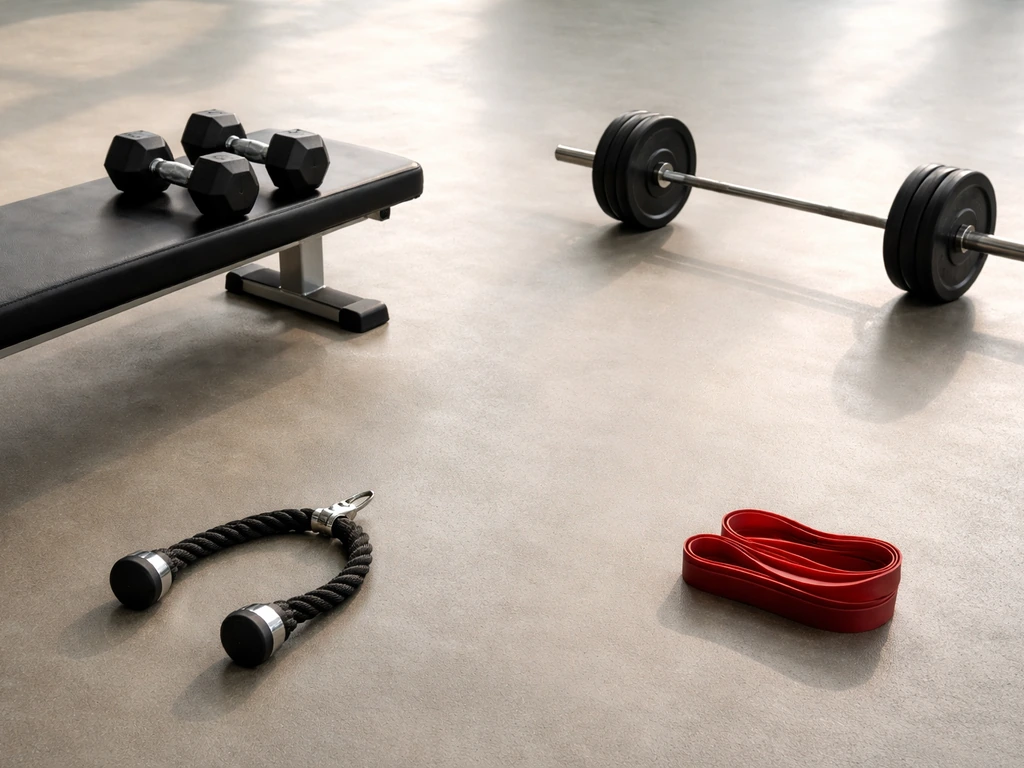
For most lifters, especially beginners, the muscles that tend to respond fastest are the glutes, quadriceps, lats, and chest. These are large, multi-joint muscles with a high density of fast-twitch fibers that respond well to compound loading. They're also muscles that get direct, high-quality mechanical tension from basic movement patterns like squats, hip hinges, rows, and presses, which are the exercises most people start with.
The glutes are often overlooked but are among the most trainable muscles in the body. They're large, they respond well to both heavy compound work (squats, deadlifts) and targeted isolation (hip thrusts, glute bridges), and many beginners are functionally undertrained in them due to sedentary lifestyles. That combination of size potential and training naivety makes them grow fast once you start targeting them deliberately.
The quads are similar. They're the largest muscle group in the lower body, they get loaded heavily in everyday movement patterns, and compound exercises like squats and leg presses hit them with substantial mechanical tension across a large range of motion. For most untrained individuals, quad growth shows up within the first 6 to 8 weeks of consistent training.
The lats and chest also show up on this list for most people because they respond quickly to pressing and pulling movements, the volume of stimulus from basic exercises is high, and compound loading means you can move heavy weight early in your training. If you're curious about which specific muscles show the fastest visible changes, it's worth exploring what muscles grow the fastest in detail, as the answer involves both the rate of protein synthesis and how much of the muscle is actually visible through the skin.
Is the back the easiest muscle to grow?
Back is one of the most common answers people throw around when this topic comes up, and there's genuine logic behind it. The back is a collection of large muscles (lats, rhomboids, traps, erectors) that respond well to volume and can handle heavy loading. Beginners often notice rapid back growth from rows and pull-downs simply because the muscles are untrained and the mechanical loading is substantial.
That said, back is also notoriously difficult to feel during training, especially for beginners. The mind-muscle connection for the lats in particular takes time to develop, and many people inadvertently shift load to the biceps and forearms on pulling exercises. That neurological limitation can blunt early hypertrophy even when the volume is technically there.
Here's how back stacks up against other commonly cited "easy to grow" muscles:
| Muscle Group | Growth Speed (Beginners) | Ease of Loading | Mind-Muscle Connection | Overall Beginner Ranking |
|---|---|---|---|---|
| Glutes | Very fast | High (hip thrust, squat) | Moderate | Top tier |
| Quads | Very fast | Very high (squat, leg press) | Easy | Top tier |
| Lats/Back | Fast | High (rows, pull-downs) | Difficult at first | Strong but not #1 |
| Chest | Fast | Very high (bench, push-up) | Moderate-easy | Top tier |
| Biceps | Moderate | Easy (curls) | Easy | Mid tier |
| Triceps | Fast | High (press movements) | Moderate | Strong |
| Calves | Slow for most | High | Easy | Bottom tier |
Back is a strong contender but probably not the single easiest for most beginners because of that mind-muscle connection barrier. Glutes and quads edge it out on sheer growth rate for untrained individuals. For intermediate lifters who have already developed a feel for pulling movements, the lats can absolutely become one of the fastest-responding muscles in their program.
It's also worth keeping in mind that certain muscles are notoriously difficult to grow regardless of training age. If you want to understand the full picture, looking at what is the hardest muscle to grow will help you set realistic expectations for the muscles at the opposite end of this spectrum, like calves and forearms.
How to figure out which muscle is easiest for you

General patterns are useful, but your body has its own blueprint. Here's a practical self-assessment approach to identify your personal easy-growers.
- Run a 6-week training block targeting all major muscle groups with consistent volume (8 to 12 sets per muscle per week) and track your measurements at the start and end. Use a soft tape measure on relaxed muscles. The muscles that gained the most measurable size are likely your best responders.
- Pay attention to strength progression across lifts. Muscles that get stronger faster are usually also growing faster, especially in the first 3 to 6 months of training.
- Notice which muscles feel pumped and fatigued after training rather than just exhausted or beaten up. A strong pump response indicates good blood flow, metabolic stress, and often correlates with a productive hypertrophic stimulus.
- Look at your limb and torso proportions. Longer limbs relative to torso often mean the posterior chain (glutes, hamstrings, lats) benefits more from leverage during compound lifts. Shorter limbs often favor chest and quad development in pressing and squatting movements.
- Factor in your training history. Any muscle group you've barely trained in the last year is a likely fast-responder right now, regardless of genetics. Untrained tissue is primed for adaptation.
Age plays a role here too, though it's less of a barrier than most people think. Research consistently shows that muscle tissue remains responsive to training stimulus well into older adulthood. That said, what age your muscles grow the most does matter for setting realistic timelines. Hormonal factors and recovery capacity shift across decades, which can influence which muscles respond most easily at different life stages.
Training your easiest muscle: exercises, volume, intensity, and progression
Once you've identified your best responder, the goal is to train it intelligently rather than just hammering it with more work. Here's what the evidence actually supports.
Volume: how many sets per week actually matter
The relationship between weekly training volume and muscle growth is one of the most reliably documented in exercise science. The frequency and hypertrophy systematic review by Schoenfeld et al. has bibliographic details listed in NCBI MedGen [Hypertrophy, concentric](https://www. ncbi.
nlm. nih. gov/medgen/383123). Research stratifying outcomes by weekly set count reports roughly 5.
4% muscle growth at fewer than 5 sets per muscle per week, 6. 6% at 5 to 9 sets, and 9. 8% at 10 or more sets per week. That's a meaningful graded response, and it means even low volumes produce gains, but you're leaving results on the table if you stay under 10 sets per week for a muscle you're trying to prioritize.
For most people, 10 to 20 weekly sets per target muscle is the practical working range.
One important caveat: volume only drives growth if the quality is there. Sets done with poor technique, insufficient load, or no progressive overload don't accumulate the way productive sets do. Volume is a vehicle, not a guarantee.
Frequency: train it twice a week minimum
Training frequency has a clear impact on hypertrophy when volume is equated. A systematic review and meta-analysis found that training a muscle twice per week produced superior hypertrophic outcomes compared to once per week, with effect sizes of 0.49 versus lower for once-weekly training. For more advanced lifters, three sessions per week may provide additional benefit. The practical takeaway: if your easiest muscle is the quads, don't just squat once a week and call it done. Hit it twice with different exercises or loading schemes to maximize the stimulus.
Intensity and proximity to failure
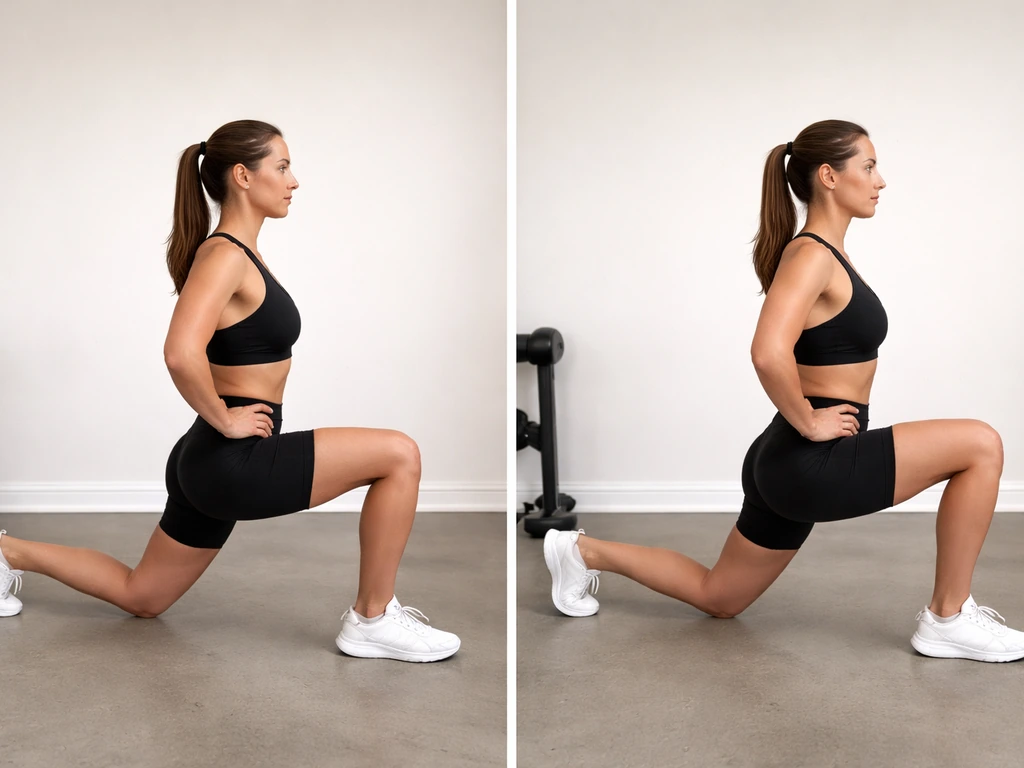
You don't need to grind every set to absolute failure. Recent research comparing continuous near-failure training to progressively varying proximity to failure found similar hypertrophy outcomes, suggesting that consistent effort (leaving 1 to 3 reps in reserve on most sets) is sufficient. What you do need is enough mechanical tension and metabolic stress to actually drive adaptation. For most exercises, that means working in the 6 to 20 rep range with loads that genuinely challenge the target muscle by the last few reps.
Exercise selection and range of motion
Range of motion and exercise selection directly influence where and how a muscle grows. Research on regional hypertrophy shows that muscles trained at longer lengths (stretched position) tend to show greater hypertrophy in certain regions compared to muscles trained only in shortened positions. This is why Romanian deadlifts and incline curls often produce different growth patterns than conventional deadlifts or preacher curls. For your priority muscle, include at least one exercise that loads it in a lengthened position.
Progressive overload: the non-negotiable
No matter which muscle you're training, progressive overload is the mechanism that keeps growth happening past the initial adaptation phase. Add weight, add reps, or add sets over time. Track your lifts. A muscle that's been doing the same 3 sets of 10 at the same weight for three months is not being challenged anymore. People who want to know why their muscles grow so fast early in a program often find the answer is simply that progressive overload is happening aggressively during that phase, and growth stalls when it stops.
Nutrition and recovery to support faster growth
Protein intake
The International Society of Sports Nutrition recommends a daily protein intake of 1.4 to 2.0 grams per kilogram of body weight for most people engaged in resistance training. If you're in a caloric deficit trying to build while leaning out, that range goes up to 2.3 to 3.1 grams per kilogram. For a 80kg (175 lb) person, that's roughly 112 to 160 grams of protein per day under normal training conditions. This isn't especially complicated to hit: four reasonably sized protein-containing meals throughout the day gets most people there. High protein intakes in resistance-trained individuals have not shown adverse liver or kidney effects in the research, so you don't need to be conservative out of concern for organ health.
For older adults, protein intake becomes even more important. Research comparing 1.3 g/kg/day versus 0.8 g/kg/day in older men found meaningfully better lean mass outcomes at the higher intake. If you're over 50, erring toward the higher end of protein recommendations is smart.
Creatine supplementation
Creatine monohydrate is the most consistently supported supplement for improving resistance training outcomes. A 2023 systematic review and meta-analysis confirmed that creatine combined with resistance training improves body composition, and one trial found strength improvements appeared within two weeks of supplementation without increasing muscle damage markers. The standard approach is a loading phase of around 20 grams per day split into four doses for 5 to 7 days, followed by a maintenance dose of 2 to 5 grams per day. If you skip the loading phase and just take 3 to 5 grams daily from the start, you'll get there in about 3 to 4 weeks instead. Both approaches work.
Sleep and recovery
Muscle growth happens during recovery, not during training. Sleep quality is a legitimate training variable, not just general wellness advice. A randomized controlled trial found that 12 weeks of resistance training itself improved sleep quality (measured by the Pittsburgh Sleep Quality Index), but if your sleep is already poor, that recovery deficit will blunt your results regardless of how well you train or eat. Aim for 7 to 9 hours per night and treat it with the same priority as your workouts. Between training sessions for the same muscle, 48 to 72 hours of recovery is typically sufficient at moderate volumes.
Common mistakes and myths that slow your gains
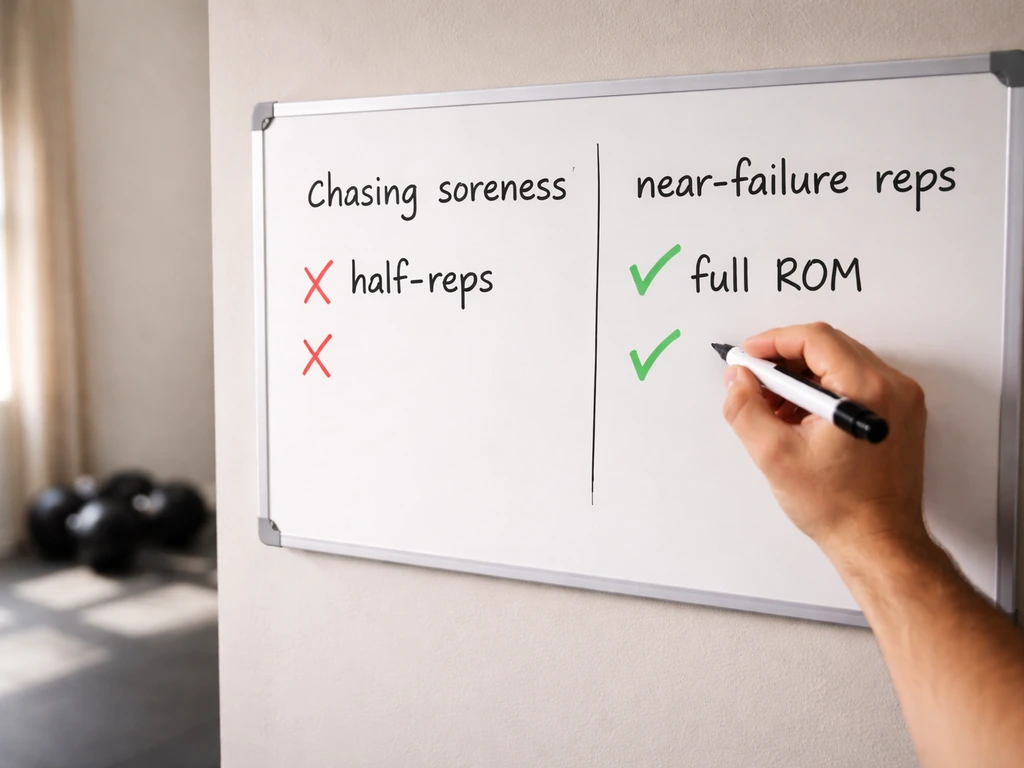
- Chasing soreness as a proxy for growth: Delayed onset muscle soreness (DOMS) is not a reliable indicator of hypertrophic stimulus. You can grow without being sore, and being sore doesn't mean you grew. Focus on progressive overload and volume, not pain.
- Training too infrequently: One session per week per muscle group is suboptimal for most people. The research is clear that twice per week beats once per week when volume is equated. If you're only hitting your target muscle once weekly, restructure.
- Underestimating protein: Many people consistently under-eat protein while wondering why they're not growing. Track your intake for a week and see where you actually land. The gap between perceived and actual protein intake is often significant.
- Ignoring progressive overload: Doing the same weights and reps for months is not training, it's maintenance at best. Your log is your growth roadmap. If you're not regularly adding load or reps, you're not progressing.
- Expecting uniform gains: Some muscles respond faster than others, and that's normal. Genetics, architecture, and training history all play a role. Comparing your calves to someone else's quads is a pointless exercise. Work with your own responders.
- Overcomplicating supplementation: Creatine and adequate protein cover the vast majority of nutritional leverage for muscle growth. Most other supplements are marginal at best. Focus your energy on the training and nutrition fundamentals before adding complexity.
- Neglecting sleep and recovery: Sleep deprivation impairs muscle protein synthesis and hormonal environment. If your sleep is poor, no amount of training optimization will fully compensate.
- Using too small a range of motion: Research on partial ROM training shows it can be effective in specific contexts, but for most lifters training for general hypertrophy, full range of motion and loading muscles in lengthened positions produces the most consistent growth.
The bottom line is this: the easiest muscle to grow is the one that's most responsive to training stimulus right now, for your body, with your history. For most people starting out, that's the glutes, quads, or chest due to their size, training naivety, and how well basic compound movements load them. Back is a strong contender but has a higher learning curve. Use the self-assessment framework above to identify your own best responder, train it twice a week with 10 to 20 quality sets, keep protein at 1.6 to 2.0 g/kg/day, and add creatine if you haven't already. That combination gives you the best shot at visible progress in 6 to 8 weeks.
FAQ
How can I tell if the “easiest muscle” idea is actually working for me?},{
Use “ease” as two separate signals: visible size changes and strength gains. If you are not seeing either within 6 to 8 weeks of consistent effort, it usually means the stimulus is not reaching that muscle (exercise selection, technique, or range of motion). If strength is rising but size is not, increase quality volume and add lengthened-position work rather than just doing more reps.
What if I want a muscle that’s “harder” for most people, but it feels easy for me?
Pick the muscle you can load with good mechanics first. If you dread the session, can’t feel the target muscle, and your reps consistently drift toward other muscles, that muscle is not “easy” for you right now. Choose the priority muscle for which you can maintain target-focused technique across sets, then build from there.
What are the most common mistakes that make an easy muscle stop growing?
If you want glute or quad growth, prioritize exercises that let you control depth and tension. Common mistakes include cutting range of motion, using momentum, and letting the working muscle become passive at the bottom. A simple fix is to add a 2 second controlled lowering phase and pause briefly in the lengthened position before the press.
Can the easiest muscle be different if I’m comparing muscle groups like calves versus glutes?
Calves and forearms often need very specific loading patterns and high exposure over time. If you are choosing based on how fast you respond, expect a lag compared with glutes, quads, lats, or chest. The “fastest” muscle for you might still be a slow responder if your recovery and technique can’t support the specialized stimulus required.
What if my weakest muscle is also the one that hurts during training?
Don’t assume your current weakest muscle is always your best responder. A weakness might reflect technique limits or joint restrictions, meaning you will struggle to produce safe mechanical tension. When this is the case, start with assisted or machine variations and build the skill and range gradually, then reassess which muscle starts gaining after 4 to 6 weeks.
Should I choose the easiest muscle based on how it looks or how it performs?
Yes. If your goal is aesthetics, train the muscle where you can realistically expose more thickness through the skin, but don’t ignore functional strength. Track both: measurements or photos for visible change, and specific lifts for strength. If one increases and the other doesn’t, adjust exercise selection or range rather than abandoning the muscle.
How should I split training across two days for my easiest muscle?
For “twice per week,” use different stressors across sessions. One session can be heavier and lower rep range, the other can emphasize lengthened-position work and slightly higher reps. This helps you hit both strength-oriented and hypertrophy-oriented mechanics without needing extreme sets close to failure every time.
How do I avoid fooling myself with compound lifts that work multiple muscles?
If you are already training multiple muscle groups, avoid using the same exercise as if it counts for everything. For example, squats can load quads and glutes, but rows can still be mostly back while biceps contribute some assistance. To estimate your “real” stimulus, keep notes on form cues and how the target muscle feels, then adjust exercise choice if another muscle is doing most of the work.
How close to failure should I train my easiest muscle, and what’s the risk of going too hard?
For most people, one to two sessions at consistent quality matter more than chasing a perfect proximity-to-failure rule. If you routinely hit failure on your priority muscle, you may lose technique and recover poorly, slowing growth. Use a buffer strategy, for example leaving about 1 to 3 reps in reserve most sets, then increase effort only on your hardest set.
What if I can’t train my priority muscle in a long-length position due to mobility limits?
If you cannot reach the lengthened position safely or comfortably, substitute the exercise while keeping the “long-length loading” idea. Examples include switching to a variation with more stable joint mechanics, using a lighter load to control the bottom, or using machines that allow consistent positioning. The goal is tension at longer muscle lengths, not pain or forced range.
Does the easiest muscle to grow change if I’m cutting calories?
If you are training in a deficit, weight training still can build muscle, but your ceiling is lower, and you must be stricter with volume quality and protein distribution. Your protein target should be toward the higher end, and you may benefit from slightly less total weekly sets until performance stabilizes. Reassess after 2 to 4 weeks based on strength trends and pump quality.
What should I do if my sleep is poor but I still want rapid muscle growth?
Yes. Stronger sleep correlates with better training output, and poor sleep can reduce how hard you are able to push while maintaining good form. If you consistently get under 6 hours, treat sleep extension like a prerequisite, not a nice-to-have, and consider reducing training intensity temporarily to protect recovery.
Is creatine still worth it if my growth is slow, and are there any precautions?
If you take creatine, expect noticeable benefits for strength and training performance within weeks, not instantly. Also, keep hydration and electrolytes consistent, and use the same daily dose rather than varying it widely. If you have a kidney condition or unusual lab results, talk with a clinician before starting.