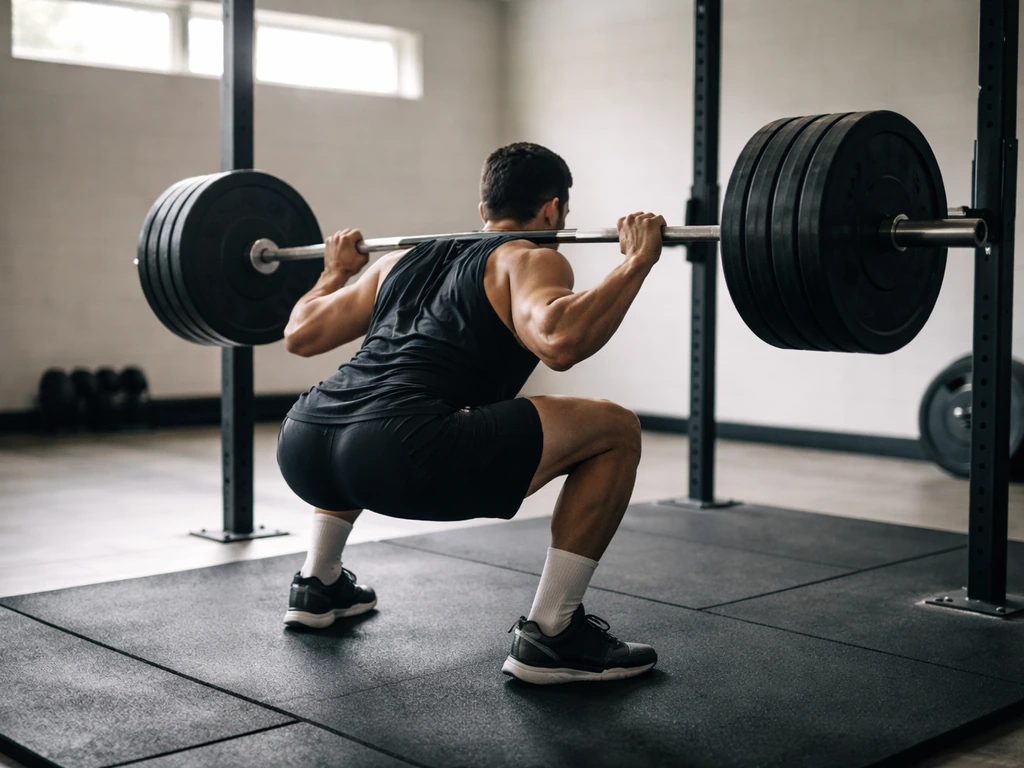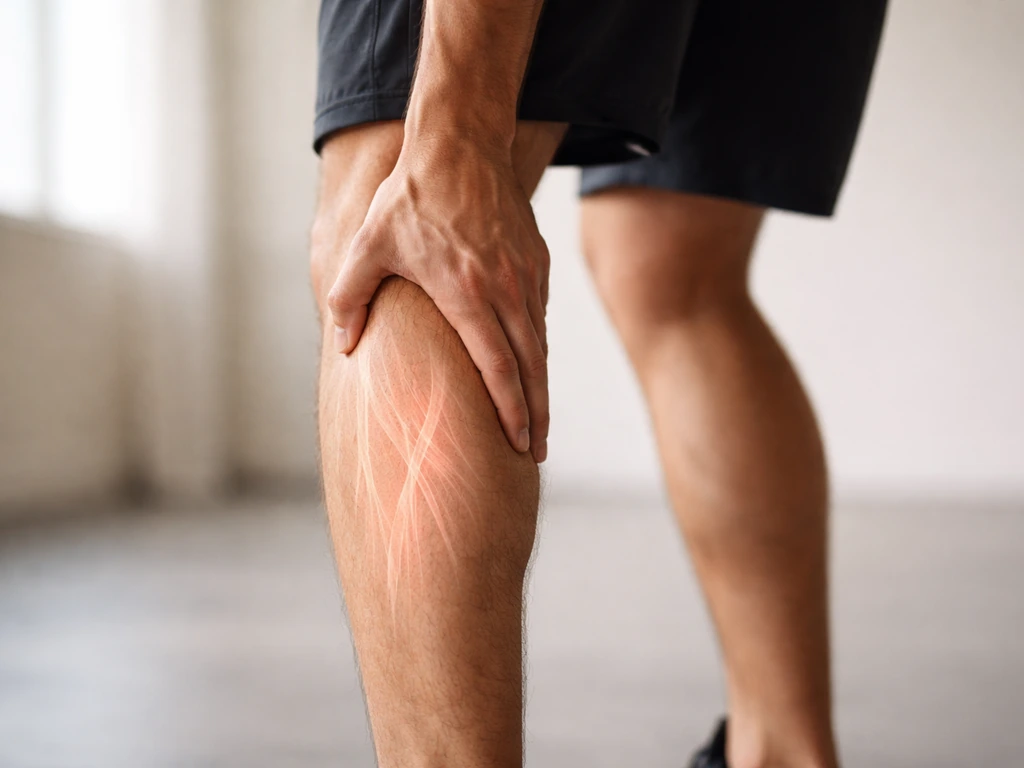
The hardest muscles to grow for most people are the calves, forearms, rear deltoids, and the long head of the triceps. If we're talking muscle groups, the calves and shoulders (particularly the rear and lateral heads) top almost every lifter's list of stubborn areas. That said, "hardest" is not universal. Your anatomy, fiber type distribution, training history, and how well you actually activate a muscle all shift the answer. But the muscles listed above consistently give the most people the most grief, and there are clear physiological reasons why.
What Is the Hardest Muscle to Grow? Fix Your Weakest

Marcus Kellerman
7 Apr 2026

The specific muscles that resist growth the most
Let's start with calves. The soleus, one of the two main calf muscles, has been reported to contain roughly 70% slow-twitch muscle fibers. Slow-twitch fibers are fatigue-resistant and built for endurance, not hypertrophy. They respond to mechanical tension, but they need higher volume and often higher rep ranges to get there. The gastrocnemius has a better mix of fast-twitch fibers, but both muscles are used constantly just from walking, which means they're adapted to a lot of low-level stress. Getting them to grow requires something significantly beyond what daily life already throws at them.
Rear deltoids are another classic sticking point. Most people never train them directly, and when they do, the upper traps and rhomboids tend to do the work instead. The rear delt is a small muscle with a tricky activation pattern. EMG research on exercises like lat pulldowns confirms how dramatically muscle activation shifts depending on grip, elbow position, and movement path, and the rear delt is especially prone to being dominated by neighboring muscles when technique slips. The result is years of rowing and face-pulling with the rear delt barely contributing.
Forearms are in a similar situation to calves. They're worked all day through grip tasks, typing, and carrying things. The baseline stimulus is high, so your training has to meaningfully exceed that baseline to drive adaptation. They're also largely composed of the kinds of fiber profiles and tendon-heavy structures that don't respond to casual training.
The long head of the triceps and the inner (short) head of the biceps are honorable mentions. Both require specific joint angles and exercise choices to put them under meaningful stretch, and most people's go-to exercises (pushdowns for triceps, standard curls for biceps) don't fully load these portions of the muscle.
Hardest muscle groups versus hardest individual muscles
There's a useful distinction between "hardest individual muscle" and "hardest muscle group" because the answer changes depending on which lens you use. At the individual muscle level, it's the small stabilizers and extremity muscles like calves, rear delts, and forearms. At the group level, the picture shifts slightly.
| Muscle Group | Most Stubborn Part | Why It's Hard |
|---|---|---|
| Calves | Soleus | ~70% slow-twitch fibers, adapted to daily use, hard to overload progressively |
| Shoulders | Rear and lateral deltoids | Small, easily dominated by larger muscles, poor isolation by most people |
| Arms | Triceps long head / bicep short head | Need specific joint angles and stretch to load effectively |
| Chest | Inner and upper pec | Requires full ROM and proper scapular position; commonly undertrained by beginners |
| Back | Mid-back thickness (rhomboids, mid traps) | Hard to isolate from lats and traps without deliberate cuing |
| Legs | Hamstrings / vastus medialis | Dominant quad and glute recruitment often overshadows them |
Legs as a whole tend to grow relatively well when trained hard because the sheer muscle mass involved means there's a lot of growth potential. But within the legs, hamstrings and the teardrop-shaped vastus medialis (the inner quad) are chronically undertrained. It's also worth noting that if you want to compare which end of the spectrum grows quickest, what muscles grow the fastest gives a useful counterpoint to this list. Spoiler: large muscle groups like glutes and quads respond quickly to the right stimulus, which is essentially the opposite of what you're dealing with when calves and rear delts won't budge.
Why some muscles just grow slower
There are four main reasons a muscle resists growth, and understanding them is what lets you actually fix the problem.
Fiber type composition
Muscles with a high proportion of slow-twitch (Type I) fibers respond more slowly to hypertrophy training. They're designed for endurance, not size. This doesn't mean they can't grow. It means they need higher volumes, more time under tension, and often rep ranges in the 15-30 zone to accumulate enough mechanical stress. The soleus is the textbook case here. Training it with 3 sets of 10 is simply not enough stimulus to provoke meaningful growth for most people.
Activation and motor control
If you can't reliably feel a muscle working, you're probably not loading it effectively. This isn't just a subjective cue. EMG research consistently shows that when movement kinematics change even slightly, activation redistributes across muscles. A rear delt fly done with too much internal rotation becomes a trap exercise. A cable curl with a forward lean becomes a front delt exercise. Poor activation is the single biggest reason people train a muscle for years and see almost no growth.
Leverage, joint angles, and range of motion
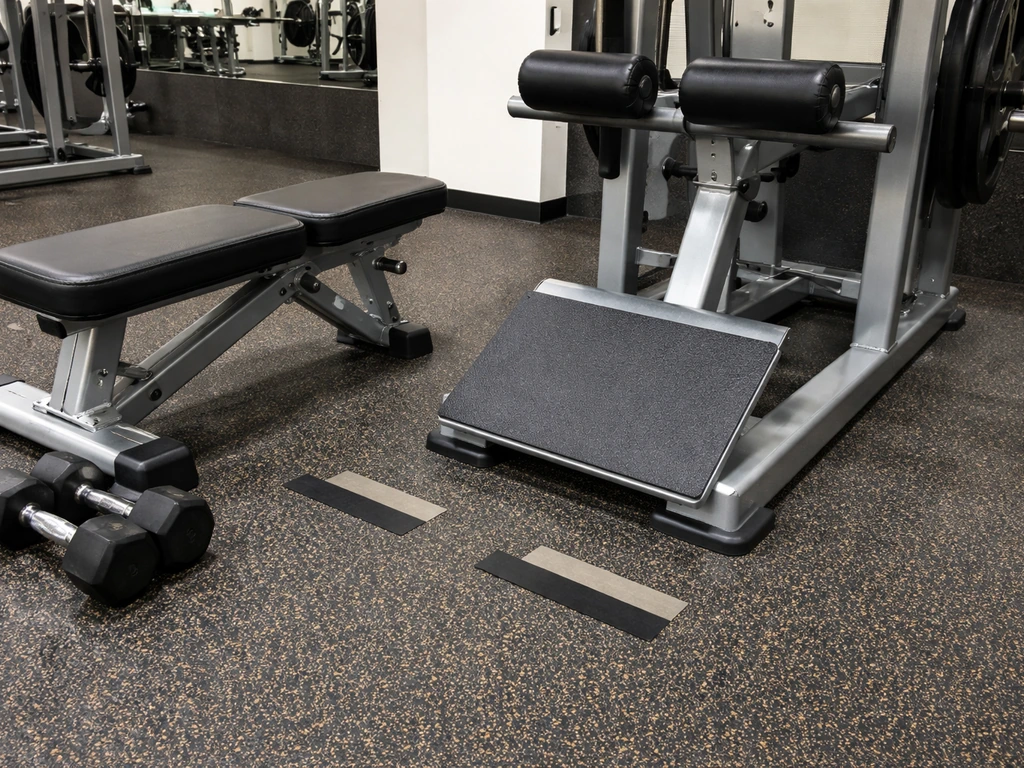
Every muscle has a length-tension relationship: it produces peak force at a specific joint angle. Training that muscle through a short range, especially at shortened positions, limits the mechanical tension on the fibers. A growing body of evidence suggests that training at longer muscle lengths, basically the stretched position, tends to produce equal or greater hypertrophy compared to shorter-length training. This is why exercises that load a muscle in its stretched position (incline curls, Romanian deadlifts, overhead tricep extensions) tend to outperform exercises that only load the contracted position (concentration curls, pushdowns, hip thrusts at top of range).
Training specificity and chronic undertraining
Some muscles are almost never directly trained. Most programs have bench, squat, deadlift, and row variations. The rear delt, the soleus, and the forearms get little to no direct work in these movements. Months or years of neglect create a situation where the muscle simply hasn't received enough training stimulus to grow, regardless of your overall progress. This is different from a stubborn genetic response. It's just a programming gap.
How to actually train the hard-to-grow muscles
Generic advice won't help here. You need specifics on volume, intensity, exercise selection, and technique for muscles that aren't responding.
Volume: more sets, done consistently
Research on the dose-response relationship between weekly training volume and muscle hypertrophy is pretty clear: more sets per week per muscle drives more growth, up to a point. Studies have used targets like 12, 18, and 24 sets per week and found progressively greater hypertrophy outcomes. For lagging muscles, you should sit at the higher end of that range. If your calves currently get 3-4 sets a week tacked onto leg day, double that as a starting point. Spread the volume across 2-3 sessions if possible rather than cramming it all into one. A recent meta-analysis specifically focused on advanced lifters also supports targeting higher weekly set volumes when a muscle group is clearly lagging.
Intensity and proximity to failure
For stubborn muscles, working close to failure matters more than it does for easier-growing muscles. That doesn't mean every set needs to be an all-out grind. Research on proximity-to-failure suggests that leaving 1-3 reps in reserve on most working sets is a reasonable target that accumulates effective reps without excessive fatigue. For calves and rear delts specifically, you need to actually feel the burn and the pump. If a set ends because you got bored or reached an arbitrary number rather than because the muscle was genuinely taxed, you didn't get the stimulus you needed.
Exercise selection: load the stretch
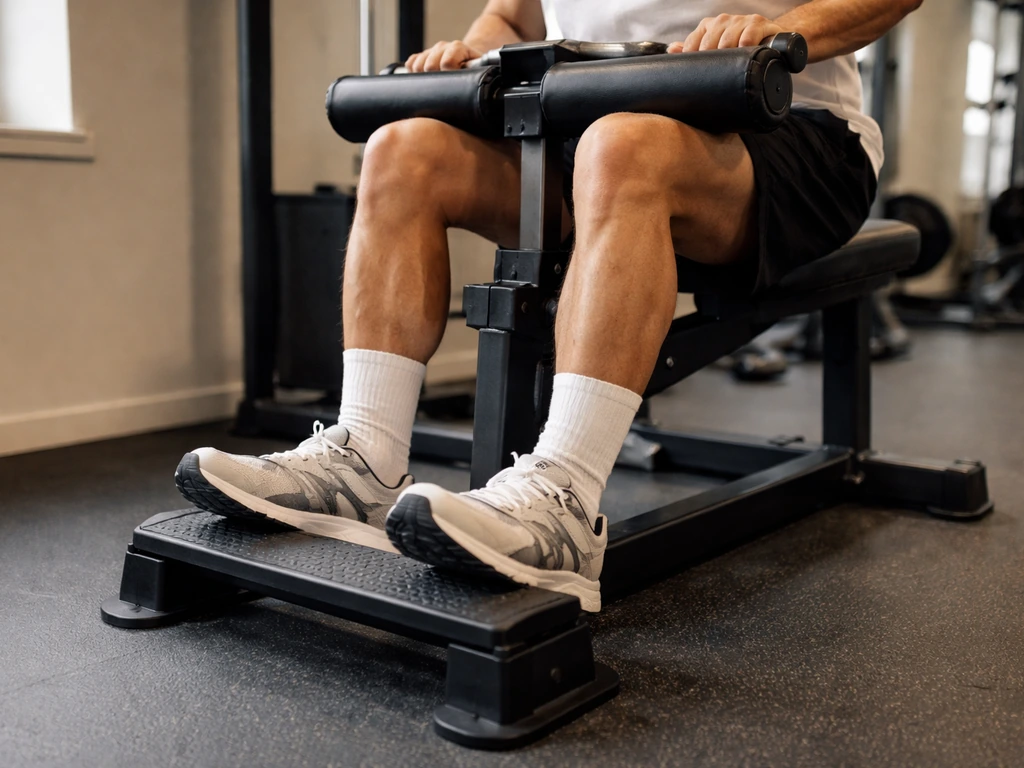
This is the single biggest technical fix most people can make. Choose exercises that load the target muscle in its lengthened position. For calves: seated calf raises (soleus emphasis at a bent knee) with a full heel drop. For rear delts: cables or bands set at face height pulling straight back with arms parallel to the floor. For triceps long head: overhead extensions with a cable or dumbbell. For biceps: incline dumbbell curls. NSCA research comparing different joint angles found that longer-muscle-length training produced distinct and often superior hypertrophy outcomes compared to training at shortened positions after just 8 weeks, which tells you this isn't a minor detail.
Technique cues that actually change what gets trained
Slow the eccentric (lowering) phase to 2-3 seconds on isolation work for small muscles. This increases time under tension in the stretched position where the growth signal is strongest. For rear delts, retract your scapula slightly before pulling and focus on driving your elbow back, not your hand. For calves, complete heel drop at the bottom and a hard pause at the top. These aren't optional refinements. They're what separates a calve raise that does nothing from one that actually drives adaptation.
Nutrition and recovery: the variables people skip
You can have perfect training and still fail to grow if your nutrition and recovery aren't supporting it. This is especially true for smaller, slower-growing muscles where the margin for error is thinner.
Protein: enough, not extreme
A consistent finding across multiple meta-analyses is that protein supplementation's hypertrophic benefit plateaus at around 1.6 g per kilogram of bodyweight per day, with some research suggesting a possible upper useful range of about 2.2 g/kg/day. Beyond that, additional protein doesn't translate to meaningfully more muscle. So if you weigh 80 kg, aim for 128-175 grams of protein daily. Spread it across 3-5 meals rather than eating it all at dinner. Getting this right consistently matters more than hitting a perfect number on any single day.
Calories: you can't grow on a deficit
If you're eating at maintenance or below while trying to grow genuinely stubborn muscles, you're making an already hard task nearly impossible. A modest caloric surplus of 200-400 calories above maintenance is enough to support muscle protein synthesis without excessive fat gain. This doesn't need to be tracked obsessively, but if the scale hasn't moved in months and neither has your muscle size, you're almost certainly not eating enough.
Creatine: use it if you're not already
Creatine monohydrate is the most consistently supported supplement for resistance training performance. Research from GSSI confirms that muscle creatine stores can be maintained with a daily dose of about 3-5 grams, and short-term supplementation has been shown to enhance strength and recovery of lower-limb muscles specifically. For lagging muscle groups like calves and quads, even small improvements in training quality and recovery between sessions add up over months. Load at 0. This loading approach aligns with the ISSN position stand's common creatine loading method of about 0.3 g/kg/day (split doses) for 5 to 7 days to increase muscle creatine stores Load at 0.. 3 g/kg/day for 5-7 days if you want faster saturation, then drop to 3-5 g/day to maintain.
Sleep: non-negotiable for small muscle growth
The National Sleep Foundation recommends 7-9 hours of sleep per night for healthy adults, and this isn't a soft guideline. Sleep deprivation disrupts protein degradation pathways and interferes with the muscle clock, a circadian mechanism that regulates muscle protein synthesis. If you're sleeping 5-6 hours and wondering why your calves won't grow, you've found a major part of the answer. Recovery from longer-muscle-length training, which you should be doing more of for stubborn areas, also appears to take longer than recovery from shorter-length training, which means the muscle needs adequate sleep and recovery days to fully adapt.
How to figure out your own hardest muscle (and what to do next)

Not everyone's weakest link is their calves. Your hardest muscle to grow is often the one where all three of these apply: you rarely feel it working during exercises targeting it, it looks visually flat despite months or years of training, and it hasn't shown measurable progress (in size or strength) in the last 3-4 months. Run through your major muscle groups and identify the one that fits all three criteria.
Once you've identified it, here's a practical 4-8 week protocol to run:
- Add 2-3 dedicated sessions per week targeting only the lagging muscle, not just one set at the end of an unrelated workout.
- Pick 1-2 exercises that load the muscle in its stretched position and learn to feel them working before adding more weight.
- Start with 10-14 sets per week total for that muscle and increase by 2 sets each week until you're at 18-22 sets or until recovery becomes difficult.
- Work 1-3 reps shy of failure on most sets. Use a slow eccentric (2-3 seconds down) to increase time under tension.
- Hit your daily protein target (1.6-2.0 g/kg) every day, not just on training days.
- Be in a slight caloric surplus (200-400 calories above maintenance).
- Take 3-5 g of creatine monohydrate daily.
- Protect 7-9 hours of sleep. This is where the adaptation actually happens.
- After 4-8 weeks, reassess. Take a photo, measure the muscle with a tape, and test your working weights. If all three have moved, the protocol is working.
One thing worth understanding is that "hardest" is relative to where you're starting. What is the easiest muscle to grow helps illustrate this contrast, because identifying your fast-responders can actually inform how you train your slow ones: the volume and intensity approaches that work for easy muscles often need to be scaled up significantly for the hard ones.
Age also plays a role in how quickly stubborn muscles respond. What age your muscles grow the most gives context here. If you're over 50, the same muscles are still growable, but the timeline for seeing visible change is longer, recovery between hard sessions needs more space, and joint-friendly exercise selection matters more. This doesn't change the protocol above, it just means patience and consistency carry more weight.
On the other end of the spectrum, if you're someone who seems to respond to training unusually quickly in general, why your muscles grow so fast is worth reading because fast responders often still have one or two genuinely stubborn areas that don't match the rest of their gains, and those areas need the same targeted attention described in this article.
The honest truth is that most people's "hardest" muscle isn't actually genetically doomed. It's undertrained, poorly activated, and not given the specific exercise selection, volume, and nutritional support it needs. Fix those things consistently over 6-12 weeks and you'll almost always see a response.
FAQ
How do I know which muscle is actually my hardest one, not just my least favorite exercise?
A useful tiebreaker is “rank by lack of progress,” check which muscle both looks flat and shows no strength increase in the past 3 to 4 months, then confirm you can feel it working with the correct lengthened-position exercise. If you cannot feel it, fix activation and range first, because adding volume without proper loading often fails.
What’s the best way to ramp up volume for a stubborn muscle without overdoing it?
Start by adding 1 to 2 additional sets per week to the lagging muscle for 2 to 3 weeks, then reassess. Going from 3 to 4 sets straight to 12 to 18 can work for some people but often backfires by lowering technique and increasing soreness enough that you miss sessions.
Should I chase higher reps or heavier weights for the hardest muscle to grow?
Use a consistent rep target that keeps the muscle in the lengthened position under load, then stop sets when you are close to failure, usually 1 to 3 reps in reserve. For small, hard-to-feel muscles like rear delts and calves, “reps to a number” is less reliable than “reps until the burn and pump show up in the target,” even if that number is lower than expected.
Can I use progressive overload on calves or rear delts if they are so hard to grow?
Yes, but the side effect is that you can lose the stretch emphasis if your form becomes sloppy. For stubborn muscles, prioritize controlled eccentrics (2 to 3 seconds) and the full lengthened range, then only increase load when you can maintain those details across all sets.
If my hardest muscle is not growing, should I always increase calories first?
Not exactly. A calorie surplus matters most if your scale and measurements are stable, but if you are already gaining weight and still not growing a specific muscle, your bottleneck is more likely activation, exercise selection, or insufficient lengthened-range tension.
How often should I train my hardest muscle each week?
Ideally, you should not. For lagging muscles, it is common to train 2 to 3 times per week, but the session quality is what counts, especially for calves and rear delts that need enough recovery to respond. If soreness is causing you to shorten range or rush the eccentric, reduce frequency or sets rather than adding more days.
What should I do if I feel my rear delts or calves in the wrong place?
If you are doing the right exercise but feel the wrong muscles, adjust one variable at a time, common ones are grip width for rear delts and toe angle or knee position for calves. Then re-test the “feel” cue during lighter warm-up sets before going heavy, because once you engrain bad kinematics under load, your progress stalls.
How do I target the long head of the triceps when I keep feeling it in my shoulders?
If the long head of the triceps is your issue, make sure the overhead position actually shortens and then stretches the long head across elbow flexion and shoulder extension. Overhead cable or dumbbell extensions help, but you still need to keep the elbow path consistent and avoid shrugging or turning it into an all-shoulder movement.
Should I train calves with the same exercises every time, or split soleus versus gastrocnemius?
For calves, the soleus and gastrocnemius both matter, but you may need a split approach because the soleus tends to require a bent-knee emphasis. If you only do straight-knee standing raises, you can get a “busy but not growing” feeling, so include a bent-knee seated variation with a real heel drop.
What if I’m already hitting my daily protein, but my hardest muscle still won’t grow?
Protein targets are a ceiling, not a guarantee. If you are consistently at 1.6 g/kg/day or higher but still see no change, the next checks are meal timing consistency, total calories, sleep duration, and whether you are actually close to failure while keeping the muscle in the stretched position.