Most natural lifters can expect to gain somewhere between 0.5 and 2 pounds of actual muscle per month during their early training years, tapering down to a few pounds per year once they've built a solid base. If you want a quick monthly estimate, it helps to think in ranges based on where you are in your training age and how consistent your calories, protein, and recovery are how much muscle can you grow in a month. That's the honest range. It's slower than social media makes it look, faster than most people expect if they're actually consistent, and heavily shaped by where you're starting from, how old you are, how you eat, and how seriously you take recovery.
How Much Muscle Can You Grow Naturally and How Fast

Marcus Kellerman
27 May 2026
Realistic natural muscle gain rates and timelines

Let's ground this in something concrete. "Muscle growth" in practice means gaining lean mass (mostly muscle protein and water bound to glycogen) while minimizing fat gain. On a scale, you can't separate them perfectly day to day, but over weeks and months a trend emerges. For a natural lifter eating and training well, here's roughly what the research and real-world experience support:
| Training Level | Monthly Gain (lbs) | Annual Gain (lbs) | Notes |
|---|---|---|---|
| True beginner (0–1 yr) | 1–2 lbs | 12–24 lbs | Newbie gains are real; muscle and strength jump fast |
| Intermediate (1–3 yrs) | 0.5–1 lb | 6–12 lbs | Progress slows but is still very meaningful |
| Advanced (3+ yrs) | 0.25–0.5 lb | 2–4 lbs | Gains are hard-won; every pound matters |
| Elite/near-genetic ceiling | Trace amounts | 0–2 lbs | Maintenance becomes the primary goal |
These numbers assume you're doing things right: consistent training, sufficient protein, a calorie intake that supports growth, and adequate sleep. They're also averages. Some beginners gain faster, some advanced lifters plateau for months before breaking through. The point isn't to hit an exact number but to calibrate your expectations so you're not chasing 20 pounds of muscle in 8 weeks (impossible naturally) or giving up because you only added 6 pounds in a year (actually excellent progress for an intermediate lifter). If you want a tighter estimate of how many months to grow muscle for your current stage, use these averages as a baseline and adjust based on your consistency and recovery.
One important note: the scale will move faster than actual muscle gain, especially early on. Water, glycogen, and gut contents all shift. Muscle itself is dense tissue that accumulates slowly. If you gain 4 pounds in your first month of lifting, maybe 1. Because three months is just three of these early timelines stacked together, your best-case muscle gain is still limited by how quickly you can recover and adapt If you gain 4 pounds in your first month of lifting. 5 of that is muscle and the rest is everything else. That's still a win.
Beginner vs intermediate vs advanced: what changes
The biggest factor separating these categories isn't talent, it's how much signal your muscles still need to respond to training. Beginners are extraordinarily responsive. Your body hasn't seen resistance training before, so almost any progressive stimulus drives adaptation. You can gain muscle and strength simultaneously, often while barely eating in a surplus. This is the famous "newbie gains" window, and it's real. You won't experience it twice.
Once you've been training seriously for a year or two, you shift into intermediate territory. Your muscles are now more efficient, your nervous system is better trained, and you need more specific stress to keep growing. Random effort stops working. You need progressive overload applied deliberately, adequate volume, and a real calorie surplus if gaining is the goal. The rate of gain roughly halves compared to your beginner phase.
Advanced lifters (three-plus years of consistent, well-structured training) are working close to their natural ceiling. At this level, the variables that beginners can ignore, like weekly volume management, deload timing, nutrient periodization, and sleep quality, become the difference between growing and spinning wheels. Gains come in months-long cycles rather than week by week. It's not discouraging once you accept it; the muscle you already have is substantial, and each new pound is genuinely impressive.
How age, sex, genetics, and starting point affect your ceiling

Age
Muscle-building capacity does decline with age, but it declines much more slowly than most people assume. Testosterone and growth hormone taper gradually after your 30s, and anabolic sensitivity to protein decreases somewhat after 60. But older adults absolutely can and do build muscle. Research consistently shows that people in their 60s, 70s, and even 80s respond to resistance training with real hypertrophy. The rate is slower, and recovery takes longer, but the process works. If you're an older adult starting out, don't let age become an excuse. Let it be context for adjusting volume and recovery, not a reason to skip training altogether.
Sex
Men typically have higher baseline testosterone, which gives a meaningful advantage in absolute muscle mass and rate of gain. Women tend to gain muscle at roughly half the rate in absolute terms, but relative to body size and starting lean mass, the gap narrows considerably. Women also tend to recover slightly faster between sessions and tolerate higher training volumes without as much fatigue. The ceiling is lower in absolute pounds, but the process of training, eating, and recovering is essentially the same.
Genetics and starting point
Genetics affect things like muscle fiber type distribution, limb length (which influences leverage and how muscles look when developed), hormonal baseline, and how efficiently your body partitions extra calories toward muscle versus fat. You can't change these. What you can change is your training, nutrition, and consistency, which together determine how close you get to your genetic ceiling. Starting point matters too: if you're carrying extra body fat, you may be able to build muscle while slowly losing fat at first (a process called body recomposition). If you're already lean and new to lifting, a modest calorie surplus speeds things up significantly.
Nutrition foundations for growth: calories, protein, and macronutrients

You can't build muscle out of nothing. Protein provides the amino acids that muscle tissue is literally made from, and total calories determine whether your body has the energy to build rather than break down. The International Society of Sports Nutrition recommends 1. The ISSN 2017 position stand concludes that, for building or maintaining muscle, an overall daily protein intake of about [1.
4 to 2. ](https://jissn. biomedcentral. com/articles/10.
1186/s12970-017-0177-8)0 g/kg body weight per day is sufficient for most exercising individuals. 4 to 2. 0 grams of protein per kilogram of body weight per day as sufficient for most people who train. In practical terms, if you weigh 80 kg (about 175 lbs), that's 112 to 160 grams of protein daily.
Many lifters do well aiming for the upper end of that range, roughly 0. 7 to 1 gram per pound of bodyweight, as a simple rule.
Calories matter just as much. Research on overfeeding confirms that eating in a surplus supports lean mass gain, but the composition of those extra calories changes how the surplus is distributed between muscle and fat. Eating a calorie surplus built around adequate protein favors more lean mass gain and less fat storage than a surplus full of refined carbs and fat with minimal protein. For most natural lifters aiming to build without excessive fat gain, a modest surplus of 200 to 400 calories above maintenance is the practical sweet spot.
Carbohydrates and fats both play supporting roles. Carbs fuel your training sessions and replenish glycogen, which directly affects how hard you can train and how well your muscles recover. Fats support hormone production, including the sex hormones that regulate anabolic processes. Neither macro should be aggressively cut while trying to build muscle. A reasonable starting split for a muscle-building phase: 40% carbohydrates, 30% protein, 30% fat, adjusted based on how you feel and perform.
Meal timing is real but not magical. Spreading protein intake across three to four meals rather than one or two improves muscle protein synthesis over the course of the day. Getting protein in around your training window (within a couple of hours before or after) is helpful but not the make-or-break factor most gym culture suggests. Total daily intake is what drives results. Timing is a fine-tuning tool, not a foundation.
On supplementation: creatine monohydrate is the most well-supported ergogenic aid for natural lifters. It increases phosphocreatine availability, lets you do more work per session, and has a modest but real effect on lean mass accumulation over time. Take 3 to 5 grams daily. Everything else (pre-workouts, BCAAs, most proprietary blends) is largely redundant if your protein intake and diet are solid. Protein powder is food, not a supplement, and is worth using if hitting your daily protein target from whole foods is genuinely difficult.
Training for hypertrophy: volume, intensity, progressive overload
Muscle grows when exposed to mechanical tension and metabolic stress that exceeds what it's used to. The primary driver is progressive overload: doing more over time, whether that's more weight, more reps, more sets, or better technique that lets you actually feel the target muscle working. Without progression, you're maintaining, not growing.
Volume (total sets per muscle per week) matters a lot. Most research points to 10 to 20 working sets per muscle group per week as the effective range for intermediate lifters. In practice, that is the same general timeframe people are usually asking about when they wonder how long it takes to grow muscle mass 10 to 20 working sets per muscle group per week.
Beginners grow on less (even 5 to 8 sets per week works), and advanced lifters sometimes push toward or beyond 20 sets for lagging body parts. Intensity, meaning how close to failure you're training, is the other key variable. Training at roughly 6 to 12 reps per set, taken within 1 to 3 reps of failure, consistently produces hypertrophy. You don't need to fail every set, but leaving 5 easy reps in the tank every session won't cut it either.
Frequency matters less than total volume, as long as recovery is managed. Training each muscle two to three times per week tends to outperform once-weekly approaches for most people, mainly because you can accumulate weekly volume without any single session becoming so long it degrades quality. A simple upper/lower split or push/pull/legs structure achieves this easily.
One myth worth addressing directly: muscle soreness is not a requirement for growth. Delayed onset muscle soreness (DOMS) is a sign of unfamiliar stimulus, not necessarily superior training. You can be sore from a session that didn't produce much hypertrophy, and you can have an excellent growth-producing session with minimal soreness afterward. Track performance, not pain.
Recovery and lifestyle: sleep, stress, and managing fatigue
Muscle doesn't grow during training. It grows during recovery, when your body repairs the micro-damage caused by training stress and adds extra contractile protein to handle future demands. In general, muscle growth tends to be slow at first and then becomes more predictable as your training and recovery get consistent. Cut recovery short and you cut growth short. It's that simple.
Sleep is the most underrated muscle-building tool available. Growth hormone is released primarily during deep sleep, and protein synthesis rates are highest during sleep when the body isn't competing with other demands. Aim for 7 to 9 hours per night. Chronic sleep restriction (less than 6 hours) measurably reduces muscle protein synthesis and increases cortisol, a catabolic hormone that works against muscle retention and growth. If you're training hard and sleeping 5 hours, you're fighting yourself.
Chronic life stress compounds the problem. Elevated cortisol from work, relationships, or poor mental health creates a physiological environment that favors fat storage and muscle breakdown over growth. This doesn't mean you can only train when life is perfect. It means managing stress actively (through whatever works for you, whether that's walking, meditation, or just protecting boundaries around sleep) is part of the muscle-building equation. High training volume layered on top of high life stress is a common recipe for plateaus.
Accumulated training fatigue is also worth managing deliberately. Deload weeks (where you reduce volume or intensity by roughly 40 to 50% for one week every 4 to 8 weeks) let your joints, connective tissue, and nervous system recover without losing muscle. Many lifters avoid them because they feel like wasted time. They're the opposite.
Estimating your personal growth target and how to track progress
Here's a practical framework for setting your own expectations and knowing whether you're on track. If you're wondering how long it takes to grow muscle naturally, start by looking at your current training level and what the first year can realistically deliver. So if you're wondering how long it takes for muscles to grow, use these timelines as the expectation baseline and then track your own progress to confirm it how long does it take for muscles to grow.
- Determine your training level honestly. Beginner (less than 1 year of consistent lifting), intermediate (1 to 3 years), or advanced (3-plus years with structured programming). Use the monthly gain ranges from the table above as your ballpark.
- Set a monthly target. For a beginner, something like 1 to 1.5 lbs of lean mass gain per month is realistic. For an intermediate, 0.5 to 1 lb. For advanced, 0.25 to 0.5 lb. These are targets, not guarantees.
- Track scale weight weekly (average of 3 to 7 morning weigh-ins to smooth out daily fluctuation). You're looking for slow upward trend over months, not daily jumps.
- Take monthly progress photos from the same angles and lighting. The mirror lies in real time; photos tell the truth over a 6 to 12 week span.
- Track key lifts (squat, deadlift, bench, row, or whatever compounds anchor your program). Strength going up over time is the most reliable proxy for muscle being built.
- Measure key body parts monthly if you want detail: upper arm, thigh, chest, waist. Arm and leg circumference increasing while waist stays roughly the same is a strong signal you're building muscle and not just getting fatter.
Don't obsess over any single metric. A combination of scale trend, strength progress, and visual change tells a much more complete story than any one number. If all three are moving in the right direction, you're growing. If none are, something in your program, nutrition, or recovery needs to change.
Common reasons natural muscle gains stall and how to fix them
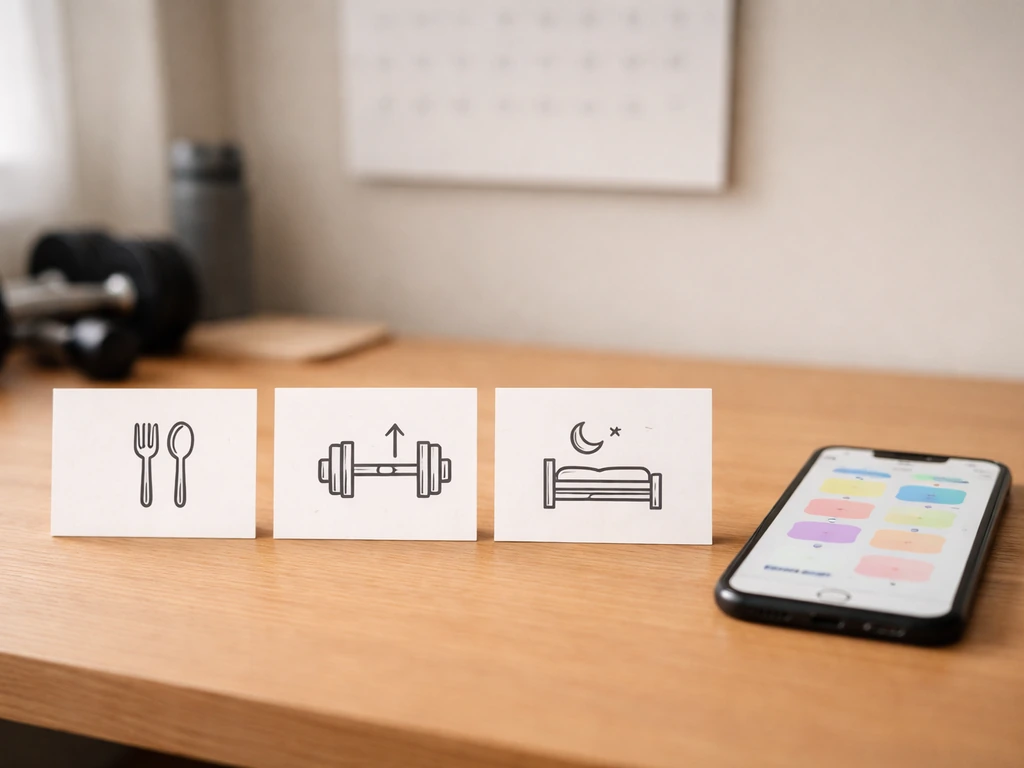
Stalling is normal and almost always fixable. Here are the most common culprits and what to actually do about them:
- Not eating enough: The single most common reason for stalled progress. Most people underestimate their food intake significantly. Track calories for two weeks using an app like Cronometer or MyFitnessPal. If you're not in at least a small surplus, you're not going to grow. Increase calories by 200 to 300 per day and reassess after three to four weeks.
- Not enough protein: Even with adequate calories, insufficient protein limits muscle protein synthesis. Check that you're hitting 1.6 to 2.0 g/kg daily. If not, add a serving of meat, eggs, Greek yogurt, or a protein shake.
- No progressive overload: If you've been lifting the same weights for months, your muscles have adapted to that load and have no reason to grow further. Add weight, reps, or sets in a structured way. Keep a training log.
- Too little sleep: If you're consistently sleeping under 7 hours, this alone can blunt your gains. Sleep is not optional recovery. Prioritize it before adding more training volume.
- Too much training without recovery: More is not always better. If you're training 6 to 7 days per week, feeling persistently tired, and your lifts are stagnating, take a deload week and then return to a slightly lower volume baseline.
- Inconsistency: Muscle grows over months and years of consistent effort, not days and weeks. Missing two to three sessions per week, or cycling on and off programs every few weeks, prevents the sustained progressive overload your muscles need. Pick a program and run it for at least 12 weeks before evaluating it.
- Chasing perfection instead of executing: Spending more time researching optimal programs than actually training is common. A decent program executed consistently beats a perfect program done sporadically every time.
One final thing worth saying plainly: genetics set your ceiling, but most natural lifters never get anywhere near it because of the fixable factors above. You probably have more room to grow than you think. The practical question isn't whether you can build impressive muscle naturally, because you can. The question is whether you're being consistent enough, eating enough, sleeping enough, and progressive enough in your training to actually find out.
FAQ
Can I tell how much muscle I’m gaining each month from the scale weight change?
Not reliably. Early on, water and glycogen can swing your weight quickly, so the scale often moves faster than true lean-mass gain. A better approach is to track a 4 to 8 week trend (average weekly body weight), combine it with strength progress, and optionally use photos or body measurements to separate fat gain from muscle gain over time.
What’s the most realistic target for muscle growth if I’m trying to minimize fat gain?
Aim for a small, controlled surplus. In practice that often means only gaining about 0.25 to 0.5% of your body weight per week. If you’re gaining faster than that and performance is not improving, you may be overshooting and adding more fat than muscle.
How long does it take before I can see muscle growth visually, not just on paper?
Most people notice real visual change after several months, even if strength gains show up earlier. If your program and nutrition are consistent, beginners often see noticeable differences in 8 to 12 weeks, while intermediates typically need longer (around 12 to 24 weeks) to overcome normal body-fat fluctuations.
If I’m already lean, can I still build muscle without a big calorie surplus?
Yes, but the rate is usually slower. With a lean start, you can use a smaller surplus (or even near-maintenance with careful progression), but expect slower gains and prioritize recovery. Also monitor training performance and body measurements, because “lean bulk” can still add fat even if it feels minimal.
Do I grow more if I train harder, like to failure every set?
Not automatically. Near-failure work can drive hypertrophy, but going to failure on every set and every session can reduce recovery and limit weekly progress. Use a mix: some sets close to failure, some with a little buffer, and manage total volume so your performance still climbs over time.
How do I adjust my expectations if I’m older than 30, 40, or 60?
The ceiling does not disappear with age, but recovery slows. Practically, that means you may need fewer total hard sets per week, longer deloads, and more consistency with sleep and stress management. Your muscle gain may be slower month-to-month, but steady progression and adequate recovery still produce real hypertrophy.
What if I’m not gaining any weight, but my workouts are improving? Am I still building muscle?
Possibly. You can gain muscle while staying the same weight, especially if you are recompositioning (for example, losing fat slowly while adding lean mass). Look for waist measurements stable or shrinking, strength improvements, and changes in how clothes fit, not just body weight.
How should I estimate my protein needs if I have a very low or very high body weight?
Use body weight, but adjust your strategy if you are extremely overweight. For high body fat levels, many people do better using a leaner target (for example, approximate goal lean mass) rather than total scale weight, because very high intakes based on body weight can become unnecessarily large. If you’re underweight or very muscular, protein based on actual body weight is usually appropriate.
Is creatine going to change how much muscle I can grow per month?
Creatine can help you train with slightly more total work, which can translate to better hypertrophy over time. The effect is usually incremental, so it’s not a substitute for progressive overload and adequate calories. Take it consistently, 3 to 5 grams daily, and give it a few weeks to fully show performance benefits.
What should I do if I plateau for 2 to 3 months and my muscle growth seems stuck?
First check the basics: are you adding weekly volume or load over time, are you eating at the right surplus, and are you sleeping enough. Then consider one change at a time, such as increasing sets for the lagging muscle by 2 to 4 per week, improving exercise selection and technique, or scheduling a deload (reducing volume and intensity about 40 to 50% for a week) before ramping back up.