In 3 months of consistent training, most beginners can realistically gain 2–4 kg (4–9 lbs) of lean muscle mass, while intermediates are looking at roughly 1–2 kg (2–4 lbs). Advanced lifters might add 0.5–1 kg if everything lines up perfectly. These aren't arbitrary numbers, they reflect what controlled resistance training studies actually show when you account for training status, nutrition, and recovery. The honest answer is that your 12-week result depends heavily on where you're starting from, how dialed in your program is, and a handful of biological factors you can't fully control.
How Much Muscle Can You Grow in 3 Months

Marcus Kellerman
13 May 2026

How much muscle you can expect in 3 months, by training level
Training status is the single biggest variable in how fast you can build muscle. The less trained you are, the more your body responds to a new stimulus. Here's a practical breakdown:
| Training Level | Experience | Realistic 3-Month Gain (kg) | Realistic 3-Month Gain (lbs) |
|---|---|---|---|
| Beginner | 0–1 year of consistent training | 2–4 kg | 4–9 lbs |
| Intermediate | 1–3 years of consistent training | 1–2 kg | 2–4 lbs |
| Advanced | 3+ years of consistent training | 0.5–1 kg | 1–2 lbs |
Beginners benefit from what's sometimes called 'newbie gains', a period where your nervous system, muscle fiber recruitment, and protein synthesis machinery all upregulate together in response to resistance training. A meta-analysis pooling resistance training studies found an average lean mass gain of around 0.8 kg from RT vs. no training in controlled conditions over roughly 8 weeks. Extrapolate that to 12 weeks with proper programming and the numbers start to make sense. Intermediates still make meaningful progress but are working against the law of diminishing returns. Advanced lifters are essentially in a different game entirely, every additional kilogram of muscle requires months of precise work.
A word on realistic expectations: these ranges assume you're training seriously, eating enough, and sleeping adequately. Partial effort delivers partial results. Plenty of people spend 3 months in the gym and barely move the needle because nutrition or recovery is off. That's not a biology problem, it's a process problem, and it's fixable.
What actually controls how fast you grow
Muscle growth happens when mechanical tension from resistance training triggers muscle protein synthesis (MPS) to outpace muscle protein breakdown over time. But the rate at which that happens varies person to person based on a cluster of factors, some modifiable and some not.
Training status and current muscle mass

The more muscle you already have, the harder it is to add more, your body has already done much of the adaptation. Beginners have a biological advantage because any novel training stimulus drives a large MPS response. Over time, your muscle becomes more efficient and requires greater specificity to keep progressing.
Genetics
Genetics influence your muscle fiber composition (more fast-twitch fibers means more growth potential), your hormonal environment, and how your satellite cells respond to damage and repair. You can't change your genetics, but you can stop using them as an excuse. The vast majority of people never come close to their genetic ceiling because programming and nutrition let them down first.
Age
Age does matter, but not as a binary wall. Younger adults (late teens through 30s) tend to have higher anabolic hormone levels and faster recovery, which supports faster gains. After 40, and especially after 60, the rate slows somewhat and you may need higher protein intake and more recovery time to achieve similar results. That said, research consistently shows people in their 60s and 70s build meaningful muscle with resistance training, the process just requires more patience and attention to recovery. Age is context, not a barrier.
Sex

Men generally gain more absolute muscle mass due to higher testosterone levels. Women tend to gain slightly less in absolute terms but show comparable relative gains (as a percentage of their starting muscle mass) in many studies. A Bayesian meta-analysis on sex differences in hypertrophy found that after accounting for body size and training status, the relative response is more similar than most people expect.
Energy availability and recovery
Your muscles can't grow if you're not supplying enough energy and amino acids to support protein synthesis. Chronic under-eating suppresses MPS and blunts the hormonal signals that drive growth. Sleep, stress levels, and overall lifestyle load also directly regulate how much adaptation actually sticks.
How to train for maximum gains in 12 weeks
A well-designed 12-week program isn't just about showing up, it's about applying enough stimulus (volume, intensity, progressive overload) without digging yourself into a recovery hole. Here's how to structure it.
Weekly volume: sets per muscle group
Training volume is one of the most well-supported levers for hypertrophy. Research shows a clear dose-response relationship: muscles trained with fewer than 5 sets per week show around 5.4% muscle thickness gains in typical study durations, those trained with 5–9 sets show around 6.6%, and those trained with 10 or more sets per week show closer to 9.8%. For a 12-week block, targeting 10–20 sets per muscle group per week is a solid evidence-based range. Beginners should start at the lower end (10–12 sets) and build from there. More experienced lifters can push toward 15–20 sets on priority muscles.
Intensity and proximity to failure
You don't need to grind every set to absolute failure, but you do need to get close. Meta-analyses on proximity to failure suggest that training within roughly 0–4 reps of failure (measured in reps-in-reserve, or RIR) produces the best hypertrophy outcomes. Proximity-to-failure syntheses indicate that trials often use different definitions of failure and estimated RIR categories, so pooled hypertrophy effects generally support training closer to failure while showing diminishing or variable returns depending on how failure is defined and how often sets are taken near that threshold training closer to failure generally improves hypertrophy. Working in the 6–20 rep range with good technique and leaving 1–3 reps in the tank on most sets is both effective and sustainable. Going to complete failure every set increases injury risk and accumulates fatigue faster than most people can manage.
Progressive overload
This is non-negotiable. Your muscles grow when they're forced to do progressively more work over time. Each week, aim to either add a small amount of weight (even 1–2.5 kg on a barbell), do one more rep at the same weight, or add an additional working set. Tracking your lifts in a notebook or app is the simplest way to ensure you're actually progressing and not just going through the motions.
Exercise selection and rest periods
Compound movements (squats, deadlifts, rows, presses, pull-ups) should form the backbone of your training because they recruit the most muscle mass and allow for the heaviest loading. Isolation exercises (curls, lateral raises, leg extensions) are useful additions, especially for muscles that don't get enough stimulus from compounds alone. Evidence suggests free weights and machines produce similar hypertrophy when volume and effort are matched, so use whatever allows safe, consistent loading. Rest 2–3 minutes between heavy compound sets and 60–90 seconds between isolation work.
A simple 12-week structure
- Weeks 1–4: Foundation phase. Learn or refine the main lifts, work up to your target volume (10–12 sets per muscle group per week), and establish progressive overload habits. Keep intensity moderate (3–4 RIR).
- Weeks 5–8: Build phase. Increase volume slightly (12–16 sets per muscle group for priority muscles), push closer to failure (1–3 RIR), and focus on weekly load or rep progression.
- Weeks 9–11: Peak phase. Volume at or near maximum tolerable (15–20 sets for priority muscles), effort high, continue progressing loads where possible.
- Week 12: Deload. Drop volume by 40–50% and keep intensity moderate. This is recovery time, not wasted time — it primes you for your next training block.
Nutrition to support 3 months of muscle growth
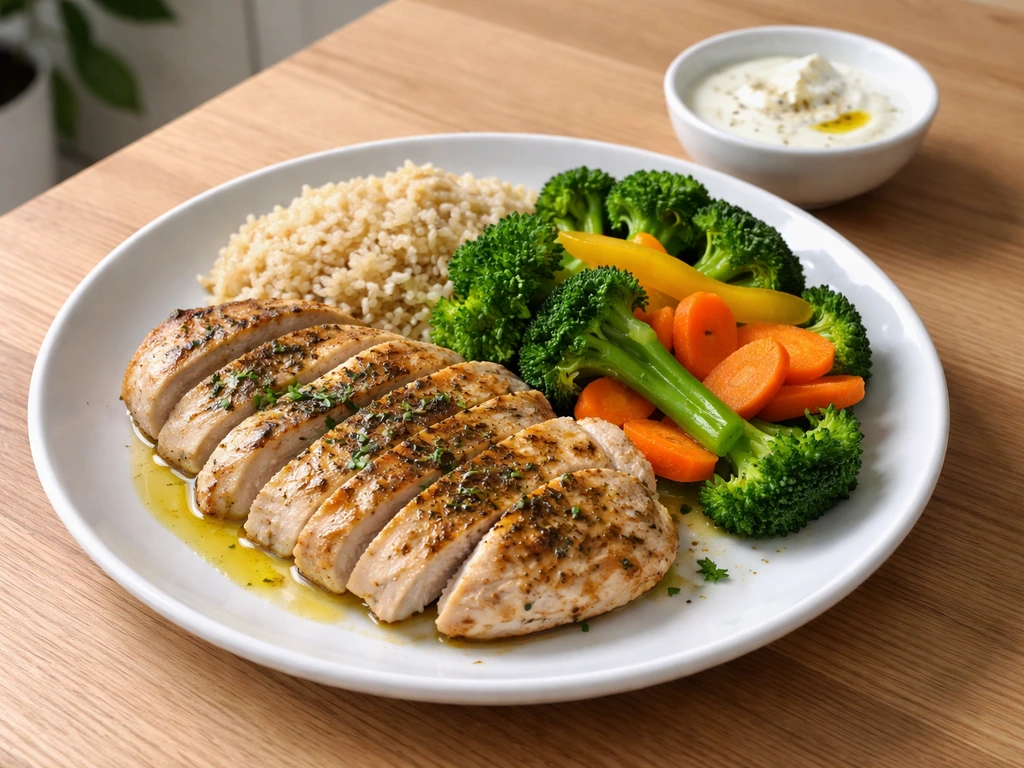
Training is the stimulus, but nutrition is what your body actually uses to build new tissue. Get this wrong and your results will be well below what your training deserves.
Calories: eating to grow
You don't need a massive calorie surplus to build muscle, and a big surplus mostly means adding extra body fat alongside the muscle. A modest surplus of 200–400 calories above your maintenance level is enough to support meaningful muscle growth while keeping fat gain in check. If you're a beginner with excess body fat, you may even be able to build muscle while eating at or very near maintenance. Track your weight weekly, if it's not moving up at all after 2–3 weeks, add 150–200 calories. If you're gaining more than about 0.5 kg per week consistently, ease back slightly.
Protein: how much you actually need
Protein is where the most distortion exists in fitness culture. Research is pretty clear: gains in muscle mass don't meaningfully increase beyond roughly 1.6 g of protein per kg of bodyweight per day during resistance training. Some meta-analyses suggest a plateau as low as 1.3 g/kg, with diminishing returns beyond that. The practical recommendation is 1.6–2.2 g/kg/day, with the higher end being appropriate for older adults, people in a calorie deficit, or anyone doing high training volumes. For a 75 kg person, that's 120–165 g of protein per day, achievable with whole foods plus a shake if needed, but not anything extreme.
Carbs, fats, and meal distribution
After protein is covered, fill remaining calories with carbohydrates and fats in whatever ratio suits your preferences. Carbohydrates fuel your training sessions and replenish muscle glycogen, keeping them reasonably high (40–50% of calories) is smart for people training 4+ days per week. Fats should make up at least 20–25% of calories to support hormone production. Spread protein across 3–5 meals throughout the day to maximize MPS, research suggests each serving should hit roughly 30–50 g of protein to optimally stimulate muscle protein synthesis.
Timing: useful but not critical
The so-called 'anabolic window', the idea that you need to slam protein immediately post-workout or miss out on gains, is mostly a myth. Meta-analyses on protein timing found no strong independent effect of timing when total daily protein intake was adequate. That said, having a protein-containing meal within a couple of hours of training is still sensible for practical reasons. Don't stress the minute-by-minute logistics. Focus on hitting your daily total first.
Recovery and lifestyle: the stuff that actually makes growth happen
Here's a blunt truth: muscle isn't built during your workout. It's built during recovery. Your session creates the stimulus; sleep, nutrition, and rest do the actual construction work.
Sleep
Seven to nine hours of sleep per night isn't just a wellness recommendation, it's a muscle-building requirement. Growth hormone secretion peaks during deep sleep, and poor or insufficient sleep elevates cortisol, reduces anabolic hormone levels, and impairs muscle protein synthesis. If your training is dialed in but you're sleeping 5–6 hours, you're leaving a significant amount of your potential gains on the table. Sleep quality matters too: a consistent sleep schedule, a dark and cool room, and cutting screens before bed aren't overthinking it, they're basic recovery hygiene.
Stress management
Chronically elevated stress, whether from work, relationships, or life pressure, raises cortisol, which directly competes with anabolic signaling. This doesn't mean you need a stress-free life to build muscle, but it does mean that if you're in a prolonged high-stress period, your recovery capacity shrinks. You may need to reduce training volume temporarily rather than pushing through and digging a deeper hole.
Managing soreness and avoiding overtraining
Delayed onset muscle soreness (DOMS) is normal, especially when you start a new program or increase volume. It's not a reliable indicator of a good workout, and chasing soreness for its own sake is counterproductive. DOMS usually peaks 24–48 hours after training and should resolve within 72 hours. Signs of overtraining or excessive overreaching look different: persistent fatigue, declining performance across multiple sessions, loss of motivation, increased soreness that doesn't resolve, and susceptibility to illness. If those patterns show up, reduce volume for a week or two, not as defeat, but as smart management.
Deloads and injury prevention
A planned deload (week 12 in the structure above) isn't optional, it's where supercompensation happens and joint health is maintained. Outside of scheduled deloads, listen to joint pain carefully. Muscle soreness and joint pain are different things. Training through sharp or persistent joint pain is how a minor issue becomes a 6-week setback. Address it early.
Supplements: what's worth it and what to skip
The supplement industry runs on hype, and most products on shelves do essentially nothing beyond what a solid diet already provides. Here's an honest breakdown.
Creatine monohydrate
Creatine is the most evidence-backed muscle-building supplement available. It works by increasing phosphocreatine stores in muscle, which supports ATP regeneration during high-intensity efforts, allowing you to do slightly more volume per session over time. Meta-analyses consistently show creatine combined with resistance training improves lean mass and strength outcomes. The benefits are most consistent in beginners and appear to hold up in older adults too, making it broadly applicable. The dose is simple: 3–5 g per day of creatine monohydrate. No loading phase required. No fancy forms, monohydrate is what the research supports.
Whey protein
Whey protein doesn't have any magical muscle-building properties beyond its amino acid content. It's simply a convenient, high-quality protein source. If you're hitting your daily protein target (1.6–2.2 g/kg) through whole foods alone, you don't need whey. If you're struggling to reach your target, a shake is a practical and cost-effective way to close the gap. That's it. Whey isn't superior to chicken or eggs from a muscle-building standpoint, it's just fast and easy.
Caffeine
Caffeine can improve training performance, focus, endurance, and perceived effort, which may allow you to train harder and get more out of your sessions indirectly. However, meta-analyses show its effects on maximal strength (1RM) are mixed, and it's more reliably useful for endurance-type performance. If a cup of coffee before training helps you feel ready to work, that's fine. Don't spend money on caffeine pills expecting direct muscle-building effects.
HMB and other hyped products
HMB (beta-hydroxy-beta-methylbutyrate) is marketed aggressively as a muscle-building supplement, but systematic reviews find it produces little to no meaningful improvement in lean mass or strength in young, trained individuals. Most other 'anabolic' supplements, testosterone boosters, BCAAs taken on top of adequate protein, nitric oxide boosters, glutamine, have weak or no evidence for adding to what a solid diet already provides. Save your money.
| Supplement | Evidence for Muscle Gain | Recommendation |
|---|---|---|
| Creatine monohydrate | Strong — consistent across studies | 3–5 g/day, worth taking |
| Whey protein | Effective as a protein source, not magic | Use to hit protein targets if needed |
| Caffeine | Modest indirect benefit via performance | Optional, practical pre-workout |
| HMB | Minimal to none in young, trained people | Skip it |
| BCAAs (on adequate protein) | No additional benefit | Skip it |
| Testosterone boosters | No meaningful evidence | Skip it |
How to track your progress and adjust when results are slow
You can't manage what you don't measure. But tracking muscle gain is genuinely tricky, the scale alone is a poor tool, and even body composition measurements have real limitations.
What to track and how

- Body weight: Weigh yourself at the same time each morning (after bathroom, before eating) and track a weekly average. Single-day fluctuations of 1–2 kg from water, food volume, and hydration are normal and tell you nothing about muscle.
- Circumference measurements: Tape measure around upper arm (flexed), chest, thighs, and waist. Take these every 2–3 weeks. A growing arm alongside a stable or shrinking waist is a good sign.
- Strength trends: Log every session. Progressive strength gains over 12 weeks are one of the best indirect indicators that you're building muscle. Stalled strength often means stalled muscle growth.
- Progress photos: Taken in the same lighting and pose every 2–3 weeks. Changes that are invisible day-to-day become visible over a month.
A note on body composition testing
BIA (bioelectrical impedance) scales are popular but notoriously unreliable for tracking short-term changes. Research shows hydration status alone can shift BIA-derived lean mass estimates significantly, meaning a post-workout reading after sweating looks different from a well-hydrated morning reading, without any actual change in muscle. DXA scans are more accurate but expensive. For most people over a 12-week block, scale weight + measurements + strength log gives you enough data to make smart decisions without expensive testing.
What to do if progress is slower than expected
After 4–6 weeks, if your weight isn't moving, your measurements are unchanged, and your lifts aren't progressing, run through this checklist in order:
- Check calories first: Are you actually eating in a surplus? Most people overestimate intake. Track honestly for a week using a food logging app.
- Check protein: Are you consistently hitting 1.6 g/kg/day or more? Protein is the most common nutrition gap.
- Check volume and effort: Are you getting 10+ sets per muscle group per week and actually pushing close to failure? Going through the motions with easy weights won't cut it.
- Check sleep: Are you averaging 7+ hours? If not, that's your problem before any other change.
- Check stress load: Is there an unusual life stressor suppressing recovery? Consider reducing training volume temporarily rather than adding more.
- Check progression: Are you adding weight or reps each week? If you've been doing the exact same workout for 6 weeks, you're maintaining, not growing.
If all of the above are genuinely in check and you're still not gaining, you may need to increase calories by another 150–200 per day, add one more session per week, or prioritize underdeveloped muscle groups with more targeted volume. Progress in a 12-week block is rarely mysterious, when results are missing, the cause is almost always in one of those six areas.
Three months is a genuinely meaningful training window. It's enough time to build visible, measurable muscle if you approach it with a plan rather than just showing up. The physiology is on your side, it just needs the right inputs consistently applied. For a broader perspective on how growth timelines compare across different windows, it's worth understanding how individual months stack up and how the longer arc of muscle development plays out beyond 12 weeks. If you're wondering how long it takes to grow muscle naturally, it helps to compare shorter benchmarks like 3 months with longer timelines that include learning, adaptation, and recovery how long does it take to grow muscle naturally. If you're curious about the day-to-day and monthly progression, see our guide on how many months to grow muscle. In 12 weeks, the range of muscle you can gain depends on your training level, nutrition, and how consistently you recover how individual months stack up. If you are wondering specifically how long it takes to grow muscle mass, the timeline still comes down to training consistency plus nutrition and recovery how long does it take to grow muscle mass. For a month-by-month view, it helps to know how much muscle you can realistically grow in 30 days based on your training level and adherence how much muscle can you grow in a month. Typical timelines for muscle growth also vary by training phase and how your progress is measured over the first few months muscle growth timelines.
FAQ
If I gain 3 to 4 kg in 3 months, how much of that should be actual muscle?
Not all of it is muscle. With a typical modest surplus (about 200 to 400 calories/day), some weight gain can be water and glycogen plus a bit of fat. A practical rule is to look for whether your strength is rising steadily and your waist measurements are not increasing rapidly, since those trends usually track lean gain better than scale weight alone.
How can I tell whether my progress is being limited by training or by food?
Track two signals for 2 to 3 weeks: gym performance (reps, load, and working-set quality) and bodyweight trend. If workouts are stalling and your weight is flat, calories are likely too low. If workouts are progressing but weight and measurements barely change, your deficit might be larger than you think, or protein and total daily volume may need adjustment.
What if I’m overweight, can I grow muscle in 3 months even if I’m cutting?
Yes, especially if you are new to lifting. You can gain lean mass while eating at or near maintenance, but expect slower gains than a small surplus scenario. Use a conservative calorie deficit, aim to keep protein toward the higher end (around 2.2 g/kg/day), and prioritize progressive overload because fatigue from dieting can otherwise cap performance.
Is training to failure necessary to maximize how much muscle I can grow in 3 months?
No. The key is proximity to failure with good recovery, not grinding every set. Most people grow well when most sets end with about 1 to 3 reps in reserve (RIR), and failure is best reserved for controlled sets on isolation exercises or for occasional work sets on big lifts.
How many days per week should I train to hit the best 3-month results?
The article’s set range implies frequency matters. If you can recover, 4 days per week often hits hypertrophy volume efficiently because you can spread hard sets and maintain quality. If you only train 2 to 3 days, you may still grow, but working-set volume per session tends to become more fatiguing and harder to progress without technique breakdown.
Do I need to train every muscle with the full 10 to 20 sets per week in a 12-week block?
Not necessarily. Use a priority approach. For muscles that lag, bias volume toward the higher end while keeping other areas at the lower end that still supports progression. If you overstuff every muscle equally, you can recover worse and end up with less total progress.
What should I do if I’m seeing muscle gain but my strength isn’t improving?
That pattern can happen if you are improving technique or bodyweight composition, but if strength truly stagnates for weeks, it can also signal that effort, loading, or rest are insufficient. Recheck whether you are truly increasing working sets or adding reps at the same load, and ensure sleep and calorie intake are steady because strength usually needs more stable recovery than appearance does.
How accurate is measuring progress in 3 months, and what should I measure?
Use multiple markers. Weekly scale weight, waist measurement (same time of day), and a strength log are usually more useful than body fat estimates. If possible, take photos under consistent lighting every 2 to 4 weeks, but judge changes alongside measurements because photos can be misleading with posture and pump.
Should I deload during the 3 months, or only after 3 months is over?
A scheduled deload during the 12th week can help keep joints healthy and performance from crashing before the block ends. If you are already getting persistent joint pain, unusually high fatigue, or declining reps for 2 straight weeks, pull a deload earlier rather than waiting for the end of the 3-month plan.
Do I need supplements to reach the upper end of the 3-month muscle gain range?
Usually no. Creatine is the one supplement that most consistently supports performance and lean mass outcomes, and whey is just a convenient protein source if you cannot hit daily protein. Everything else often adds little compared with fixing sleep, protein, calorie consistency, and progressive overload.
How long should I try the plan before changing something if I’m not gaining?
Give it at least 4 to 6 weeks with consistent execution, then adjust based on the specific missing input. If weight and measurements are flat and lifts are not progressing, start by tightening calorie intake, then protein, then volume and frequency. If strength is improving but measurements are not, reassess whether you are too close to maintenance or if your volume is not well matched to your weak areas.
Can new exercises or poor technique make it seem like I gained muscle even when I didn’t?
Yes. Early changes can be a mix of muscle swelling, better coordination, and improved neural efficiency. That is why strength progression and consistent measurement trends matter, and why short-term changes on BIA scales can overestimate lean mass due to hydration swings after training.