Push ups primarily grow the pectoralis major (your chest), the anterior deltoids (front of your shoulders), and the triceps brachii (back of your upper arms). Those are the main movers. But depending on how you position your hands, how you brace your body, and which variation you choose, you can meaningfully shift emphasis between those muscles and also recruit secondary muscles like the serratus anterior, the core stabilizers, and even the biceps as a stabilizing force. The short version: push ups are a genuine upper-body mass builder when programmed correctly, and understanding which muscles they hit and why they grow is the fastest way to actually get results from them.
What Muscles Do Push Ups Grow and How to Get Bigger

Marcus Kellerman
18 Apr 2026

The main muscles push ups actually work

The pectoralis major is the primary target. Both the sternal head (the larger, lower portion of the chest) and the clavicular head (upper chest) are active during a standard push up, with the sternal head typically doing more work in a flat position. The anterior deltoid fires hard through the pressing motion, especially as you push through lockout. The triceps brachii takes over progressively as your elbows extend from the bottom of the rep to the top. These three muscles are working together on every rep, which is exactly why push ups transfer well to bench press strength and why people who can bang out high-quality push ups tend to have developed chests, shoulders, and arms.
Secondary muscles include the serratus anterior, which wraps around the ribs and is responsible for protracting your shoulder blades at the top of the push up. This muscle is notoriously hard to train directly, but push up variations that include a deliberate protraction at the top, sometimes called the push up plus, produce significantly higher serratus anterior activation than stopping at elbow lockout. The core muscles, specifically the transverse abdominis and obliques, work isometrically to keep your spine neutral throughout the movement. Think of a push up as a moving plank: your abs and glutes have to stay braced the whole time or your hips sag and you lose both safety and efficiency.
How hand position and form shift which muscles get hit
This is where a lot of people leave gains on the table by doing the same push up forever. Hand position changes the mechanical advantage of different muscles, and the EMG research on this is pretty clear. An EMG study found that serratus anterior and trapezius activity changes across push-up plus phases and setup factors like hand position and support surface EMG research on hand position.
| Push Up Variation | Primary Muscle Emphasis | Secondary Benefit |
|---|---|---|
| Standard (shoulder-width hands) | Balanced pec major and triceps | Anterior deltoid, serratus anterior |
| Diamond / Narrow (hands close together) | Triceps brachii (higher activation), pec major (medial focus) | Anterior deltoid |
| Wide (hands wider than shoulder-width) | Pectoralis major (lateral, outer chest) | Anterior deltoid, reduced triceps demand |
| Decline (feet elevated) | Upper chest (clavicular head), anterior deltoid | Triceps, serratus anterior |
| Incline (hands elevated) | Lower chest emphasis, easier overall load | Triceps, core stabilizers |
| Push Up Plus (add protraction at top) | Serratus anterior (significantly higher) | Upper back, rotator cuff stabilizers |
| Archer Push Up | Unilateral pec major load | Triceps, core anti-rotation |
A 2014 analysis of pushing variations found that a narrow-base hand position produced greater EMG activation in both the triceps brachii and pectoralis major compared to a wide-base position. A 2024 study specifically comparing standard, diamond, and wide-hand push ups confirmed this pattern using surface EMG, showing that diamond push ups produced the highest triceps activation. What this means practically: if your triceps are the weak link in your bench press or pressing movements, spending time on diamond push ups is a smart move. If you want to build more outer chest width, wider hands shift the emphasis there. Most people should rotate through at least two or three variations in their weekly training rather than defaulting to shoulder-width every single session.
How torso position and bracing change the equation
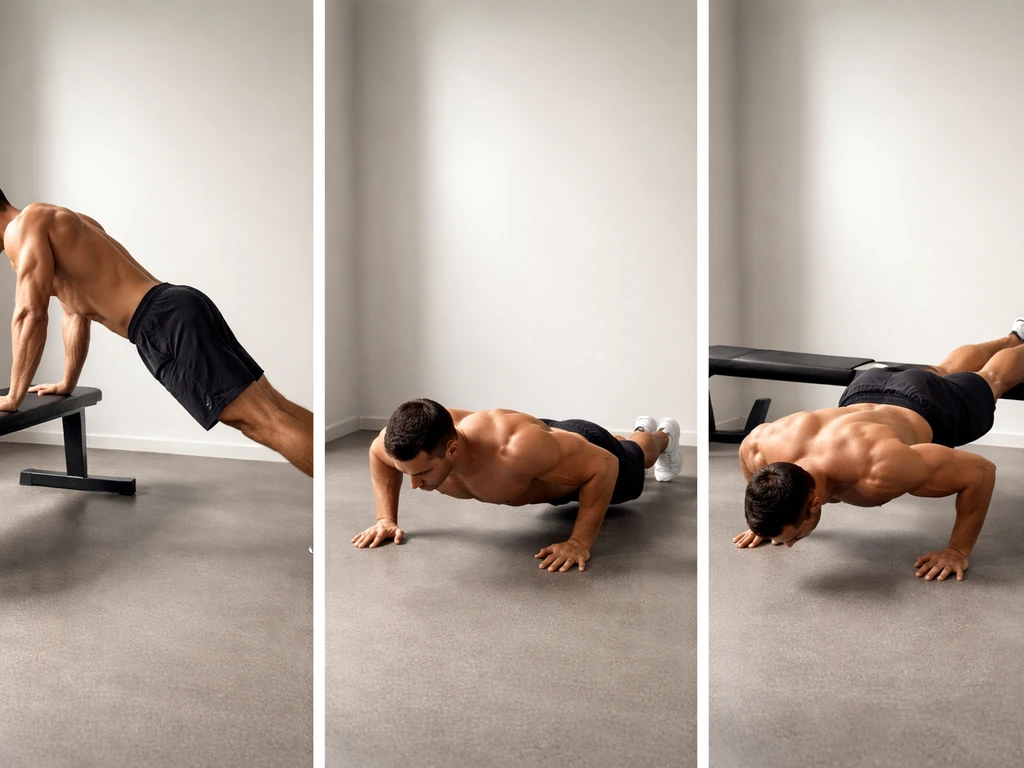
It is not just about hand placement. The angle of your torso relative to the floor matters too. Decline push ups (feet on a bench or box) shift tension onto the upper chest and anterior deltoid. Incline push ups (hands on a surface above foot level) reduce the load and bias the lower chest, which also makes them a useful entry point for beginners building toward floor-level reps. Keeping your elbows at roughly 45 degrees from your torso, rather than flaring them wide, protects your shoulder joint and keeps the pec in a better position to produce force through the full range. Core bracing is non-negotiable: a loose, sagging torso means you are doing a different (worse) exercise.
Why push ups actually cause muscle growth
Muscle grows in response to mechanical tension, the force that muscles experience when they contract under load. Push ups produce that tension through your bodyweight, and the pecs, anterior deltoids, and triceps are the structures absorbing and producing that force on every rep. When mechanical tension is high enough (meaning the muscle is working near its capacity) and repeated frequently enough over time, it triggers a cascade: muscle protein synthesis ramps up, and over days and weeks, new contractile proteins are added to the muscle fibers, making them thicker and stronger. That same muscle-building logic explains why muscles grow larger and stronger in weightlifters: they repeatedly create high tension, and then progressively challenge the muscles over time.
The honest caveat is that muscle growth requires progressive overload: the stimulus has to increase over time, or your muscles adapt to the current load and stop growing. This is where push ups get a reputation as a "beginner exercise," but that reputation only holds if you stay at the same variation forever. Progressing to harder variations (archer push ups, weighted push ups, ring push ups, one-arm push up progressions) is the same principle as adding weight to a barbell, just with different tools. The adaptation mechanisms, which are mechanical tension and metabolic stress, are identical. If you are wondering why some muscles seem to lag behind others regardless of training, the bigger picture of muscle growth rate and why certain muscles are slower to respond is worth understanding as part of your programming mindset. If you’re wondering what muscle takes the longest to grow, that “slower to respond” category is usually the one you’ll need to target with extra specific work and patience muscles seem to lag behind others regardless of training, the bigger picture of muscle growth rate and why certain muscles are slower to respond.
How to program push ups to actually build muscle
Doing 20 push ups at the end of a workout as an afterthought is not going to build much. You need volume and proximity to failure. Here is what the hypertrophy literature and practical experience point to: In a Reddit discussion about SBS RTF versus SBS hypertrophy targets, commenters connect practical RIR targets to the hypertrophy stimulus and the volume tradeoffs you can expect.
- Sets per muscle group per week: aim for 10 to 20 working sets targeting chest and triceps combined across all sessions. If push ups are your only pressing movement, you need to be on the higher end.
- Rep ranges: for hypertrophy, 8 to 30 reps per set all work, provided the last few reps are genuinely hard. Stopping 5 reps short of failure on sets of 20 leaves most of the stimulus on the table.
- Proximity to failure: each working set should end 1 to 3 reps before you physically cannot do another clean rep. This is called leaving reps in reserve (RIR) and it is the standard in evidence-based hypertrophy programming.
- Frequency: 2 to 4 sessions per week targeting these muscles is appropriate for most people. More frequent sessions work if volume per session is moderate. Fewer sessions require higher volume per workout to hit your weekly targets.
- Progression: when you can do more than 30 clean reps of a variation, it is time to move to a harder variation, add a weight vest, or elevate your feet. Continuing to add reps indefinitely eventually stops being a hypertrophy stimulus and becomes more of a cardiovascular endurance drill.
A simple weekly structure to start with

- Day 1: 4 sets of standard push ups to 2 RIR, plus 3 sets of diamond push ups to 2 RIR
- Day 2: rest or train different muscle groups
- Day 3: 4 sets of decline push ups to 2 RIR, plus 3 sets of wide push ups to 2 RIR
- Day 4: rest
- Day 5: 3 sets of the hardest variation you can do (archer, weighted, ring push ups) plus 2 sets of push up plus for serratus anterior
- Days 6 and 7: rest or active recovery
That structure gives you 14 to 20 sets per week across multiple variations and angles, which is enough training volume to drive meaningful hypertrophy in the chest, triceps, and anterior delts for most people. Add sets as your work capacity increases, and swap in harder variations as rep counts climb above 25 to 30 per set.
Mistakes that quietly kill your progress
Most people who do push ups regularly and complain that they "don't do anything" are making one or more of these errors. They are worth being honest about because they are extremely common.
- Partial range of motion: if your chest does not touch or nearly touch the floor at the bottom, you are shortchanging the stretch under load, which is one of the most important drivers of hypertrophy. The full range matters. Lock your elbows at the top and reach your chest to the floor at the bottom, every rep.
- Not bracing the core: a sagging lower back or piked hips changes the exercise mechanics entirely. Squeeze your glutes, brace your abs like you expect a punch, and maintain that through the full set.
- Stopping well short of failure: this is the biggest one. Most people stop when it starts getting uncomfortable, not when they are actually close to muscular failure. Those last hard reps are where most of the growth stimulus comes from.
- No tempo control: bouncing through reps uses momentum instead of muscle. A 2 to 3 second descent keeps the muscle under tension longer and removes momentum from the equation. You do not need to go extremely slow, but controlled matters.
- Not progressing the variation: doing the same standard push up for months on end without increasing difficulty is not training, it is maintenance. Progression is not optional if growth is the goal.
- Too much volume too fast: the opposite problem also exists. If you add volume aggressively and cannot recover between sessions, you get cumulative fatigue without the adaptation. Add sets gradually, 1 to 2 per week at most.
What you need outside the gym to turn push ups into muscle
Training is the stimulus. Nutrition and recovery are where the actual growth happens. This is not optional background information, it is the mechanism: muscle protein synthesis requires amino acids to build new tissue, and if you are not providing enough protein, your body cannot complete the repair and growth process no matter how well you train.
Protein: the non-negotiable
The current evidence supports a target of 1.6 to 2.2 grams of protein per kilogram of bodyweight per day for people trying to build muscle. For a 75 kg (165 lb) person, that is roughly 120 to 165 grams of protein per day. Spread across 3 to 5 meals or eating occasions, each containing at least 20 to 40 grams of protein, is the most practical way to hit that target. Sources like chicken, eggs, Greek yogurt, cottage cheese, fish, lean beef, and legumes all work. If you consistently fall short on protein, push up training will produce some strength adaptation but much less visible muscle growth.
Calories and overall diet
You do not need to be in a large caloric surplus to build muscle, especially as a beginner. But you do need to be eating enough to support recovery. If you are significantly undereating (more than a 500-calorie daily deficit), muscle growth will be very slow or stalled. A modest surplus of 200 to 300 calories above your maintenance level is sufficient for most people looking to add muscle without excessive fat gain. If you are a true beginner, you can often gain muscle even at maintenance or in a slight deficit, a phenomenon sometimes called newbie gains.
Sleep and recovery
Muscle protein synthesis is elevated for roughly 24 to 48 hours after a training session, and most of that synthesis happens during sleep. Getting 7 to 9 hours of sleep per night is genuinely one of the most impactful things you can do for muscle growth, not because it feels good but because it is when the hormonal environment (growth hormone release, testosterone) is most favorable for tissue repair. Training a muscle group 2 to 3 times per week, as outlined above, fits neatly into this recovery window.
Supplementation basics
If you have protein and calories dialed in, the supplements with the most evidence behind them for muscle growth are creatine monohydrate (3 to 5 grams per day, every day, no loading phase required) and, if you struggle to hit protein targets through food, a whey or plant protein powder. That is genuinely it for most people. Creatine supports the phosphocreatine energy system, which means you can get more quality reps in a set, and more quality volume over time equals more growth. Everything else in the supplement aisle is a distant second.
Realistic timeline and what to expect
Beginners who start a consistent push up program with good nutrition can expect to see visible changes in chest, shoulder, and arm size within 8 to 12 weeks. The first few weeks are largely neural adaptation, meaning you get stronger without much visible size change. After week 4 to 6, if volume and protein are where they need to be, hypertrophy (actual muscle tissue growth) becomes the dominant adaptation. Intermediate lifters who have been training with weights will need harder variations and more volume to keep progressing, since their muscles are already adapted to standard loading. The principles, however, are the same as with any compound movement: progressive overload drives growth, and deadlifts, for example, follow the same basic rules when it comes to which muscles are stressed and how the body responds over time. Deadlifts work many of the same core and posterior-chain muscles, which is why they can be such a strong stimulus for hypertrophy.
One more thing worth saying directly: you do not need soreness to know a session was productive. Post-workout soreness (DOMS) is a sign of novelty in training, not a reliable marker of growth stimulus. Once you have been doing push ups for a few weeks, you may not get sore at all from them even as you continue making progress. That is normal. Track your reps, sets, and variation difficulty over time. If those numbers are going up, you are progressing.
Your next steps starting today
- Test your current max reps on a standard push up with full range of motion. This is your baseline.
- Pick the variation where you can do 8 to 15 reps to near-failure. That is your primary working variation right now.
- Set up a 3-day per week schedule with 5 to 7 working sets per session, mixing at least two variations.
- Calculate your daily protein target (bodyweight in kg multiplied by 1.6 to 2.2) and start tracking it for one week to see where you actually land.
- Add creatine monohydrate at 3 to 5 grams per day if you are not already using it.
- Every 2 weeks, test whether you need to move to a harder variation or add more sets. Keep a simple log: date, variation, sets, reps per set.
- Prioritize 7 to 9 hours of sleep per night. This is not a minor variable.
Push ups are not a lesser exercise. Done with intention, progressive difficulty, and solid nutrition behind them, they build real chest, shoulder, and arm muscle the same way any other pressing movement does. If you’re specifically wondering what muscles swimming grows, the same idea applies: different strokes and techniques shift emphasis across major muscle groups what muscles does swimming grow. The muscles respond to tension and overload regardless of whether the load comes from a barbell or your own bodyweight. The people who get results from push ups are the ones who treat them with the same seriousness they would give any other resistance training, not the ones who knock out a casual set of 15 before bed and wonder why nothing is changing.
FAQ
Can I grow my chest and triceps from push ups if I only do one type every week?
If your goal is bigger chest and arms, you will usually need more than just one push up style. A practical approach is to pick 2 or 3 variations (for example, shoulder-width standard, diamond for triceps, and a wide-hand or push up plus for chest or serratus) and rotate them across the week so the same muscles get enough total sets while the weak link is continually challenged.
Should I feel sore after push ups to know they are working for muscle growth?
Soreness is not a reliable sign you are growing. Use performance signals instead: stop sets when your form breaks, aim for sets that end with about 0 to 3 reps in reserve for most working sets, then track reps at the same difficulty (or harder variations when you hit the top end of a rep range). If your reps or total volume go up over time, you are getting the needed stimulus.
Why do push ups stop building muscle for me, even though I still do 15 to 20 reps?
Yes, but only if the dose matches your current ability. When you are strong enough to do many reps, a set of 15 at easy tempo may not create enough mechanical tension. Consider slower eccentrics (about 2 to 3 seconds down), harder variations, or external load once you can perform roughly 25 to 30 high-quality reps in the standard push up.
What form mistakes reduce how much muscle push ups grow in my chest and shoulders?
Push up training can grow the upper body without flaring your elbows, but poor elbow angle is a common limiter. As a rule of thumb, keep elbows roughly around 45 degrees from your torso (not straight out wide) and keep your shoulder blades moving smoothly. If you feel sharp shoulder pain, reduce range or switch to an incline version until you can control the bottom position.
How does core bracing change which muscles push ups grow?
If your torso sags or your hips rise, you shift load away from the chest and triceps and you lose stable pressing mechanics. Think of the movement as a moving plank, brace your abs and glutes before each rep, and keep your body rigid as you lower. Repping with a “bowed” midsection often makes push ups feel easier but produces less effective tension.
Are diamond or narrow push ups always better for triceps growth, and what if they bother my wrists?
Your hand width changes emphasis, but it also changes joint stress. Narrow or diamond variations can boost triceps contribution, yet they may irritate wrists or elbows for some people. If wrists hurt, try slightly wider-than-diamond positioning, use push up handles to neutralize wrist angle, or use a safer variation like standard or incline while you build tolerance.
How many push up sets per week do I need to actually grow the muscles involved?
For most people, you will grow best with enough weekly “hard sets” close to failure, not with long sessions. Aim for about 14 to 20 challenging sets per muscle per week using your main push up variations and angles, then progress by adding sets or making the variation harder once reps get too easy.
What is the best way to progress push ups for muscle growth?
If you are trying to keep the stimulus high, you should not automatically keep the same rep target forever. A simple progression is to choose a rep range (for example 8 to 15). When you can hit the top end for all sets with solid form, move to a harder variation (decline, deficit, slower tempo, weighted, or harder one-arm progression).
Why do my shoulders and triceps get stronger, but my chest seems to lag from push ups?
If your chest grows less than your shoulders or arms, it is often a technique and hand placement issue. Use a range of variations that bias the pec (for many people, slightly wider than narrow, plus controlling scap movement), keep elbows at the right angle, and ensure you are not bouncing out of the bottom. Also make sure you are getting enough total chest-biased sets, not just lots of triceps work.
How can I make push ups grow my serratus anterior, not just my chest and triceps?
To target the serratus anterior more, stop briefly at the top and actively protract your shoulder blades rather than locking out and relaxing. This is commonly done as a “push up plus,” where the rep includes a controlled extra push at the top. It should feel like additional work around the front of the rib cage, not like shrugging.
Will a calorie deficit stop push ups from growing the chest and arms?
Losing fat can make your muscles look smaller even if they are growing, so cutting too aggressively is a common mistake. If you are more than about a 500-calorie daily deficit, muscle growth often stalls. If you are not gaining after several weeks, try tightening sleep, protein, and reducing how steep your deficit is (or move closer to maintenance).
What should I do if I cannot reach my protein target while doing push ups?
Protein quality and distribution matter. If you struggle to hit daily targets, whey or a plant protein shake can help you consistently reach your grams per day. For better muscle building, aim for multiple protein-containing meals throughout the day, rather than relying on one large serving.
Does creatine help push up progress and muscle size, or is it only for gym lifting?
Creatine is a low-friction option that can indirectly increase growth by letting you perform more quality reps over time. Take 3 to 5 grams daily consistently (no loading phase needed). Also, monitor hydration and adjust if you have stomach sensitivity, but for most people it is well-tolerated.
How long until I can expect my chest and arms to look bigger from push ups?
You can see changes within about 8 to 12 weeks if volume and nutrition are in place. Early changes are often strength and “appearance” from improved technique, then true size becomes more noticeable after the first month or so. If nothing changes after 12 weeks, check volume close to failure first, then protein and progression of variation or reps.
What should I do if I am too weak for standard push ups but still want muscle growth?
If you cannot reach a rep count high enough to challenge your target muscles, you can still make push ups effective by changing the setup: incline push ups for beginners, then progress to lower inclines, slower eccentrics, or assisted variations. If you can already do many reps, the fix is harder variations or added load to keep mechanical tension high.
If I do not feel sore, how do I know my push up workout is still building muscle?
You should not need soreness to confirm training worked, but you should expect some fatigue and performance progression. Use a simple metric, for example total quality reps across your main variations, and compare week to week. If those numbers rise, you are progressing even if your muscles feel normal the next day.