Muscles grow when you consistently expose them to tension they aren't fully prepared for, give them enough food to repair and rebuild, and then get out of the way so they can actually do it. That's the whole system: progressive mechanical stress, sufficient protein and calories, and adequate recovery. Everything else, including the specific rep range, the exact supplement stack, the time you eat your post-workout meal, is just detail layered on top of those three pillars. Get those right and your muscles will grow. Miss any one of them consistently and they won't, no matter how hard you train.
How to Force Muscles to Grow: Training, Nutrition, Recovery Plan

Marcus Kellerman
19 May 2026

How muscle growth actually works

Hypertrophy, the technical word for muscle growth, is driven primarily by mechanical tension. When a muscle fiber is stretched under load, especially during the lowering (eccentric) phase of a movement, it triggers a cascade of molecular signals that tell your body to synthesize new contractile proteins. Over time, those fibers get thicker and stronger. That's it. The whole game is creating enough tension, often enough, with enough progressive challenge that your body decides it needs to build more muscle to cope.
Two other contributors are metabolic stress (the pump and burn you feel during high-rep sets) and muscle damage (soreness from unfamiliar movements). Both play a supporting role, but mechanical tension is the main driver. And critically, soreness is not a reliable indicator of growth. You can have an excellent session with zero soreness the next day. Chasing soreness is one of the most common mistakes beginners make, and it's a good way to train yourself into the ground.
blank" rel="noopener noreferrer">Training volume, meaning total sets per muscle group per week, has a clear dose-response relationship with muscle growth. More weekly sets generally produce more growth, up to a point where recovery can't keep up. The research also shows that loads across a wide spectrum (from about 30% to 85% of your one-rep max) can all produce hypertrophy when effort is high enough. That means rep ranges are more flexible than most gym culture suggests. What isn't flexible is the need to progressively make things harder over time. That's called progressive overload, and it's non-negotiable. If you want to “shock” a muscle into growing, the most reliable way is still progressive overload rather than random changes.
A training plan that actually forces growth
How many sets, reps, and sessions per week
For most people trying to force real muscle growth, aim for 10 to 20 working sets per muscle group per week. Beginners can see solid results at the lower end of that range, around 10 to 12 sets. More advanced trainees generally need to push toward 15 to 20 sets to keep the stimulus high enough. Spread those sets across at least 2 training sessions per muscle group per week. Training a muscle twice a week consistently outperforms once-a-week training in the research on hypertrophy.
For rep ranges, anywhere from 5 to 30 reps per set can produce hypertrophy when effort is appropriate. A practical sweet spot is 6 to 15 reps for most exercises because it lets you load heavy enough to create strong tension without the technical breakdown that comes with very low reps on complex movements. Use heavier sets (5 to 8 reps) for compound lifts like squats, deadlifts, rows, and presses where you can control the load well. Use moderate to higher reps (10 to 20) for isolation work like curls, lateral raises, and leg curls.
Which exercises to prioritize
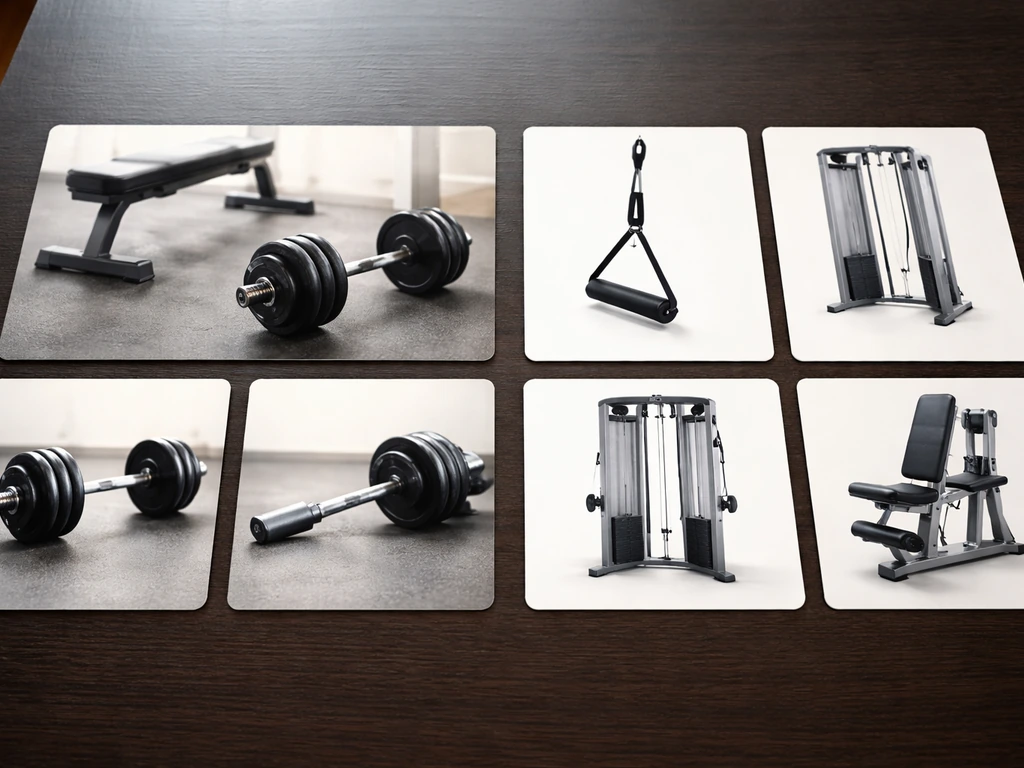
Build your plan around compound movements that train multiple muscle groups at once. These give you the most mechanical tension per set and let you use heavier loads. Then add isolation exercises to target muscles that the compound lifts don't hit as directly.
| Muscle Group | Primary Compound Lift | Isolation Add-On |
|---|---|---|
| Chest | Bench press (flat or incline) | Cable fly or dumbbell fly |
| Back | Barbell or dumbbell row | Lat pulldown or straight-arm pulldown |
| Shoulders | Overhead press | Lateral raise, rear delt fly |
| Quads | Squat or leg press | Leg extension |
| Hamstrings | Romanian deadlift | Leg curl |
| Biceps | Chin-up or supinated row | Dumbbell or barbell curl |
| Triceps | Close-grip bench or dip | Overhead extension or pushdown |
| Glutes | Hip thrust or sumo deadlift | Abduction machine or cable kickback |
A simple 3 or 4-day full-body or upper/lower split works extremely well for most people. If you're training 3 days a week, do full-body sessions on non-consecutive days. If you're training 4 days, run an upper/lower split (upper Monday/Thursday, lower Tuesday/Friday). Either approach hits each muscle group twice a week, which is the frequency target you want.
How to progressively overload without destroying yourself
Progressive overload just means making your sessions slightly harder over time. The most practical way to do that is to add reps before you add weight. If your target is 3 sets of 8 to 12 reps on the bench press and you hit the top of that range on all 3 sets, add 2. 5 to 5 lbs next session.
When you add weight and drop back to 8 reps, work your way back up to 12 again before adding more weight. This method, called double progression, is simple, trackable, and it works. If you want the nuts-and-bolts on how to structure training over time, see how to grow skeletal muscle as a related step beyond progressive overload.
If you want a fuller overview of how to grow muscles naturally, progressive overload is one of the key training levers to get right.
Track your workouts. Every session, write down the exercise, the weight, and the reps for each set. You don't need an app, a notebook works fine. The point is to know what you did last time so you have a target to beat. Without tracking, most people unconsciously underload and then wonder why they stopped making progress.
Rest periods matter more than most people think. Longer rest intervals (2 to 3 minutes between sets) are associated with better hypertrophy outcomes than very short rests (under 60 seconds), likely because you can maintain heavier loads and more quality reps per set. For compound lifts, rest 2 to 3 minutes. For isolation exercises, 60 to 90 seconds is usually enough. Don't cut rest short just to keep your heart rate up. This is hypertrophy training, not cardio.
On effort: you don't need to train to absolute muscular failure every set. Research shows hypertrophy outcomes are similar whether you train to failure or stop 1 to 3 reps short (called reps-in-reserve). A systematic review and meta-analysis found no significant difference in muscular strength or hypertrophy outcomes when comparing resistance training performed to repetition failure versus non-failure (when accounting for differing study designs and controls) [train to failure or stop 1 to 3 reps short](https://www. sciencedirect.
com/science/article/pii/S2095254621000077). For most sets on compound lifts, stopping 2 to 3 reps short is the smarter move because it limits fatigue accumulation and lets you maintain form. On isolation exercises in the last set of a muscle group, taking it closer to failure is generally safe and gives you that extra stimulus without much added risk.
Nutrition basics for forcing muscle gains
Calories: the foundation you can't skip
You can train perfectly and still barely grow if you're consistently under-eating. Muscle tissue is metabolically expensive to build. For lean mass gain, aim for a modest calorie surplus of around 200 to 300 calories above your maintenance level. That's enough to support growth without adding excessive body fat. If you're a beginner or returning after a long break, you may gain muscle even closer to maintenance, but once you're past the beginner stage, some surplus is usually necessary to drive meaningful growth.
Protein: the non-negotiable macronutrient
Protein is the building block of muscle tissue. The evidence-based target is 1.4 to 2.0 grams of protein per kilogram of bodyweight per day for most people who train regularly. For a 175-pound (80 kg) person, that's roughly 112 to 160 grams of protein daily. If you're cutting calories while trying to maintain muscle, push toward the higher end of that range. If you're in a surplus and eating well, the lower end is usually sufficient.
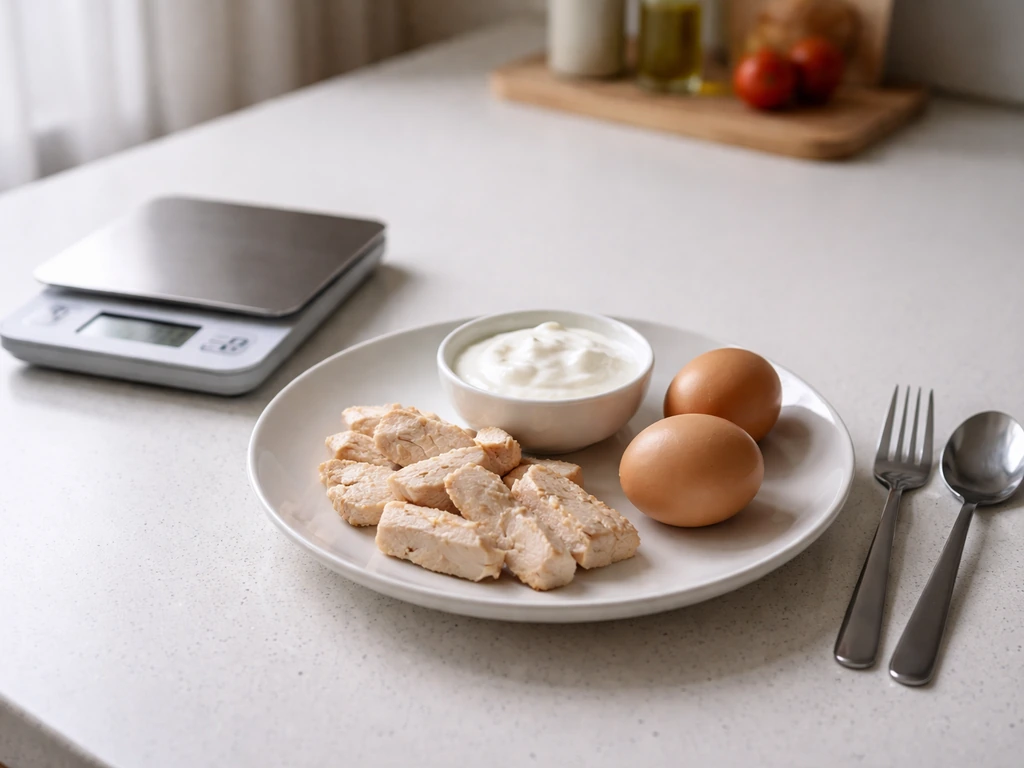
Spreading protein across 3 to 4 meals is more effective than cramming it all into one or two. Aim for about 0.4 grams per kilogram of bodyweight per meal. For that same 80 kg person, that's roughly 30 to 35 grams of protein per meal across 4 meals. Good practical sources include chicken breast, eggs, Greek yogurt, cottage cheese, lean beef, fish, and protein powder when needed to fill gaps.
Carbs, fats, and timing
Carbohydrates fuel your training. Low carb intake leads to worse training performance, which means less mechanical tension, which means less growth stimulus. You don't need to obsess over exact grams, but don't be afraid of carbs around your training. Having a carb-containing meal 1 to 2 hours before training and within a couple of hours after is a reasonable practical approach, though the research shows total daily protein is far more important than exact timing. Think of timing as a bonus, not a requirement.
Fats support hormone production, including testosterone, which matters for muscle growth. Don't drop fat below about 20% of total calories. Sources like olive oil, avocado, nuts, and fatty fish are solid choices. There's no need to go out of your way to eat more fat than that for muscle-building purposes.
Supplements worth considering (and ones to skip)

Supplements are a small piece of the puzzle and only matter when training, protein, and sleep are already dialed in. That said, a couple of them are genuinely evidence-backed and worth using.
- Creatine monohydrate: This is the most well-researched muscle-building supplement available. It increases the muscle's capacity to regenerate ATP during high-effort sets, letting you do more work before fatigue kicks in. The standard approach is 3 to 5 grams daily. You can load with 0.3 g/kg/day for 5 to 7 days to saturate stores faster, then drop to 3 to 5 g/day to maintain. Or skip the loading phase and just take 3 to 5 g daily from the start. Both strategies work. It's cheap, safe, and effective for most people.
- Protein powder: Not a supplement in any magical sense, it's just a convenient food source. Whey protein is fast-digesting and useful post-workout or when you need to hit your daily protein target without eating another full meal. Casein is slower-digesting and works well before bed. Use them to fill gaps, not as a foundation.
- Caffeine: A pre-workout dose of caffeine (3 to 6 mg/kg bodyweight) can improve training performance and effort levels. Coffee works fine. Don't overthink it.
- Omega-3 fish oil: Has some evidence for benefits in older adults and may support muscle protein synthesis, but it's not a primary growth driver for younger healthy lifters. Worth taking for general health even if the muscle-building signal is modest.
- Testosterone boosters: Skip them. The research on commercially marketed testosterone boosters is consistently weak. Claims far outpace the evidence. Save your money.
- Pre-workout proprietary blends: Most of what you're paying for in these products is caffeine and marketing. If you want the effect, drink coffee.
Recovery and lifestyle: where gains actually happen
You don't grow in the gym. You grow when you're recovering from the gym. Training is just the stimulus. The actual construction happens during rest, particularly sleep. Sleep deprivation measurably impairs resistance training performance and recovery. Aim for 7 to 9 hours per night. If you're consistently getting 5 to 6 hours, you are actively working against your own progress, and no amount of training optimization will fully compensate for it.
Chronic psychological stress elevates cortisol, which competes with anabolic signaling. You can't always eliminate life stress, but managing it matters for your gains. High-stress periods are often when people overtrain or under-recover without realizing it. Pay attention to how you feel. If you're consistently fatigued, losing strength, or dreading workouts, those are signs your recovery is lagging behind your training volume.
Soreness is not a progress metric. Delayed onset muscle soreness (DOMS) tends to be highest when you're new to an exercise or movement pattern, not when growth is occurring most rapidly. Experienced lifters often feel very little soreness after sessions that absolutely are driving hypertrophy. If you want to explore the idea of strategically varying your training to stay out of adaptation ruts, that's related to the concept of muscle confusion or "surprising" the muscle, but the core driver is still just progressive overload. That said, you still have to progressively overload, because no plan works if you never make the stimulus harder over time surprising the muscle.
Active recovery between sessions, such as light walking, mobility work, or easy swimming, can help manage soreness without adding meaningful fatigue to your system. Full rest days are also legitimate. You don't need to be active every single day.
Common mistakes, myths, and what a realistic timeline looks like
Mistakes that kill progress
- Not tracking workouts: If you don't know what you lifted last week, you can't progressively overload. This is the single most fixable mistake.
- Eating too little protein: Most people think they eat enough protein. Most people don't. Track it for a week and see where you actually land.
- Undereating overall: Trying to build muscle in a significant caloric deficit is like trying to build a house without buying enough bricks. A small surplus is your friend.
- Training too close to failure on every set: This creates excessive fatigue that bleeds into the rest of your week. Save the all-out effort for the last set of isolation work, not every set of squats.
- Changing programs every few weeks: You can't judge whether a program is working in two weeks. Give any well-designed plan at least 8 to 12 weeks before evaluating.
- Skipping the boring basics: People spend time on elaborate programming while benching the same weight they did six months ago. The fundamentals (compound lifts, enough protein, consistent sleep) drive most of your results.
- Thinking more soreness means more growth: Soreness reflects novelty, not progress. A well-trained muscle can grow significantly with very little soreness.
What to realistically expect, week by week
Weeks 1 to 4 are primarily about neuromuscular adaptation. Your nervous system is learning to recruit muscle fibers more efficiently. You'll likely get stronger during this period without much visible muscle growth yet. This is normal and it's not wasted time. Don't be discouraged.
Weeks 5 to 12 are where meaningful hypertrophy begins to show up. Most people start noticing visible changes around weeks 6 to 8 when nutrition and training are consistent. The rate of gain varies by individual, genetics, training history, age, and how well recovery is managed. A realistic expectation for muscle gain is roughly 0.5 to 2 pounds of actual muscle per month for most natural trainees in a surplus. Beginners tend to sit at the higher end of that range.
Beyond 12 weeks, the rate typically slows as you become more trained. That's when higher volumes, more precise nutrition, and smarter programming start to matter more. But the first 8 to 12 weeks are where you build the foundation and prove to yourself that the system works. Follow the plan, track your lifts, hit your protein target, and sleep. For women specifically, the same fundamentals of training with progressive overload, eating enough protein, and getting quality sleep are what make muscle growth happen protein, and sleep. If you want to grow muscles at home, apply the same pillars with home-friendly exercises, consistent progression, and recovery. Then reassess based on what the data actually shows.
Your starting checklist for the next 8 weeks
- Pick a 3 or 4-day training split that hits each muscle group twice per week.
- Choose 2 to 3 compound movements and 1 to 2 isolation exercises per session.
- Start at 10 to 12 working sets per muscle group per week and work up from there.
- Use rep ranges of 6 to 12 for compounds, 10 to 20 for isolation exercises.
- Rest 2 to 3 minutes between compound sets, 60 to 90 seconds between isolation sets.
- Track every session: exercise, weight, reps per set.
- Apply double progression: add reps until you hit the top of the range, then add weight.
- Hit 1.6 to 2.0 g of protein per kg of bodyweight daily, spread across 3 to 4 meals.
- Eat in a modest calorie surplus of 200 to 300 calories above maintenance.
- Take 3 to 5 g of creatine monohydrate daily.
- Prioritize 7 to 9 hours of sleep every night.
- Evaluate progress at week 8: are your lifts going up? Is your weight trending appropriately? Adjust volume or calories based on results.
FAQ
Should I train to failure to force muscle growth, or stop earlier?
A good rule is to stop most sets with 1 to 3 reps still in reserve (RIR), then keep pushing the same rep target week to week using double progression. If you are never within 0 to 3 RIR, you are usually under-stimulating. If form degrades, range of motion shortens, or you miss reps, you are probably overdoing it.
What do I do when I stall and can’t add reps or weight anymore?
If you cannot progress by adding reps, add load the next microcycle only when you can maintain full range of motion and similar RIR. For example, if your 3x8-12 range stalls at 11 reps on set 1, 10 on set 2, and 10 on set 3, you can first try to reach 12s across all sets before increasing weight.
Do warm-up sets count toward the weekly 10 to 20 sets per muscle group?
Your weekly set target is for “hard sets” taken with sufficient effort, not every warm-up set. A practical approach is to count only sets where you are within about 3 RIR on compounds and within about 2 RIR on isolations, and where the target muscle is actually being trained through a full, controlled range.
Can I just increase volume to force more growth faster?
Yes, but only up to your recovery limits. If you add sets and your performance (load or reps) drops for multiple sessions in a row, you are likely exceeding recovery capacity. A simple adjustment is to cut 20 to 30% of sets for the most fatigued muscles for 1 to 2 weeks, then rebuild.
What if I miss workouts, do I make up the sets?
Split schedule matters less than total quality volume, but timing does matter for consistency. If you miss a day, move the next session earlier or later, keep the same weekly set count, and avoid squeezing extra sets into a single workout if it ruins technique or increases soreness for days.
Does meal timing, like a post-workout meal, actually affect muscle growth?
Nutrient targets matter more than exact timing, but there are two useful levers. First, hit your total daily protein consistently. Second, include carbs around training to keep performance high, especially if your workouts happen later in the day and you struggle to train with enough effort.
How do I know if my calorie surplus is too high or too low for lean muscle gain?
If your surplus is too aggressive, scale will rise faster than muscle can be built, increasing fat gain. A practical check is to aim for about 0.25 to 0.5% bodyweight gain per week. If you are gaining much faster, reduce calories slightly to stay closer to the 200 to 300 calorie surplus idea.
What should I do if I cannot hit the protein grams every day?
If you’re short on protein, prioritize reaching your daily total first, then optimize distribution. For example, if you only can hit 2 meals, make the second meal larger and add a convenient option like Greek yogurt or a protein shake, but don’t let total protein fall below the lower end of your target range.
How do I tell if I need more recovery or if my plan is fine?
For most people, rest days are not optional if recovery is lagging. Signs include persistent strength declines, unusually high resting heart rate, poor sleep, or workouts that feel “heavier” at the same weights. In those cases, reduce sets or add a full rest day, then reassess after 7 to 10 days.
Is there a best way to vary exercises to avoid a plateau without losing progress?
Training the same muscle at a slightly different emphasis can help. Keep the weekly set total similar, then vary the exercise pattern (for example, press variation then fly variation) or the rep scheme (slightly heavier compounds one week, slightly higher reps another week) without removing the progressive overload requirement.
If I am not sore, does that mean I am not growing?
Soreness can happen, but the growth “signal” is mechanical tension and effort, not pain. If you feel little soreness, it does not mean the workout was ineffective, as long as you were close to your rep targets with controlled technique and you are progressing over time.