Growing muscle strength comes down to three things done consistently: training that progressively challenges your muscles, eating enough of the right nutrients to fuel and repair them, and recovering well enough that your body can actually make the adaptations you're asking for. That's the whole game. Everything else is just detail. Let's get into the detail.
How to Grow Muscle Strength: A Practical Weekly Plan

Marcus Kellerman
7 Apr 2026

Strength vs. size: they're related, but not the same thing
A lot of people assume that getting stronger and getting bigger are basically the same process. They overlap a lot, but the mechanisms are different enough that it matters for how you train. Muscle size (hypertrophy) is mostly about adding more contractile protein to the muscle fibers. Muscle strength is about how much force those fibers can produce, and that depends on both how big they are and how well your nervous system recruits and coordinates them.
Here's what the research actually shows: in the first few weeks of a new training program, the biggest driver of strength gains is neuromuscular, not structural. Your brain gets better at firing the right motor units in the right sequence, at the right rate, and with better synchronization. Studies measuring EMG activity after short-term resistance training show measurable changes in motor unit recruitment, firing frequency, and synchronization that precede any real change in muscle cross-sectional area.
Corticospinal excitability and muscle contractile function also improve early, well before you see thickness or architecture changes on an ultrasound. This is why a complete beginner can double their squat in six weeks without gaining a pound of muscle. The wiring gets more efficient before the hardware gets upgraded.
After those early neural adaptations plateau, continued strength gains rely more heavily on actual hypertrophy. Bigger fibers produce more force. Motor unit size also increases with longer-term training. So if you want to keep getting stronger past the beginner stage, you need to be building real muscle tissue too. The good news is that the training you need to do for strength and for growing skeletal muscle overlap significantly. You don't need two completely different programs.
The non-negotiable training principle: progressive overload

If there's one concept worth tattooing on your training philosophy, it's progressive overload. Your muscles adapt to the demands you place on them. If those demands never increase, your muscles have no reason to get stronger. Progressive overload means systematically increasing the challenge over time, and it's the reason every good program is built around it.
The most practical way to apply progressive overload is to add weight to the bar when you can hit the top of your rep range with good form across all your sets. If your program says 3 sets of 5 at 100 kg and you complete all 15 reps cleanly, add 2.5–5 kg next session. That's the simplest version. You can also progress by adding reps, adding sets, reducing rest time, or improving technique, but for strength specifically, load is king. Research ranked higher-load, multiset, three-times-weekly training as the top prescription for strength outcomes in a Bayesian network meta-analysis of resistance training studies. That's a good north star.
Intensity for strength work is typically expressed as a percentage of your one-rep max (1RM). Strength-focused prescriptions from ACSM and NSCA-aligned guidance point toward loads at 85% of 1RM or higher for core strength development, with fewer reps per set. Power-oriented work sits slightly lower, around 75–85% 1RM. The point is that to get stronger, you need to train heavy relative to your current capacity, not just perform a lot of volume at moderate weight.
Build your week around the right exercises
For strength, multi-joint compound movements should be the foundation of every session. Squats, deadlifts, bench press, overhead press, and rows recruit the most muscle mass, allow you to move the most weight, and produce the strongest neuromuscular stimulus. These are the exercises that build real-world strength because they train movement patterns, not just isolated muscles.
Accessory work has a place, but it's secondary. Isolation exercises like curls, lateral raises, or leg extensions are useful for targeting weak links or adding volume to specific muscles, but they shouldn't crowd out your main lifts. A simple rule: spend 70–80% of your training time on compound patterns, and use accessories to fill gaps.
A simple 3-day full-body template
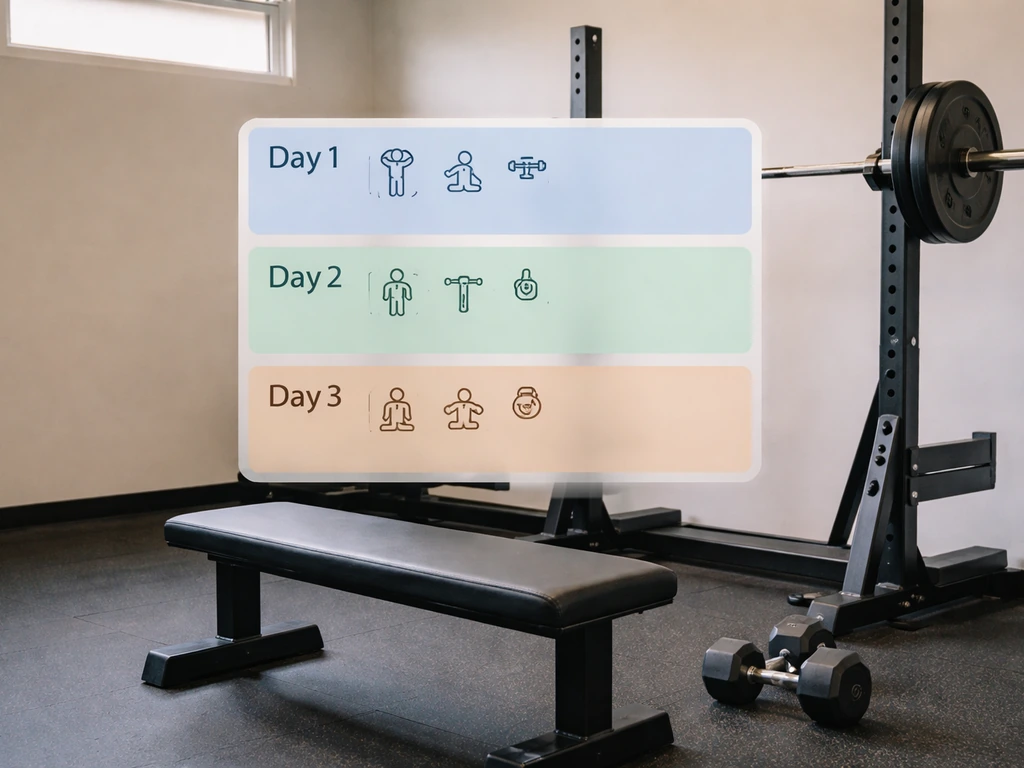
Three sessions per week is the sweet spot backed by the evidence for strength. It gives you enough frequency to practice the movement patterns and accumulate the volume needed, while leaving room to recover. Here's what a simple week could look like:
- Day 1: Squat pattern (e.g., back squat or goblet squat), horizontal push (e.g., bench press), horizontal pull (e.g., barbell row), core work
- Day 2: Rest or light activity
- Day 3: Hip hinge (e.g., deadlift or Romanian deadlift), vertical push (e.g., overhead press), vertical pull (e.g., pull-ups or lat pulldown), core work
- Day 4: Rest or light activity
- Day 5: Repeat Day 1 or 3 with slightly different variations or loading
- Days 6–7: Rest or light movement
This isn't the only way to structure things, and if you prefer training at home, there are solid ways to build strength without a gym. You can explore how to grow muscles at home for a fuller picture of bodyweight and minimal-equipment approaches. But if you have access to free weights or a barbell, lean on compound loaded movements and train three days a week.
Rep ranges, rest periods, and technique that actually matter
Rep ranges for strength
For maximal strength development, stay in the 1–5 rep range on your primary lifts. This is where you're lifting heavy enough to drive both the neural adaptations and the mechanical tension needed for strength gains. NSCA and ACSM-aligned prescriptions consistently point to 1–5 reps with loads at or above 85% 1RM for strength goals. Hypertrophy-oriented work sits at 6–12 reps, which is still valuable and should appear in your program, but if strength is the priority, your heavy sets should be in that lower range.
| Goal | Rep Range | Typical Load (% 1RM) | Rest Between Sets |
|---|---|---|---|
| Maximal Strength | 1–5 reps | 85%+ 1RM | 3–5 minutes |
| Strength/Hypertrophy Mix | 4–6 reps | 75–85% 1RM | 2–4 minutes |
| Hypertrophy | 6–12 reps | 65–80% 1RM | 1–2 minutes |
Rest periods: take more than you think you need
Rest is one of the most underrated variables for strength. Research on rest interval length consistently shows that longer rest periods, blank" rel="noopener noreferrer">at least 3 minutes and ideally 3–5 minutes between heavy sets, produce better absolute strength outcomes than shorter rest. The reason is simple: heavier sets deplete more ATP and create more central fatigue. If you rush back in, you're weaker on the next set and the quality of the training stimulus drops. When you're doing 1–5 rep sets at near-maximal load, take the full rest. Skimping on rest to save time defeats the purpose of training heavy.
Technique: full range of motion is worth the effort

Training through a full range of motion produces greater muscle activation, greater muscle damage (the productive kind that drives adaptation), and better long-term development than partial range work. Studies comparing full versus partial ROM consistently show more complete activation and greater adaptation in the full ROM group. This matters practically: don't cut your squats short, don't bounce your bench press off your chest, and don't curl just the top half. You'll get more out of every rep. That said, full ROM only matters if your technique is sound. Mobility limitations or injury history may require you to use a modified range temporarily, which is fine, but work toward full ROM as your goal.
What to eat to get stronger
Calories: eating enough matters
You can build strength in a calorie deficit, especially early on or if you're carrying excess body fat. But if you're trying to maximize strength gains, eating at or slightly above maintenance gives your body the raw materials it needs for muscle protein synthesis and keeps training performance high. Chronic undereating suppresses recovery, reduces training output, and slows adaptation. You don't need to bulk aggressively. Aim for roughly maintenance calories if you're lean and want to stay that way, or a modest 200–300 calorie surplus if adding muscle mass alongside strength is the goal.
Protein: the most important nutrient for strength
The ISSN's position stand on protein and exercise puts the target range for building and maintaining muscle at 1. 4–2. 0 grams of protein per kilogram of body weight per day for most exercising individuals. If you're eating in a calorie deficit, you may need to go higher, up to 2.
3–3. 1 g/kg/day, to protect lean mass. A practical starting point: aim for 1. 6–2.
2 g/kg/day and spread it across 3–5 meals or snacks. Protein quality matters too. Prioritize complete sources like meat, fish, eggs, dairy, or soy, which provide all essential amino acids needed to drive muscle protein synthesis. If you want a deeper look at building muscle without supplements or special products, the guide on how to grow muscles naturally covers the fundamentals well.
Carbohydrates: your fuel for heavy lifting
Carbohydrates are the primary fuel source for high-intensity resistance training. Glycogen, which your muscles store from dietary carbohydrate, is what powers those heavy sets. If you train depleted, your performance drops and so does the training stimulus. For most people doing 3–4 strength sessions per week at moderate-to-high intensity, a range of 4–7 grams of carbohydrate per kilogram of body weight per day keeps glycogen stores topped up. In the 1–4 hours before a session, consuming 1–4 g of carbohydrate per kg of body weight can support performance. Practical examples: a bowl of oats with fruit before training, or rice and chicken in a pre-workout meal 2–3 hours out.
Hydration
Even mild dehydration impairs strength output and cognitive function during training. Drink water consistently throughout the day, not just during your session. A simple guide: your urine should be pale yellow before you train. For most people training in normal conditions, 2–3 liters of water per day is adequate, with additional fluid during and after training based on sweat rate and session length.
Recovery is where strength actually gets built
Sleep is the most powerful recovery tool you have
Strength adaptations happen during recovery, not during the workout itself. Sleep is where growth hormone is released, muscle protein synthesis peaks, and the nervous system consolidates the motor patterns you practiced in training. The Strength and Conditioning Journal notes that at least 7 hours of sleep per night is the commonly accepted minimum for athletic populations, and for people doing serious strength work, getting 8–9 hours is even better. Chronically sleeping 5–6 hours while trying to build strength is working against yourself. It's one of those things that's easy to de-prioritize but has a surprisingly large impact on progress.
Deload weeks: don't skip them
A deload is a planned reduction in training stress, typically every 4–8 weeks depending on your training intensity and how fatigued you accumulate. Practically, this means reducing your training volume by around 40–50%, dropping load slightly, or both.
A NASA Integrated Human Performance report provides an example deload-week schedule that reduces training volume and load, such as moving from a normal 5x5 to a deload 3x8 with lower percentages of 1RM an example deload-week schedule with reduced training volume and load (3x8 vs 5x5 with lower % of 1RM). You're not taking a week off.
You're training at a level that lets your body absorb all the accumulated adaptation without digging deeper into a fatigue hole. The NSCA frames deloading as modifying intensity, volume, duration, or frequency, and the specific approach depends on what's been accumulating. If you've been pushing hard for 4–6 weeks and your joints ache, motivation is tanking, and your lifts feel heavy even at submaximal loads, that's your body signaling it needs a deload.
Managing total training stress
Strength training is a stressor, and your body doesn't distinguish between training stress and life stress. Work pressure, poor sleep, illness, and emotional stress all compete for the same recovery resources. When life gets hectic, be willing to reduce training volume temporarily rather than grinding through sessions that won't produce good adaptations. This is also why programming matters: knowing how to force muscles to grow without overreaching is partly about managing this total load intelligently, not just adding more and more work.
Injury prevention
The best injury prevention strategy is smart programming: progress load gradually, use full range of motion with proper form, don't skip warm-ups, and listen to the difference between productive muscle discomfort and joint pain. Overuse injuries in strength training almost always come from doing too much too fast. If something hurts in a sharp or joint-located way, stop and address it. Missing a week to treat a minor issue beats missing three months because you ignored it.
Tracking progress and adjusting when you plateau
You cannot manage what you don't measure. Keep a training log, even a simple one. Record the exercise, load, sets, and reps every session. This gives you an objective picture of whether you're actually progressing over time, or just feeling like you are. Many people are surprised to look back and realize they've been lifting the same weight for months.
When progress stalls, run through this checklist before changing your program completely. First, are you actually eating enough protein and total calories? Under-eating is the most common hidden reason strength progress stops. Second, is your sleep consistent? Third, are you genuinely applying progressive overload, or have you been doing the same weights because they feel comfortable? Sometimes a plateau is just a comfort zone in disguise.
If you've honestly addressed all of that and you're still stuck, it's time to adjust the program. The most effective adjustments are usually: add a set to your main lifts, change the rep scheme slightly (e.g., shift from 3x5 to 4x4 at slightly higher intensity), or introduce a variation of the main lift to hit it from a different angle. Changing everything at once makes it hard to know what worked. Change one variable at a time, give it 3–4 weeks, and reassess.
One legitimate strategy for breaking a plateau is introducing variation to disrupt adaptation. Your muscles are efficient adapters. They get used to the same stimulus and stop responding as strongly. This is the principle behind shocking the muscle to grow, and while the term sounds dramatic, the practical application is simple: rotate exercise variations, change rep ranges periodically, or alter loading schemes every 4–8 weeks. You don't need to reinvent your program. Small, strategic changes keep the stimulus fresh.
Realistic timelines and what to expect
Beginners can expect meaningful strength gains within the first 4–8 weeks, driven largely by neural adaptation. NSCA similarly highlights that you can manipulate resistance training variables such as exercise selection, volume, rest intervals, and frequency to shape performance adaptations resistance training program variables (exercise selection, volume, rest intervals, frequency) can be manipulated. An 8-week resistance training study showed significant increases in isometric strength and muscle cross-sectional area within that window. You don't need months before you see results. You'll feel the difference in 2–3 weeks and see measurable changes in your training log by week 6.
Intermediate lifters (6–24 months of consistent training) gain strength more slowly and need more structured programming with intentional progression. Advanced lifters may add only a few kilograms to their main lifts over months of dedicated work. That's normal. The more advanced you are, the more precisely you need to manage every variable. For most people reading this, consistent application of the basics for 6–12 months will produce strength levels that genuinely change how you feel and move day to day.
If you're a woman wondering whether this all applies equally to you, the short answer is yes. The mechanisms of strength gain are the same regardless of sex. Hormonal differences mean women typically gain less muscle mass overall, but strength gains from training are proportionally similar. Growing muscles as a woman follows the same progressive overload, nutrition, and recovery principles covered here. There's nothing about this approach that is male-specific.
Your action plan starting today
Here's what to do right now if you want to start building strength systematically. Pick three days per week to train. Build each session around one or two compound movements. Start at a weight that feels challenging but manageable for 3–5 reps with good form, probably around 70–80% of your best effort to give yourself room to progress. Add weight when you complete all your reps cleanly across all sets. Take 3–5 minutes of rest between your heavy working sets. Eat 1.6–2.2 g of protein per kg of your body weight daily. Sleep 7–9 hours. Schedule a deload every 4–6 weeks. Log everything.
That's a complete, evidence-backed starting point. For a broader look at optimizing the process, it's worth reading about the best ways to grow muscle since many of those principles reinforce and deepen what's here. And if you want to understand the surprising element that keeps long-term progress moving, the idea that you have to surprise the muscle to keep it adapting is worth understanding before you hit your first real plateau.
Strength doesn't require complexity. It requires consistency, progressive challenge, enough fuel, and enough rest. Start simple, track your progress honestly, and add nuance as you need it. Most people who aren't getting stronger have a problem with one of those four things, not a program design problem.
FAQ
How long should it take to notice strength gains, and what’s “normal” if I’m slow to progress?
Most beginners feel changes in 2 to 3 weeks and see clear log progress by week 6, but some people start slower if their sleep or calorie intake is inconsistent. If your working sets are not adding reps or load within 3 to 4 weeks, verify you are truly reaching near-failure on heavy sets and that rest periods are long enough (3 to 5 minutes) before you assume the program is wrong.
What should I do if I can’t train three days per week consistently?
If you can only do two days, keep the same main compound movements and use progressive overload, but reduce total sets per lift (for example, cut volume by about a third to a half). Make each session count with heavier, lower-rep work (1 to 5 reps on the main lift), longer rest between heavy sets, and ensure you still get enough weekly frequency for practice and recovery.
How close to failure should I train for strength?
You generally want effort high, but not sloppy. A practical target is leaving about 0 to 2 reps in reserve on your heaviest working sets (especially when you are in the 1 to 5 rep range), while keeping technique solid across all sets. If you miss reps or your form degrades early, you likely progressed too fast on load, and the fix is to adjust next session rather than pushing through.
Do I need to track a 1RM to follow the program’s % intensity guidance?
You don’t have to test a true 1RM. Use a recent top set or rep-max estimate to approximate your 1RM, then base your training percentages on that estimate. As you get stronger, update the estimate every few weeks by recalculating from your best set with the same exercise and consistent technique.
How should I progress when the “add weight next session” rule stops working?
If you hit the top of your rep range with good form but the next session fails to add weight, use a step-back strategy: keep the same weight for an additional week or reduce slightly and build reps back up. Another option is to add a rep or an extra set before increasing load again, so the stimulus rises gradually without wrecking recovery.
What’s the best way to pick accessory exercises for weak links?
Choose accessories that support the movement that limits your main lift, for example rows or rear-delt work if pressing stalls due to upper-back weakness, or hamstring and glute work if your deadlift strength plateaus due to hip extension. Limit accessories so they do not steal recovery from your heavy compounds, and keep them in the 6 to 12 rep range with controlled technique.
If I’m sore, does that mean the workout worked?
Muscle soreness can happen, especially when you start or change training, but it is not a reliable measure of strength progress. For strength, focus on objective changes in your log, like improved reps at the same load or stable performance across sets with full rest. If soreness is so intense that performance drops for multiple sessions, you likely need a deload or reduced volume.
How do I know the difference between productive discomfort and joint pain?
Productive discomfort is usually muscular fatigue or a burn that improves as you warm up, while joint pain tends to be sharp, localized, or worsening as you continue the set. If pain appears in a specific joint position or persists after training, stop that variation and replace it temporarily with a safer range or a similar movement pattern, and consult a professional if it keeps recurring.
Should I train through tendon pain or sharp “pinching” sensations?
No, sharp or pinching sensations are a warning sign. Stop the movement that triggers it and swap to a variation that keeps the pain away while you address technique limits, range, or load. If it does not improve over a couple of weeks, a deload alone may not be enough, and you should get it assessed so you do not turn a minor issue into a long outage.
Do I need carbohydrates even if I’m cutting calories?
Yes, especially if you want heavy sessions. Even in a deficit, aim to keep enough carbs to support your 1 to 5 rep work, or you will often see performance and progression slow. If calories are tight, prioritize carbs around training (pre and post) rather than cutting them from the entire day.
What protein timing approach actually helps for strength?
A simple, effective approach is to distribute protein across 3 to 5 meals, ensuring each feeding is large enough to stimulate muscle protein synthesis, not just the total daily amount. If you train in the evening, a meal with protein and carbs after training can help you recover, but the total daily protein is still the main driver.
Is more sleep always better, and what if I can’t reach 8 to 9 hours?
More sleep helps, but if you cannot hit 8 to 9 hours consistently, focus on making sleep timing and wake time consistent, and protect the night before hard sessions. You can also reduce training volume slightly during heavy-life weeks, so your nervous system and joints get enough recovery even with shorter sleep.
How do I schedule a deload if my progress is still good but I feel run down?
If your lifts feel heavier at the same loads, motivation is dropping, or small aches are accumulating, deload even if you are still technically adding weight. A common approach is a planned reduction every 4 to 6 weeks for many people, then adjust based on how you recover. Deloading earlier can prevent weeks of stalled performance and extra fatigue.
What should I do when my progress stalls but my diet and sleep look fine?
Run the troubleshooting steps, then change one variable at a time. The most effective single changes are usually adding a small amount of volume (like one extra set on the main lift), shifting rep scheme slightly (example 3x5 to 4x4), or using a variation that changes the angle without changing the skill too much. Give it 3 to 4 weeks before making another change.