One situation where things genuinely move faster is when you're coming back after a break. If you've trained before and lost muscle through inactivity (what exercise scientists call detraining), your body has an epigenetic memory of previous resistance-exercise-induced hypertrophy. Studies on human skeletal muscle show that prior training leaves molecular marks that make retraining significantly more effective than starting from scratch. So if you're rebuilding after a period off, you're not starting from zero, you're starting from a shortcut. That's worth knowing because it changes your expectations and your sense of urgency.
Minimum requirements for hypertrophy at home
Three things drive muscle growth regardless of where you train: progressive overload, enough weekly volume, and adequate frequency. Get all three right at home and your muscles don't know they're not in a gym.
Progressive overload
Progressive overload means you're always making training slightly harder over time. At the gym, this usually means adding weight to the bar. At home without equipment, it means progressing through harder exercise variations, adding reps, slowing down your tempo, reducing rest periods, or adding volume. The principle is the same: your muscles need a reason to grow, and that reason is stress that exceeds what they've already adapted to. If you've been doing the same 15 push-ups every day for six months and it still feels easy, your muscles have already adapted. You need to give them something new to respond to. Learning how to force muscles to grow through smart progression is the skill that separates people who see results from people who plateau.
Weekly volume
Volume is the total number of hard sets you perform for a muscle group each week. In real-world practice, even experienced lifters debate what exactly counts as a “set per muscle group,” so clarifying your definition before you track volume can help you stay consistent what counts as a “set per muscle group”. The research here is pretty clear and consistent. A graded dose-response relationship exists between weekly sets and muscle growth: studies show roughly 5.4% muscle growth at fewer than 5 sets per week, 6.6% with 5 to 9 sets per week, and 9.8% with 10 or more sets per week. ACSM's 2026 updated resistance-training guidelines, based on a review of over 30,000 participants, recommend targeting around 10 sets per muscle group per week for hypertrophy. The good news is that even low volumes (4 or fewer sets per week) still produce meaningful gains, especially for beginners. So if you're starting from nothing, even 3 to 4 hard sets of push-ups per week for your chest will produce results. Build up from there.
Training frequency
For most people, training each muscle group 2 to 3 times per week is the sweet spot. This lets you accumulate enough weekly volume without destroying yourself in a single session. For older adults specifically, a systematic review of dose-response relationships found that about 3 sessions per week with 2 to 3 sets per exercise produced effective muscle and strength outcomes. That's a manageable and sustainable target no matter your age. If you want to grow both muscle and functional strength, consistent frequency is probably the single most important variable to protect.
Best home exercises without equipment (and how to progress)
You don't need a single piece of equipment to train every major muscle group. Bodyweight training covers push, pull, squat, hinge, and core patterns. The trick is knowing how to make exercises harder as you get stronger, because that's where most home trainers stall out.
Push (chest, shoulders, triceps)

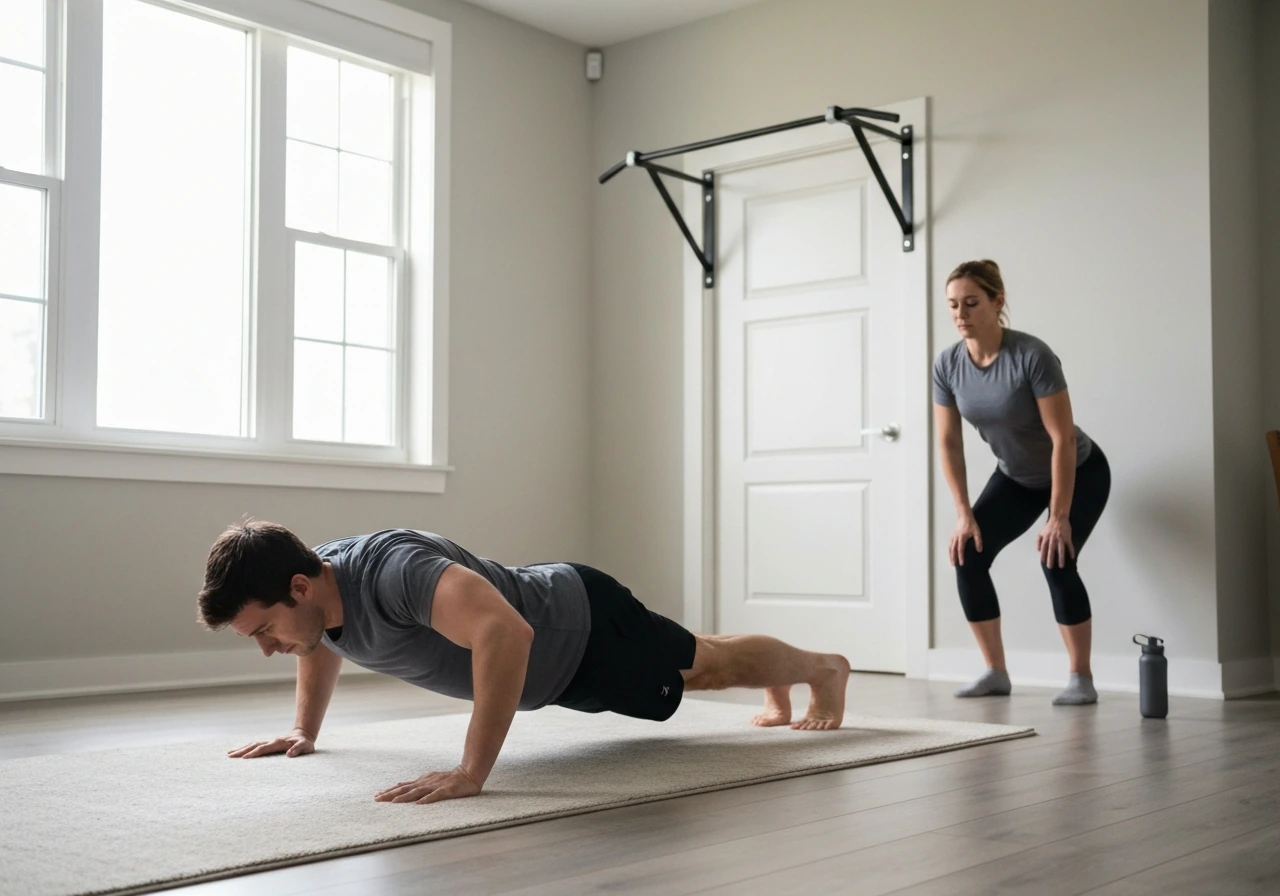
Start with knee push-ups if regular push-ups are too hard, then progress to standard push-ups, then close-grip push-ups (more triceps), then decline push-ups with feet elevated (more upper chest and shoulders), and eventually to pike push-ups for shoulder emphasis and single-arm push-up progressions. Slowing the lowering phase to 3 to 4 seconds increases time under tension and makes each rep significantly harder without adding weight.
Pull (back, biceps)
This is the hardest pattern to train without equipment. A doorframe pull-up bar (around $20 to $30) is the most practical investment you can make for home training. Without one, use a sturdy table: lie underneath it and pull your chest up to the edge (bodyweight rows). You can also use filled backpacks, water jugs, or suitcases for basic rows. For biceps, supinated table rows or using a heavy bag work well. If you do invest in one piece of kit, make it a pull-up bar.
Squat (quads, glutes)
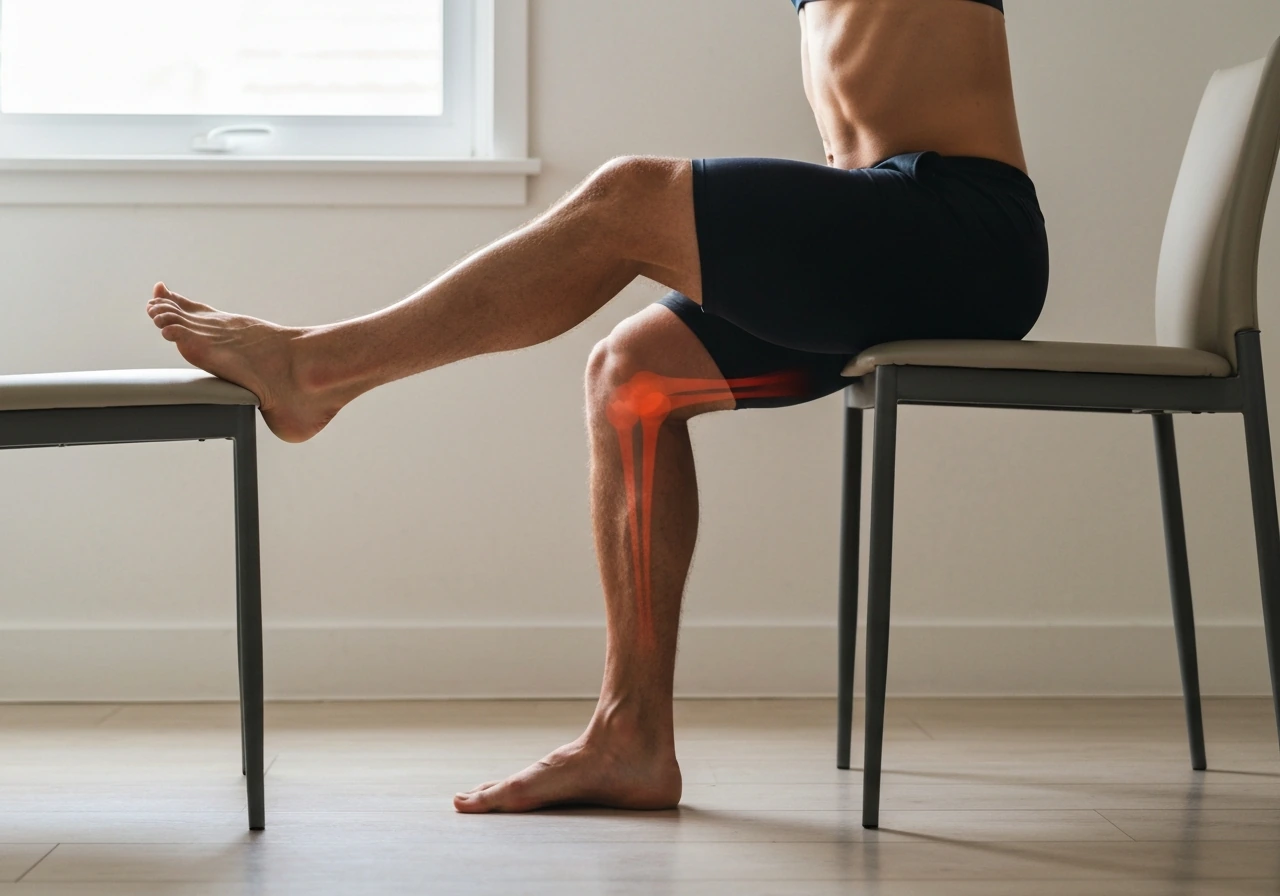
Bodyweight squats progress to jump squats, then Bulgarian split squats (rear foot elevated on a chair), then single-leg squats to a chair, and eventually pistol squat progressions. Bulgarian split squats are genuinely difficult and load your legs significantly even with just bodyweight. Add a slow tempo or a pause at the bottom to increase difficulty. You can also load a backpack with books to add resistance to any squat variation.
Hinge (hamstrings, glutes, lower back)
Hip hinges are underused in home training. Nordic hamstring curls (anchor your feet under a couch and lower your torso toward the floor) are one of the most effective hamstring exercises that exist, full stop. Good mornings with bodyweight, single-leg Romanian deadlifts, and glute bridges progressing to single-leg glute bridges and hip thrusts with a loaded backpack all cover this pattern well.
Core
Dead bugs, hollow body holds, plank variations, ab wheel rollouts (if you have one), and leg raises cover the core effectively. Anti-rotation and anti-extension work (planks, dead bugs) tend to be more useful for functional strength than endless crunches.
A key concept here is that muscles respond to challenge and variety over time. If your routine starts feeling stale and you're not progressing, shocking the muscle with new stimuli through different tempos, angles, or exercise variations can help restart progress. It doesn't mean you need gimmicks. A new variation or a harder progression is stimulus enough.
Below are three practical templates. Each one follows the volume and frequency targets backed by the research. All can be done with zero equipment, though a pull-up bar dramatically improves the pull options. Choose the frequency that fits your schedule and stick to it consistently before adding more days.
3-day full-body (beginner)
Train Monday, Wednesday, and Friday (or any three non-consecutive days). Each session covers all major muscle groups. This approach accumulates your weekly volume across three sessions, keeps frequency high, and allows recovery between sessions. Aim for 3 sets of each exercise with 8 to 15 reps, resting 60 to 90 seconds between sets.
| Exercise | Sets x Reps | Muscle Focus |
|---|
| Push-ups (or knee push-ups) | 3 x 8–12 | Chest, shoulders, triceps |
| Table rows or bodyweight rows | 3 x 8–12 | Back, biceps |
| Bodyweight squats | 3 x 12–15 | Quads, glutes |
| Glute bridges | 3 x 12–15 | Glutes, hamstrings |
| Dead bugs | 3 x 8 per side | Core |
| Pike push-ups | 2 x 8–10 | Shoulders, triceps |
Train Monday/Thursday (upper body) and Tuesday/Friday (lower body). This lets you put more volume into each session while still hitting each muscle group twice per week. Aim for 4 sets per exercise with 8 to 12 reps for upper body and 10 to 15 reps for lower body.
| Day | Exercises | Sets x Reps |
|---|
| Upper A (Mon/Thu) | Decline push-ups, Close-grip push-ups, Table rows, Pike push-ups, Dips (using chair) | 4 x 8–12 each |
| Lower A (Tue/Fri) | Bulgarian split squats, Nordic hamstring curls, Single-leg glute bridges, Calf raises, Bodyweight good mornings | 4 x 10–15 each |
5-day push/pull/legs (advanced bodyweight)
For those with a solid base, a push/pull/legs split with one rest day and one full-body day works well: push (Monday), pull (Tuesday), legs (Wednesday), rest (Thursday), push/pull (Friday), legs (Saturday). This structure gets you closer to the 10-plus sets per muscle group per week target that the research associates with the best hypertrophy outcomes. At this level, incorporating harder progressions (single-arm push-up work, pistol squat progressions, archer rows) is essential to keep delivering a sufficient training stimulus.
No matter which plan you follow, track your reps and sets. If you hit the top of your rep range for all sets, make the exercise harder next session. That's progressive overload in practice. And if you're a woman reading this and wondering whether home training will produce different results for you, the underlying physiology is essentially the same. Building muscle as a woman follows the same principles of tension, volume, and protein, just sometimes with different aesthetic goals and starting points.
Nutrition for gaining muscle at home
Training is the stimulus. Food is the raw material. You can do everything right in your workouts and still spin your wheels if your nutrition isn't supporting growth. Here's what the evidence actually says, without overcomplicating it.
Calories: surplus vs maintenance
To gain new muscle, you generally need to be eating at or slightly above your maintenance calories. A modest surplus of 200 to 300 calories per day is enough to support muscle protein synthesis without excessive fat gain. If you're a complete beginner, you can sometimes gain muscle close to maintenance (a phenomenon sometimes called 'newbie gains'), but once you've been training for 6 months or more, a small surplus becomes increasingly important. If fat loss is also a goal, you can build muscle in a deficit, but progress will be slower and requires very high protein intake to protect muscle tissue.
Protein: the most important number

A landmark meta-analysis by Morton et al. found that dietary protein intakes beyond about 1.6 g per kg of bodyweight per day produce diminishing returns for muscle gains during resistance training. That's your practical ceiling. Aim for 1.6 to 2.2 g per kg daily, with the higher end being useful if you're in a calorie deficit, older, or training hard. For a 75 kg person, that's roughly 120 to 165 g of protein per day. Per meal, research suggests around 0. A widely cited review on protein timing reports a maximal stimulation of muscle protein synthesis with ingestion of roughly 20 to 30 g of high-quality protein, or about 0.24 g/kg, in healthy young adults around 20 to 30 g of high-quality protein (or about 0.24 g/kg) per meal maximally stimulates muscle protein synthesis. 4 g per kg is a useful threshold for maximizing muscle protein synthesis in a single sitting, which means spreading your protein across 3 to 4 meals works better than eating it all in one go.
Practical meal ideas
- Breakfast: 4 whole eggs plus Greek yogurt (roughly 40 to 45 g protein)
- Lunch: 150 g canned tuna or chicken breast with rice and vegetables (roughly 40 g protein)
- Snack: cottage cheese with fruit or a protein shake if needed (roughly 25 to 30 g protein)
- Dinner: 200 g lean beef, fish, or tofu with potatoes and a green vegetable (roughly 35 to 45 g protein)
You don't need expensive foods or complicated meal prep. Eggs, canned fish, Greek yogurt, cottage cheese, legumes, and lean meat are all cost-effective, high-protein options that will get the job done. The nutritional principles behind growing muscles naturally aren't complicated: hit your protein target, eat enough total calories, and eat mostly whole foods. Meal timing beyond that is a fine-tuning detail, not a dealbreaker.
Supplements that can help (and what to skip)
Most supplements are noise. A small number are worth considering if your diet and training are already consistent. Here's a clear breakdown:
| Supplement | Evidence | Recommendation |
|---|
| Creatine monohydrate | Strong: consistently improves strength and lean mass gains | Worth taking: 3–5 g daily, no loading required |
| Protein powder (whey, casein, plant) | Good: effective way to hit daily protein targets | Useful if you struggle to get protein from food alone |
| Caffeine | Moderate: improves training performance acutely | Optional: use if it helps your workout quality |
| BCAAs | Weak: redundant if protein intake is already adequate | Skip if eating enough protein |
| Fat burners / testosterone boosters | Very weak to none | Skip entirely |
| Pre-workout blends | Mixed: mostly caffeine with filler ingredients | Skip or just use caffeine separately |
Creatine monohydrate is the one supplement with a genuinely strong evidence base. The International Society of Sports Nutrition has published a full position stand confirming its safety and efficacy across a wide range of populations, including older adults. 3 to 5 g daily is the effective dose. It's cheap, safe, and works. Everything else is secondary to consistent training and adequate protein. If you want the full picture on the best approaches to muscle growth, supplementation is a small part of a much larger picture dominated by training quality and food.
Recovery and growing muscle back after a break
Muscle growth doesn't happen during the workout. It happens during recovery. Training creates the stimulus; sleep, rest, and nutrition provide the environment for adaptation. Getting this wrong is one of the most common reasons people train hard and see nothing.
Sleep

7 to 9 hours per night is the evidence-backed range for optimal recovery. Growth hormone secretion is highest during deep sleep, and muscle protein synthesis is elevated post-exercise for up to 48 hours. Chronic sleep restriction (under 6 hours per night) measurably impairs muscle recovery and hormonal output. This isn't optional. If you're training hard and sleeping 5 hours, your results will reflect that.
Soreness vs. growth
Soreness (delayed onset muscle soreness, or DOMS) is not a reliable indicator of muscle growth. You can grow muscle without being sore, and you can be very sore without growing much. DOMS is primarily caused by novelty and eccentric (lengthening) muscle contractions. As you adapt to training, you'll get less sore doing the same work, and that's a sign of adaptation, not a sign that it's not working. Don't chase soreness. Chase progressive overload.
Managing fatigue
Accumulated fatigue is the main reason people plateau or regress. Signs of overreaching include persistent soreness lasting more than 72 hours, declining performance, disrupted sleep, and reduced motivation. If these show up, take an extra rest day or a deload week (reduce volume by 40 to 50% while keeping intensity similar). Deloads aren't a setback, they're part of the process. Skeletal muscle responds best to alternating periods of challenge and recovery, not relentless high volume every week.
Regaining lost muscle
If you've lost muscle through a period of inactivity, injury, or illness, the timeline for getting it back is genuinely faster than building it from scratch. This isn't wishful thinking; it's supported by research on muscle memory at the epigenetic level. In older adults, a study following resistance training and detraining found that many strength and functional gains persisted even after training stopped. For anyone restarting after time off, the practical takeaway is: don't be discouraged by how much you feel you've lost. Your muscles remember, and they respond faster to retraining than they did the first time around. The same training principles apply, and surprising the muscle with new challenges during the retraining phase can accelerate your return to previous levels.
Timelines: what to actually expect
Beginners typically notice strength improvements within 2 to 4 weeks (mostly neural adaptations). Visible muscle changes become apparent around 8 to 12 weeks of consistent training. By 6 months, with consistent training, nutrition, and sleep, the difference is clear and measurable. Intermediate trainees growing back lost muscle can see faster visible progress in 4 to 8 weeks. These timelines assume consistent effort across all three pillars: training, nutrition, and recovery. Missing any one of them extends the timeline significantly.
Start today: your home muscle-building checklist
Here's everything condensed into the steps you can take right now. No equipment needed for any of it except optional items noted. Keeping your muscles surprised and challenged over time is what separates the people who actually see results from those who spin their wheels for months.
- Pick a workout plan (3, 4, or 5 days) and schedule it in your calendar this week.
- Do your first session today using the beginner full-body template above.
- Track every set and rep in your phone notes or a notebook.
- Calculate your daily protein target: bodyweight in kg multiplied by 1.6 to 2.0 gives you the grams per day to aim for.
- Eat protein at every meal, aiming for at least 30 to 40 g per sitting.
- Add 200 to 300 calories above your normal intake if muscle gain is the primary goal.
- Commit to 7 to 9 hours of sleep per night as a non-negotiable.
- If budget allows, buy a pull-up bar ($20 to $30) to add pulling exercises.
- Consider 3 to 5 g of creatine monohydrate daily if you want to use the one supplement worth taking.
- Reassess after 4 weeks: are you progressing reps, are exercises getting harder to complete? If yes, keep going. If no, check your protein, sleep, and whether you're actually adding difficulty to your sessions.
Building muscle at home is completely realistic. The biology doesn't change based on your postcode or your equipment budget. What changes results is consistency over weeks and months, not perfection on any single day. Start with one session, do it well, recover, repeat. That's the whole framework, and it works.